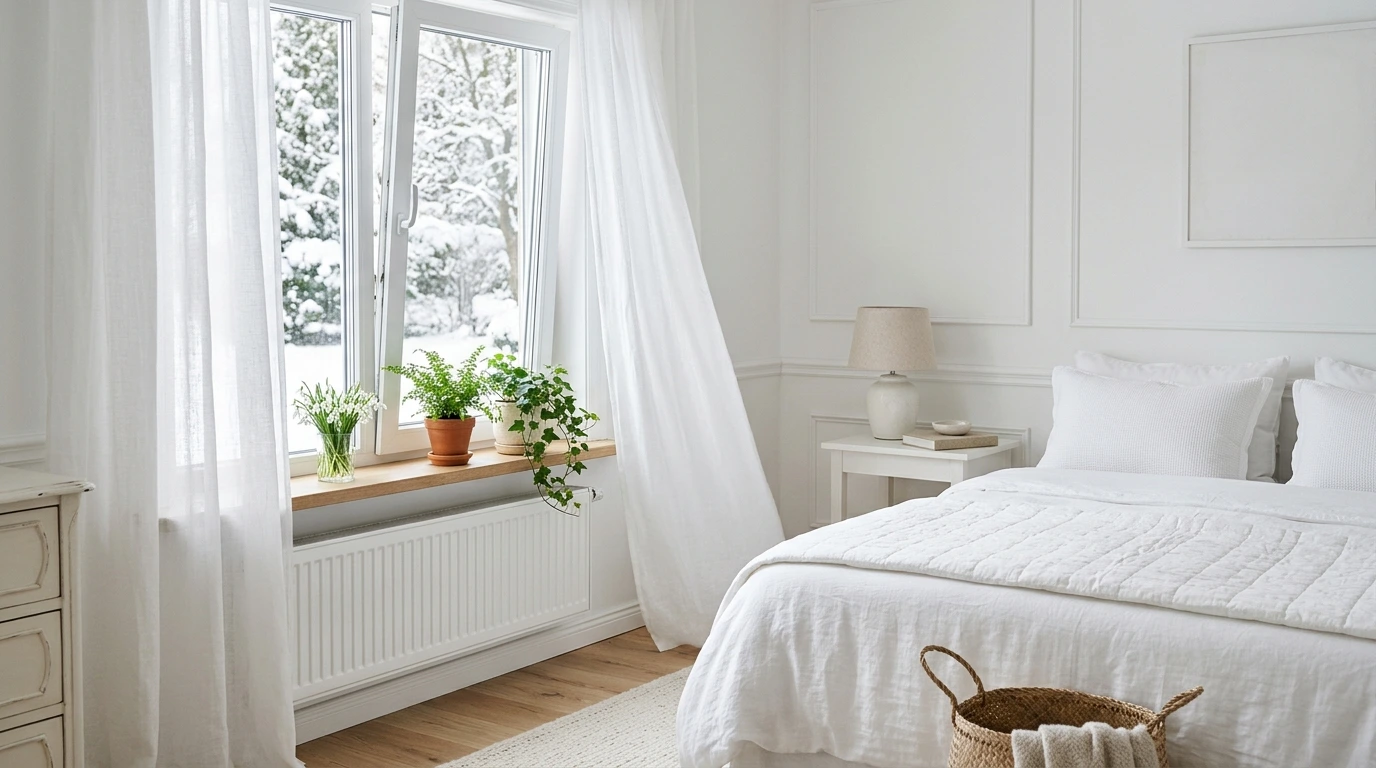
Airing out your house in winter sounds odd when the furnace is working hard, yet it is one of the simplest ways to keep a Quebec home healthy. Today's houses are tighter than they used to be, so the moisture from cooking, showers and breathing has fewer ways to escape. Done the right way, a few short bursts of fresh air a day clear out humidity and stale air without chilling the walls, the furniture or the people inside.
Why Airing Out Your House in Winter Still Matters
A typical household releases a surprising amount of water vapour every day. Boiling pasta, taking a hot shower, drying laundry on a rack and simply breathing overnight all add moisture to the indoor air. In summer, that moisture leaves through open windows. In winter, with everything closed, it stays inside and looks for the coldest surface it can find.
That surface is usually the glass, the bottom of the window frame or an exterior corner behind a bookcase. Water that condenses there drips onto sills, stains drywall and, over a season, feeds mould along the frame. Stale air also collects carbon dioxide, cooking odours and fumes from cleaning products and furniture, which is why a closed-up house can feel heavy by February.
Outdoor air in a Quebec winter is cold, but it is also very dry. Once it warms up inside, it can absorb much of the moisture you want to get rid of. That is the whole idea: swap a little humid indoor air for dry outdoor air, then close up before the house has time to cool down. A tighter envelope makes this habit more important, not less; to see why airtightness and ventilation go hand in hand, read our page on understanding energy efficiency.
Short Bursts Beat a Window Left Cracked Open
The most common mistake is leaving a window slightly open for hours. A small gap lets cold air pour steadily over the sill and down the wall, chilling the frame, the drywall and the floor below. The heating runs non-stop to compensate, and those cold surfaces become the perfect spot for condensation once the window is closed again.
Short, wide-open airing works the other way around. When you open windows fully for a few minutes, the air in the room is replaced quickly, while walls, floors and furniture keep the heat they have stored. As soon as you close up, those warm surfaces bring the room back to a comfortable temperature.
Cross-ventilation speeds things up even more. Opening windows on two opposite sides of the house, or a window and a door at the far end of a hallway, flushes a room in a fraction of the time. On a windy day, a couple of minutes can be enough.
- Turn down the heat first: lower the thermostat or the baseboard heater under the window so it does not heat the outdoors.
- Open wide: open windows fully rather than a crack, ideally on opposite sides of the house.
- Keep it short: a few minutes is usually enough in deep cold; on milder days you can go a little longer.
- Close and lock: shut each window and lock it so the sash presses evenly against the weatherstripping.
- Turn the heat back up: restore the thermostat once every window is closed.
When and Where to Air Out in Cold Weather
Timing matters more than duration. The best moments to air out come right after the house produces a burst of moisture: after showers, after cooking a big meal, after drying laundry indoors and first thing in the morning, when bedrooms are full of the humidity released overnight. Airing at that moment removes the moisture before it settles on cold glass.
Focus on the rooms that produce the most humidity. Bathrooms and kitchens come first, followed by bedrooms, especially small ones. Basements deserve attention too, since they are naturally cooler and condensation forms there more easily. A laundry room with a drying rack is one of the biggest moisture sources in a winter house.
Window Styles That Make Winter Airing Easier
Not every window is equally practical for quick airing. Casement windows swing fully open on a crank, which gives a large opening for fast air exchange, and when they are locked, the sash is pressed firmly against the weatherstripping.
Awning windows, hinged at the top, are handy in bathrooms, kitchens and basements. Because the sash opens outward and downward, it sheds light snow and rain while you air out, and it can sit higher on a wall for privacy. Sliding windows open easily, although only half of the unit opens at a time.
Whatever the style, the hardware has to cooperate. A crank that is stiff in January or a sash frozen to its weatherstripping turns a two-minute habit into a chore, and people simply stop doing it. In the fall, clean the hardware and lubricate the moving parts with the product the manufacturer recommends, often a dry silicone spray. Never force a crank when the sash is frozen shut, since that can strip the operator gears: let the room warm up or gently free the edge first. Always lock after closing: on casement and awning windows, the lock is what pulls the sash tight against the weatherstripping.
Reading the Signs: Humidity, Condensation and Frost
A simple digital hygrometer is the best tool for knowing whether you air out enough. In cold weather, indoor humidity is generally kept lower than in summer, and lower still during deep cold snaps, because the colder the glass, the sooner moisture condenses on it. If the reading climbs after cooking or showers and stays there, air out more often.
Your windows also act as a built-in humidity gauge. A thin band of condensation along the bottom of the glass on the coldest mornings is fairly common on older units. Water running onto the sill, frost building up on the inside of the glass or frame, or fog on several windows at once are signs that indoor humidity is too high for the conditions.
Pay attention to where the condensation appears. If it shows up on every window, the house needs more airing or better mechanical ventilation. If it appears on only one or two windows, the problem may be the window itself: a failed seal, a cold aluminum spacer or worn weatherstripping that lets cold air chill the edge of the glass.
- Fog along the bottom of the glass: air out more often, especially in the morning.
- Water pooling on sills: wipe it up daily and increase airing in that room.
- Frost on the inside of the frame: check the weatherstripping and the lock, and lower the humidity.
- Fog between the panes: the sealed unit has failed, and airing will not fix it.
- Musty smell or dark spots near windows: clean small surface spots promptly, wearing gloves and with the room ventilated, fix the moisture source, and get professional advice if the area is large or keeps coming back.
Bathroom Fans, Range Hoods and Air Exchangers
Window airing works best as a complement to mechanical ventilation, not a replacement. Run the bathroom fan during every shower and for a while afterward, and use the range hood whenever you cook, especially when water is boiling. These fans remove moisture at the source before it spreads through the house.
Many Quebec homes have an air exchanger (an HRV or ERV) that brings in fresh air continuously while recovering part of the heat from the outgoing air. If you have one, make sure it runs in winter, that its filters and core are clean and that the outdoor hoods are not blocked by snow. A neglected or switched-off exchanger can contribute to winter condensation in an otherwise tight house.
Even with an exchanger, a quick airing after a shower or a big cooking session remains useful. The manufacturer's manual explains the right winter settings.
When Your Windows Make Airing Harder: Free Estimate
Sometimes airing out the house in winter is difficult because of the windows themselves. Cranks break, sashes freeze shut, sliders jump their tracks and old units fog between the panes no matter how much fresh air you let in. Windows with cold edges and older glazing also invite condensation, so you end up airing more often just to keep the sills dry.
Modern windows with warm-edge spacers and low-emissivity glass generally keep the inner pane warmer, which can help reduce condensation and make the area near the glass more comfortable. Hardware in good condition also lets you open wide and close tight in seconds, which is what effective winter airing needs.
It makes sense to have a professional look at your windows when condensation keeps returning on the same units despite reasonable humidity, when fog sits between the panes, or when cranks and locks no longer close the sash firmly. Unisson Groupe manufactures and installs windows and doors in Saint-Laurent and serves homeowners across Greater Montreal. Request a free in-home estimate to talk through the options that fit your home.
Frequently Asked Questions
Is it a good idea to open windows in winter?
Yes, as long as you do it in short bursts. Opening windows wide for a few minutes replaces humid, stale indoor air with dry outdoor air without giving walls and furniture time to cool down. Leaving a window cracked for hours is what wastes heat and creates cold spots.
How long should I air out my house in winter?
In very cold weather, a few minutes with the windows wide open is usually enough. On milder days you can air a little longer. Watch the glass: once the condensation clears, you can close up.
Does airing out the house in winter waste heat?
Short airing loses little heat because walls, floors and furniture keep their warmth and quickly reheat the fresh air. Turn the thermostat down while windows are open and back up afterward.
Should I still open windows if I have an air exchanger?
An air exchanger handles continuous ventilation, so daily airing is less critical, but a quick airing after a shower or cooking still helps. If condensation persists, check that the exchanger is running, that its filters are clean and that its outdoor hoods are clear.
Why do my windows still fog up after I air out the house?
If condensation quickly returns on every window, indoor humidity is probably still too high and more airing or ventilation is needed. If only a few windows are affected, look at their seals, weatherstripping and spacers. Fog between the panes means the sealed unit has failed.