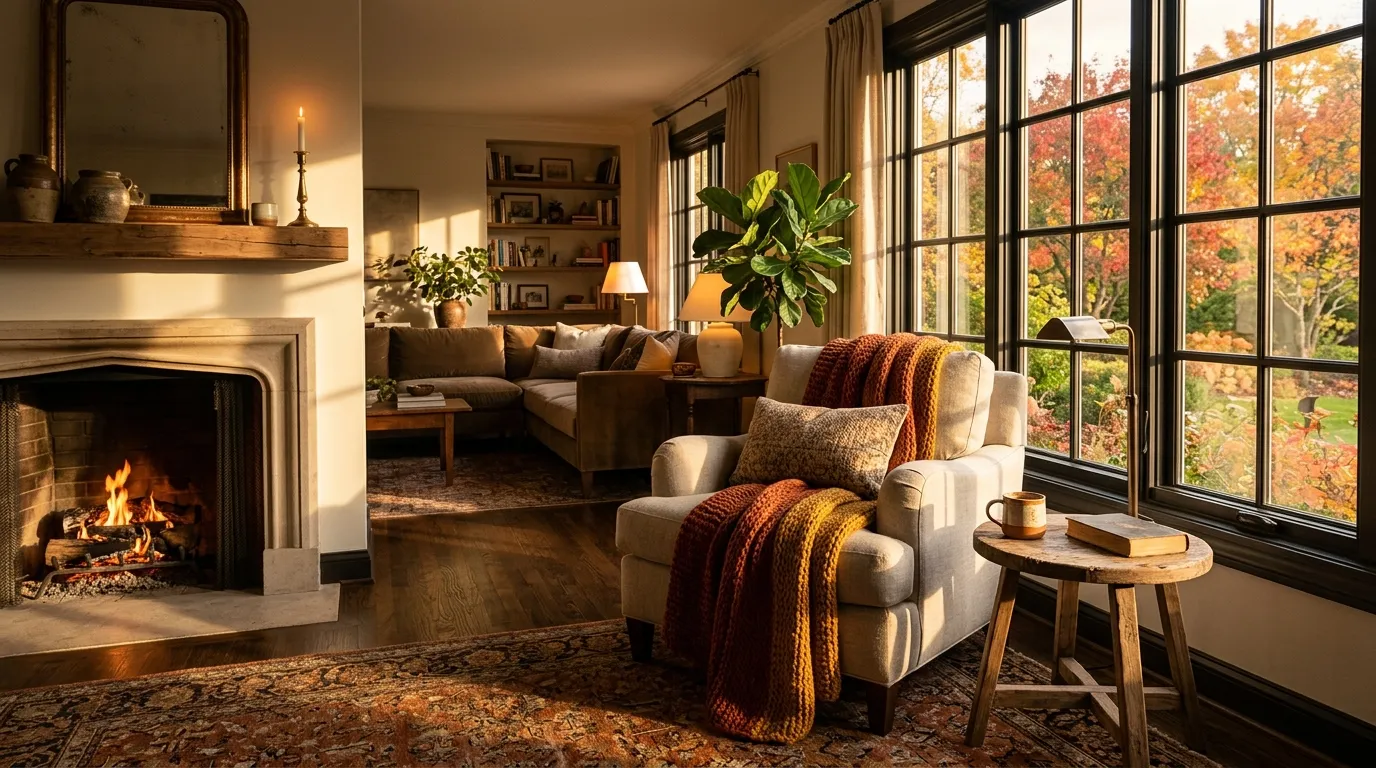
By late September the sun rises later, sets earlier and travels much lower across the southern sky. The same windows that felt bright in June can suddenly leave a living room grey by four in the afternoon. The good news is that autumn and winter light is also the warmest and most beautiful of the year, and the right window placement lets you bring far more of it into the house.
How the autumn sun moves across a Quebec home
At Montréal's latitude, around 45° north, the noon sun stands roughly 68° above the horizon at the summer solstice but only about 21° at the winter solstice. By the autumn equinox it is already halfway there, and it keeps dropping until late December. A lower sun sends light deeper into the house through south-facing windows, but it also means that anything in its path, from a neighbour's house to a deep roof overhang, casts a much longer shadow.
The sun's path also shortens. In June it rises in the northeast and sets in the northwest, touching almost every side of the house. From October to February it rises in the southeast and sets in the southwest, so north-facing rooms receive essentially no direct sun at all, and east and west rooms get only a brief window of it.
Understanding this geometry is the starting point for any decision about windows. It explains why a south-facing kitchen feels cheerful in January while a north-facing one needs the lights on at lunch, and why the same window can be perfect in one room and disappointing in another.
South and west light: where the winter sun really comes from
South-facing glass is the workhorse of the cold season. Because the winter sun is low and to the south, a south window collects direct light and warmth for most of the short day, while a modest overhang easily shades the same window from the high summer sun. It is the most rewarding orientation for enlarging an opening or adding a new one.
West light is more dramatic: warm, golden and low in the late afternoon, when most families are home. In autumn, a west window in a living or dining room turns the hour before sunset into the brightest moment of the day. In summer, however, the same window can overheat a room, so glass selection and shading deserve more attention on the west side than anywhere else.
East windows offer soft morning light that suits kitchens, breakfast nooks and bedrooms, while north windows provide steady, shadow-free light that artists and home offices appreciate. Neither brings much solar warmth in winter, so on those sides the priority is a well-insulated window rather than a large one.
- South: the best orientation for larger openings, with the most winter light and warmth
- West: golden late-day light for living areas; choose glass and shading carefully for summer
- East: gentle morning light for kitchens and bedrooms
- North: even, glare-free light; focus on insulation over size
Bigger openings where the family actually lives
The rooms where you spend your autumn evenings, usually the living room, kitchen and dining area, deserve the most generous glass. Replacing a pair of small windows with a single wide picture window, or widening an opening toward the south or west, changes the character of a room more than almost any other renovation. A fixed picture window has no sash and fewer seals, so for a given size it lets in more light and is among the most airtight window types.
A common and effective layout combines a large fixed centre panel with operable casement or awning windows on each side. You keep the uninterrupted view and the daylight while still being able to ventilate in spring and fall. Lowering the sill height a little in a living room also lets seated people see out, and brings the low autumn light across the floor.
Structural changes, such as widening an opening in a load-bearing wall, need a proper lintel and sometimes a permit, so they are worth planning early. Our team can tell you during the estimate what is realistic for a given wall and which openings can simply be replaced at the same size.
Transoms and high windows for depth
Light that enters high in a wall travels deeper into the room. A transom above a door or a large window, or a row of clerestory windows near the ceiling, carries daylight toward the back of a deep living space where a standard window would never reach. This is especially useful in older Quebec houses and semi-detached homes, where rooms are often long and narrow.
Transoms also help balance light. A room lit from a single low window can feel harsh, with a bright zone near the glass and deep shadow elsewhere; adding light from above softens that contrast and reduces glare on screens. Above an entry door, a transom or sidelights bring daylight into a hallway that would otherwise be the darkest part of the house.
Because they are usually fixed, transoms are simple, airtight and durable. They can follow the shape of the opening, from a plain rectangle to an arched or angled top, and they pair naturally with picture windows and patio doors.
Glass that lets the light in: visible transmittance
Not all glass lets in the same amount of light. The key figure is visible transmittance (VT), the fraction of visible light that passes through the glass, expressed as a number between 0 and 1. Clear double glazing typically sits around 0.8, while triple glazing with several coatings may fall closer to 0.5 or 0.6. The higher the VT, the brighter the room will feel.
Visible transmittance works alongside two other ratings. The U-factor describes how well the window insulates, and the solar heat gain coefficient (SHGC) describes how much of the sun's heat passes through. For a south-facing living room, glass with a good VT and a relatively high SHGC lets in both light and free winter warmth, while a west-facing room may benefit from a lower SHGC to limit summer overheating.
The frame matters too. Slimmer frames and sashes mean more glass for the same opening, and a fixed picture window typically has the highest glass-to-frame ratio of any window type. When comparing options, ask for the VT of the whole unit, not only the centre of the glass.
Reading nooks, window seats and places to linger
Autumn is the season of books, tea and long evenings, and a well-placed window can turn a corner into the favourite spot in the house. A window seat under a wide south or west window, a bay that projects slightly from the wall or a simple armchair beside a tall casement all create a place to enjoy the last light of the day. The key is to place the seat so the light falls from the side, which is more comfortable for reading than light shining straight into your eyes.
For comfort in winter, the window next to a reading nook must be well insulated. A high-performance window keeps the inside glass surface warm, so you do not feel the chill radiating from the pane. Built-in seating should also leave room for warm air to rise in front of the glass, for example with a grille in the seat base if there is a heating register below.
- Side light is gentler for reading than light from straight ahead
- A deeper sill or a bay creates a natural seat or shelf
- Keep heating registers clear so warm air still washes the glass
- Plan operable windows nearby for fresh air in spring and fall
Balancing light with winter comfort
More glass does not have to mean a colder house. Modern ENERGY STAR windows with warm-edge spacers and insulated frames keep a room comfortable even with large openings, and triple glazing raises the inside surface temperature further on the coldest nights. The goal is to put the generous glass where the sun is, and keep the north side more modest.
Window coverings complete the picture. Light-filtering shades or sheers soften late-afternoon glare without losing brightness, while insulated drapes can be closed at night to hold heat in. Leaving them open on sunny winter days lets the low sun warm floors and walls, which then release that warmth into the evening.
If you are thinking of enlarging a living-room window, adding a transom or reworking the openings on the south side, the exact figure depends on your project. Request a free estimate and our team will look at your rooms, their orientation and your walls with you.
Frequently Asked Questions
Which direction should a living room window face in Quebec?
South is usually best, because it receives the most direct light and warmth from October to March. West is a close second for rooms used in the evening, with more attention to summer shading.
Do larger windows make a house colder in winter?
Not with modern high-performance windows. A well-insulated window with a warm-edge spacer keeps the inside glass warm, and on the south side it can even bring in useful solar warmth on sunny days.
What is visible transmittance?
It is the share of visible light that passes through the glass, from 0 to 1. A higher number means a brighter room. It is worth comparing alongside the U-factor and SHGC when choosing glass.
Can I add a transom above an existing window or door?
Often yes, if there is enough height in the wall and the structure allows it. We assess the lintel and wall framing during the estimate.
Is a picture window a good choice for a cold climate?
Yes. A fixed picture window has no operable sash, so it is very airtight and lets in the most light for its size. Pairing it with side casements keeps the ability to ventilate.
How much does it cost to enlarge a window opening?
The exact figure depends on your project, the wall structure and the window you choose. Request a free estimate for a precise quote.