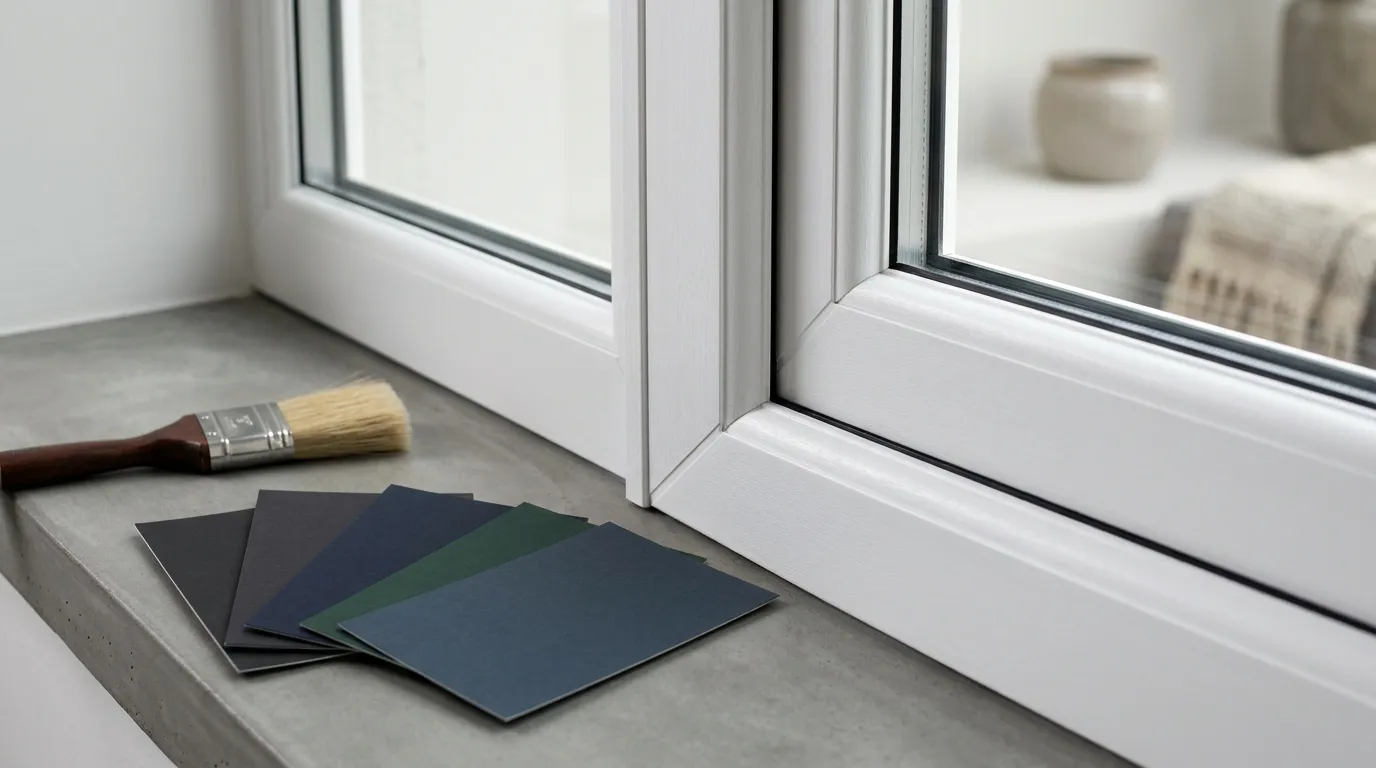
The question arrives every spring: the white vinyl windows are fine, the house is getting new siding in charcoal, and the white frames will look wrong. Can they be painted? The short answer is yes, it can be done, and the longer answer is that in Quebec's climate it is usually the wrong decision. Here is what actually happens to painted UPVC over a few winters, what it does to your warranty, and the alternatives that give you the colour without the risk.
Technically, Yes: How UPVC Gets Painted
Unplasticized PVC has a smooth, slightly waxy surface that ordinary paint will not bond to. Painting it properly requires four things: a thorough cleaning with a degreaser to remove the mould-release residue and years of oxidized surface, a light scuff with a fine abrasive pad, a bonding primer designed for plastics, and a topcoat that is 100% acrylic or a urethane-modified acrylic labelled for vinyl. Spraying gives a far better finish than brushing on the profiled surfaces of a window frame.
Done this way, by a painter who has done it before, the finish will look good on the day it is finished and will hold for a while. Professional painting of a house's windows is priced per window in the Montreal area, which adds up quickly on a typical 20-window house, with a realistic service life of three to six years before the first touch-ups. DIY materials for the same job cost far less, and the results are usually visibly worse because brushed paint shows every stroke on smooth vinyl.
The catch is not whether paint sticks. It is what the paint does to the window, and what the window does to the paint, once the seasons start turning.
The Warranty Problem
Nearly every UPVC window manufacturer in Canada, including ours, excludes damage related to painting from the warranty. That is not a technicality. A vinyl window's warranty typically covers the frame against warping, cracking and discolouration for 20 years or more, and the sealed glass unit against seal failure for 10 to 20 years. Painting the frame voids the frame coverage outright, and because paint on the glazing bead can compromise the glass seal, many manufacturers void the glass coverage as well.
The practical consequence is that if a painted frame warps in the third summer, or a sealed unit fogs in the fifth winter, you are paying for the replacement yourself. A replacement sealed unit is not cheap; a replacement sash or full window costs far more. Set against what a painting job saves relative to replacing 20 windows, the risk is not trivial, particularly since the reasons manufacturers exclude painting are not hypothetical.
Before painting, check your paperwork. If your windows are less than ten years old and still under warranty, the arithmetic almost never favours painting them. If they are 25 years old, out of warranty and approaching replacement anyway, paint is a cosmetic bridge and the calculation is different.
Dark Colours, Heat and Warping
The most serious risk is physical. White vinyl reflects most of the sun's energy; its surface stays within about 10 degrees of the air temperature on a sunny day. A charcoal or black surface absorbs most of that energy, and on a south- or west-facing wall in July, a dark painted frame can reach 65 to 80 °C. Standard rigid PVC begins to soften at around 60 to 70 °C. A frame that softens under load — the weight of a sash, the pressure of a lock — deforms, and it does not fully return when it cools.
This is why paint manufacturers publish lists of vinyl-safe colours, defined by light reflectance value: colours with an LRV above roughly 55 are considered safe on vinyl, and anything darker is at your own risk. Charcoal, black, navy and deep greens all fail that test. In other words, the specific colours people want to paint their windows are the ones the paint industry itself says not to use on vinyl.
The damage pattern is predictable. Casement sashes on the sunny side of the house begin to bind at the lock corner by the second summer. Sliders develop a bow in the meeting rail. Glazing beads pull away from the glass at the corners, opening the sealed unit to moisture. None of it is covered, and none of it is reversible.
Freeze-Thaw and Why the Paint Fails
Even in safe colours, paint on UPVC has a durability problem in Quebec that it does not have in milder climates. PVC expands and contracts with temperature at roughly three times the rate of aluminum and many times the rate of a dried paint film. Across Quebec's annual range — a -30 °C night in January to a 35 °C afternoon in July, plus the sun-heated surface temperatures above that — a two-metre vinyl frame changes length by several millimetres. The paint film, bonded to the surface, is stretched and compressed with it, thousands of cycles a year in the shoulder seasons.
The result is micro-cracking at the corners and along the welds first, then peeling where water enters the cracks and freezes. On the north side, where the surface stays damp longer, chalking and mildew set in under the film. Most painted vinyl in the Montreal area needs a touch-up by year three and a full repaint by year six to eight, which means the painting job is really a recurring cost.
There is also the maintenance trap. Once a frame is painted, it cannot be cleaned with anything abrasive, cannot be pressure-washed, and cannot go back to bare vinyl without heavy stripping that damages the surface. You have committed the window to paint for the rest of its life.
Better Alternatives for a Coloured Window
The good news is that the industry solved this problem a long time ago, and the solutions are all factory-applied. The first is a factory colour finish on the UPVC itself. Manufacturers apply either a laminated acrylic foil, bonded to the profile under heat and pressure, or a co-extruded colour cap — a layer of colour-stable, heat-reflecting acrylic that is part of the profile itself. Both are formulated with infrared-reflecting pigments so a dark exterior stays far cooler than a painted one, and both are warranted along with the frame, typically for 10 to 20 years against fading, peeling and chalking.
The second is painted aluminum cladding. The exterior face of the window is a shaped aluminum extrusion with a baked-on powder or PVDF (Kynar-type) finish, in any colour, including black, and the interior remains UPVC. Aluminum does not soften in the sun, the finish is rated for decades, and the cladding can be specified on any face of the house. This is the standard approach for a dark exterior in Quebec.
The third is a true hybrid window: an aluminum exterior sash and frame combined with a UPVC or wood interior, engineered together rather than clad. Hybrids give the slimmest sightlines, the widest colour range and the most robust exterior, at a premium over UPVC. All three options are available on the UPVC window range and its hybrid counterparts, and all three keep your warranty intact.
What It Actually Costs
For a typical 20-window house in the Montreal area, the comparison looks like this. Painting existing white UPVC professionally: the lowest upfront outlay, but warranty void, repaint every six to eight years, and real risk of frame damage in dark colours. New UPVC windows in white: the largest investment, priced by size, glazing and style, installed with a full warranty. Factory colour finish on those same windows: a moderate premium over white. Aluminum-clad exterior: a larger premium. Full hybrid: the highest premium above white UPVC. The exact figures depend on your openings and glazing — request a free estimate.
If your windows are due for replacement anyway — fogged units, drafts, worn hardware — the factory colour is a small increment on a purchase you are making regardless, and it comes with a warranty. If the windows are five years old and perfect, the honest recommendation is to live with white, choose a siding or trim colour that works with it, or, if colour is non-negotiable, paint only in a vinyl-safe light shade and accept the maintenance.
One more option that costs nothing: many dark-sided houses look best with white or light windows anyway, because the contrast reads as intentional trim. Black windows on a charcoal house are a specific look; white windows on a charcoal house are the traditional Quebec one.
- Paint existing UPVC: lowest upfront cost, 3–8 year life, warranty void, warping risk in dark colours.
- New white UPVC windows: the largest investment for 20 windows, priced by size and glazing, installed with a full warranty.
- Factory colour finish: +10–20% on new windows, 10–20 year finish warranty.
- Aluminum-clad exterior: +15–30%, any colour including black, decades-rated finish.
- Hybrid aluminum/UPVC: +30–50%, slimmest profiles, most durable exterior.
If You Paint Anyway: How to Limit the Damage
Some situations justify painting: a house being sold next year, windows already out of warranty, a landlord bridging a few seasons before a full replacement. If that is you, the following rules keep the risk manageable.
- Choose a colour with an LRV of 55 or higher; avoid black, charcoal, navy and deep greens entirely.
- Paint the exterior face only; never paint glazing beads, weatherstrip channels, hardware or the frame's interior.
- Clean with a vinyl-safe degreaser, scuff lightly, and use a plastic bonding primer under a 100% acrylic topcoat.
- Spray rather than brush; paint in the shade at 10 to 25 °C with low humidity, and allow full cure before the first frost.
- Mask the glass and gaskets carefully; paint that bridges the sash-to-glass joint will crack the seal.
- Inspect every spring, touch up early, and budget for replacement rather than a second full repaint.
Frequently Asked Questions
Will painting my UPVC windows void the warranty?
Yes, with almost every manufacturer, including ours. Frame coverage is void once the frame is painted, and glass coverage is void as well if paint reaches the glazing beads. Check your warranty certificate before opening a can.
Can I paint vinyl windows black?
Not safely. Black has a very low light reflectance value, and a black vinyl frame in July sun can exceed the softening temperature of PVC. If you want black windows, the safe route is aluminum cladding or a hybrid window.
What paint works on UPVC?
A plastic bonding primer followed by a 100% acrylic or acrylic-urethane topcoat labelled for vinyl, in a vinyl-safe colour. Alkyd paints and ordinary acrylics for wood peel within a winter or two.
How long does paint last on vinyl windows in Quebec?
Three to eight years depending on colour, exposure and preparation quality. Freeze-thaw cycles and the expansion of PVC crack the film at corners and welds long before the paint wears anywhere else.
What is the best way to get black windows?
A painted aluminum-clad exterior or a hybrid aluminum/UPVC window. Aluminum does not soften in the sun, the baked finish is warranted for decades, and the UPVC interior keeps the insulation. Factory colour on UPVC is also available in dark shades thanks to heat-reflecting pigments.
Is a factory colour finish more durable than paint?
Considerably. The laminated foil or co-extruded layer is applied in the factory under heat and pressure, formulated to expand with the profile, and warranted for 10 to 20 years against fading and peeling. On-site paint offers nothing comparable.