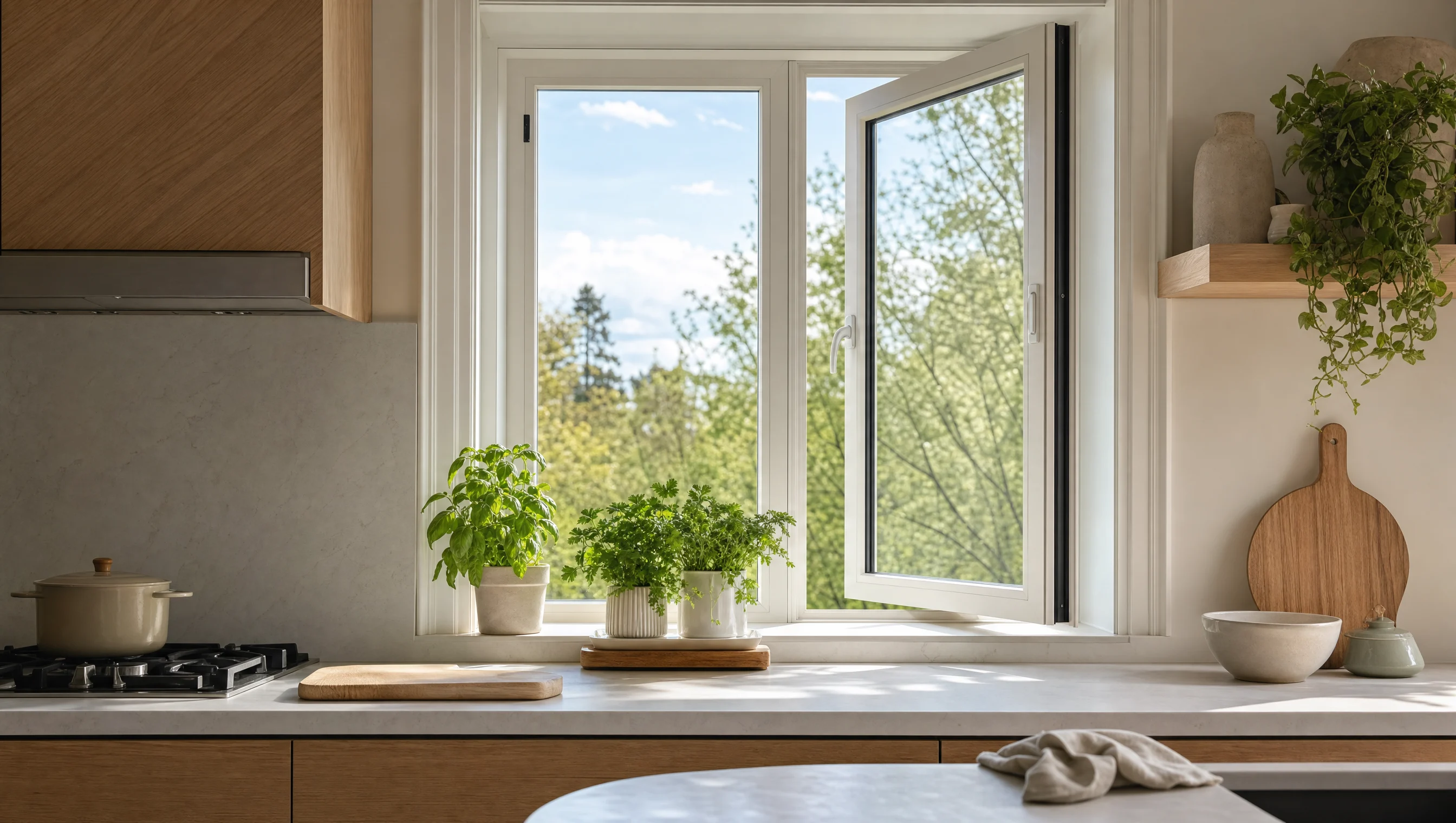
Casement and double hung windows are the two best-selling styles in Quebec homes — and for good reason. One delivers the tightest seal money can buy for our brutal January cold; the other offers timeless heritage charm and tilt-in cleaning that upper-floor owners swear by. This guide breaks down exactly how the two compare on energy, ventilation, cost, and curb appeal so you can spec each opening with confidence.
Casement Windows in Detail
Casement windows hinge on the side and crank outward like a small door. Because the sash compresses directly into a continuous weatherstrip when you turn the handle, they form one of the tightest air seals of any operable window — a decisive advantage when a Montreal cold snap drops to −25°C and a northwest wind is hammering the facade.
That mechanical clamping action is why casements consistently post the lowest air-leakage numbers in independent testing. A quality vinyl casement will typically achieve an air infiltration rate at or below 0.5 m³/h·m, which is roughly half the leakage of a comparable slider. Over a 25-year window lifespan in a duplex on the Plateau, that difference adds up to real money on the Hydro-Québec bill.
Casements also shine on ventilation. Because the sash swings fully open, the entire opening becomes available airflow — and the projecting sash acts like a scoop that catches a breeze running parallel to the wall. In a kitchen above a counter, the crank handle is easy to reach without leaning over the sink, which is exactly why so many Quebec renovators default to casements for that room.
- Tightest air seal of any operable window — sash compresses into the weatherstrip
- Opens a full 100% of the rough opening for maximum ventilation
- Crank operation is effortless over counters, behind couches, and in hard-to-reach spots
- Pairs naturally with picture windows for a modern facade
- Excellent candidate for triple-pane glass thanks to the robust multi-point hardware
Double Hung Windows in Detail
Double hung windows use two sashes that slide vertically within the frame. Both the upper and lower sash operate, which lets you open the top to release rising warm air while drawing cooler air through the bottom — a small but genuinely useful trick during a humid Montreal July when nighttime temperatures finally drop.
The headline feature for many homeowners is the tilt-in cleaning function. Both sashes pivot inward so you can wash the exterior glass from inside your living room. On a three-storey triplex in Verdun or a heritage home in Westmount, that means no ladder, no contortions, and no calling a window-washing service every spring — a real safety and convenience win on upper floors.
Double hung windows are also the natural aesthetic match for Quebec's older housing stock. Greystones, Victorian rowhouses, and century homes throughout Outremont, the Plateau, and Old Montreal were originally built with vertically divided sashes, so a double hung replacement preserves the proportions that heritage districts and many municipal permit offices expect.
- Both sashes tilt inward for safe cleaning from inside — ideal above the ground floor
- Open top and bottom independently for natural stack ventilation
- Authentic look for greystones, Victorians, and heritage facades
- No projecting sash — safe beside walkways, patios, and decks
- Optional simulated divided lites recreate a true period appearance
Energy Performance in Quebec Winters
Quebec sits in ENERGY STAR climate Zone D — the most demanding zone in the certification system — covering Greater Montreal, Laval, and the South Shore. Any window you buy should carry a Zone D rating, with an Energy Rating (ER) of 34 or higher and a U-factor (USI) of 1.40 W/m²·K or lower as a practical baseline for our heating-dominated climate.
On a like-for-like basis, casement windows typically outperform double hung windows by 10 to 15% on air-tightness and overall energy rating. The reason is structural: a double hung relies on a sliding interface between the two sashes and the jamb, and any sliding joint is inherently harder to seal perfectly than a sash that clamps shut. Modern double hung units close that gap with compression balances and quality weatherstripping, but the laws of physics still favour the casement in extreme wind.
That said, the glazing package usually matters more than the operating style. A triple-pane unit with two Low-E coatings and argon or krypton fill will dramatically outperform a single-Low-E double-pane in either format. If you are spending on an upgrade, prioritize the glass spec first, then choose the style that suits the room.
Quick Comparison Table
Here is the side-by-side at a glance. Use it to decide opening by opening rather than picking one style for the whole house — most Quebec homes end up with a sensible mix.
- Energy efficiency — casement typically wins by 10–15%
- Ventilation — casement opens 100% of the opening, double hung roughly 50%
- Cleaning — double hung tilts in; casement is reached from inside but needs a screen removed
- Cost — double hung is usually 5–10% cheaper for the same size and glazing
- Style — double hung suits traditional and heritage homes, casement suits modern lines
- Wind resistance — casement holds its seal better on exposed, high-rise, or windward walls
Cost and Rebates in 2026
In 2026, expect to pay roughly $700 to $1,300 per installed casement window and about $650 to $1,200 for a comparable double hung — before rebates, and depending on size, glazing, and finish. Custom colours, exterior aluminum cladding, and triple glazing push you toward the upper end of those ranges.
Both styles qualify for the same incentives when ENERGY STAR certified for Zone D. Rénoclimat, administered through the province, pays up to $150 per rough opening when you replace older single-pane or early double-pane windows with eligible models. Federally, the Canada Greener Homes ecosystem can stack additional support up to $5,000 across windows, doors, and insulation when combined with the required energy evaluation.
A reputable RBQ-licensed installer will file most of this paperwork for you at no charge and confirm eligibility before you order. Always ask for an itemized quote that separates the window, the glazing upgrade, and the labour — an “all-in” number makes it impossible to compare bids fairly.
Which Should You Pick?
For cold-climate energy savings and exposed, windward elevations, casement wins. It is the smart default for kitchens, modern facades, and any wall that takes the brunt of a winter storm rolling in off the river.
For heritage homes, upper floors where ladder-free cleaning matters, and anywhere a window opens onto a deck or walkway, double hung is the practical choice. There is no shame in mixing the two — casements on the cold north and west walls, double hung on the street-facing heritage facade is a combination we install constantly across the island.
The best way to settle it is to see both operating in person. Visit our showroom in Saint-Laurent, or request a free estimation and our team will measure every opening and recommend the right style and glazing room by room.
Frequently Asked Questions
Are casement windows more expensive than double hung?
Slightly — expect 5 to 10% more than a double hung of the same size and glazing. The extra cost buys you a tighter air seal and a full 100% opening, which often pays for itself in heating savings over the window's life.
Which is better for kitchens?
Casement, in most cases. The full opening moves more air to clear cooking odours, and the crank handle is easy to operate over a counter or sink without stretching.
Do double hung windows leak more air than casements?
Modern double hung windows with compression balances and quality weatherstripping are very tight, but a casement still seals better in extreme winds because the sash physically clamps shut rather than sliding closed.
Are casement windows good for upper floors?
They work well, but cleaning the exterior glass means removing the interior screen and reaching out. If ladder-free cleaning is a priority on a second or third storey, a double hung that tilts inward is more convenient.
Can both styles get triple-pane glass for Quebec winters?
Yes. Both casement and double hung windows are available with triple-pane, double Low-E, argon-filled glazing certified for ENERGY STAR Zone D, which covers Montreal, Laval, and the South Shore.
Do either of these styles qualify for Quebec rebates?
Both qualify when ENERGY STAR certified for Zone D. Rénoclimat offers up to $150 per rough opening and Canada Greener Homes can add further support up to $5,000 across an eligible upgrade.