Two windows can carry the same Low-E label, the same argon fill and the same warranty, and still perform completely differently in a Quebec January. The difference is in the coating: how it is applied, how many silver layers it contains, and which glass surface it sits on. This guide explains the choices behind the sticker so you can ask for the right glass, not just any Low-E.
What a Low-E coating actually does
Low-emissivity coatings are microscopically thin layers of metal and metal oxide deposited on glass. Their job is to let visible light through while reflecting long-wave infrared, the heat radiated by warm objects. Clear glass has an emissivity around 0.84, meaning it radiates most of the heat that reaches it; a good Low-E coating drops that to 0.02 to 0.10. In practical terms, the coating bounces room heat back inside in winter and, depending on its design, bounces solar heat back outside in summer.
Every coating trades three numbers against each other: U-factor (insulation), solar heat gain coefficient or SHGC (how much sun energy gets through) and visible transmittance or VT (how much daylight gets through). No coating maximizes all three. Choosing well means deciding which of the three you value most on each facade of your house, which is why the same product line ships in several versions.
If you want the physics in more depth, our page on low-emissivity glass covers the fundamentals. What follows is the buyer's layer on top of that: the options you will actually be asked to choose between.
Hard-coat vs soft-coat: two different products
Hard-coat, or pyrolytic, Low-E is sprayed onto the glass while it is still hot on the float line, so the tin oxide layer fuses into the surface. It is durable, can be handled and even used as a single pane, and it is the cheapest Low-E available. The catch is performance: emissivity typically lands around 0.15 to 0.20, and the coating carries a faint haze and a slight warm tint. It was the standard in the 1990s and still appears in budget windows and in storm-window applications.
Soft-coat, or sputtered, Low-E is applied in a vacuum chamber after the glass is made, in a stack of silver and dielectric layers a few nanometres thick. Emissivity falls to 0.02 to 0.05, three to five times better than hard-coat. The layers are delicate and oxidize in air, so the coating must always face the sealed cavity of an insulating unit and the edges are stripped before the spacer goes on. Virtually every window sold in Quebec today with a serious ENERGY STAR rating uses soft-coat glass.
For a homeowner the takeaway is simple: if a quote says Low-E without specifying, ask whether it is sputtered. A window with hard-coat Low-E can carry a U-factor of 1.6 to 1.8 W/m²·K in a double unit where a soft-coat version reaches 1.3 to 1.4, and the price difference is often less than 10 percent of the glass cost.
- Hard-coat (pyrolytic): durable, low cost, emissivity 0.15 to 0.20, slight haze; acceptable in garages and unheated spaces
- Soft-coat (sputtered): emissivity 0.02 to 0.05, neutral clarity, must be inside the sealed unit; the standard for heated living space
- Rule of thumb: if the U-factor on the label is above 1.6, the coating is probably hard-coat or absent
One, two or three layers of silver
Soft-coat products are sorted by how many silver layers the stack contains. Single-silver coatings are the oldest generation and the most transparent to solar heat: SHGC around 0.65 to 0.70, VT around 0.75 to 0.80, emissivity near 0.05. Double-silver coatings, which most manufacturers market under names with numbers in the 270 range, tighten the SHGC to roughly 0.40 with VT near 0.70 and emissivity near 0.04. Triple-silver coatings push SHGC down to 0.25 to 0.30, VT to 0.60 to 0.65 and emissivity to 0.02, and are the choice for hot-climate and west-facing glass.
Product names vary by glass maker, and the numbers above are typical ranges rather than any single brand's spec sheet; the coating on your quote will be identified by a code, and you can ask the dealer for its published SHGC and VT. What matters is the pattern: more silver means better insulation and less solar gain, at the cost of some daylight and a subtly cooler, greener or bluer tint when you look at the glass from outside.
More silver is not automatically better in Quebec. A triple-silver coating on a south-facing living room rejects the free solar heat that would have warmed the room on a -20 °C sunny day. Manufacturers know this, which is why the same product family includes a high-gain option built for heating climates.
Passive vs solar-control Low-E in a heating climate
The simplest way to sort coatings for Quebec is into two families. Passive, or high-solar-gain, Low-E has one silver layer, keeps the SHGC high and the emissivity low, and is designed for houses that spend most of the year heating. Solar-control, or low-solar-gain, Low-E has two or three silver layers and is designed for houses that spend most of the year cooling. Montreal runs roughly 4,500 heating degree-days against a few hundred cooling degree-days, so on paper the passive option wins the energy balance for most of the house.
In practice the answer is more nuanced. A south or west window in a room with big glass area and no exterior shading can overheat from April to September, and air conditioning is now standard in new Quebec homes. Energy modelling for the Montreal climate typically shows a passive coating saving a few percent more heating energy on north and east faces, and a double-silver coating cutting summer peak loads noticeably on south and west faces. The net annual difference on a whole house is small; the comfort difference room by room is not.
ENERGY STAR for Canada uses an energy rating (ER) that credits solar gain, which is why passive coatings often score higher ER numbers than solar-control coatings in the same frame. If your goal is the lowest heating bill and you have overhangs or trees on the sunny sides, favour passive glass. If you have a west-facing wall of glass and a heat pump doing double duty in summer, a double-silver coating on that facade is the better long-term choice.
- Passive Low-E (single silver, SHGC 0.55 to 0.70): north, east and shaded south windows; maximizes free winter heat
- Double-silver (SHGC around 0.40): unshaded south and west windows, large glazed walls, rooms that overheat
- Triple-silver (SHGC 0.25 to 0.30): rare in Quebec homes; sunrooms, west-facing glass doors and commercial glazing
Surface #2 or #3: where the coating sits
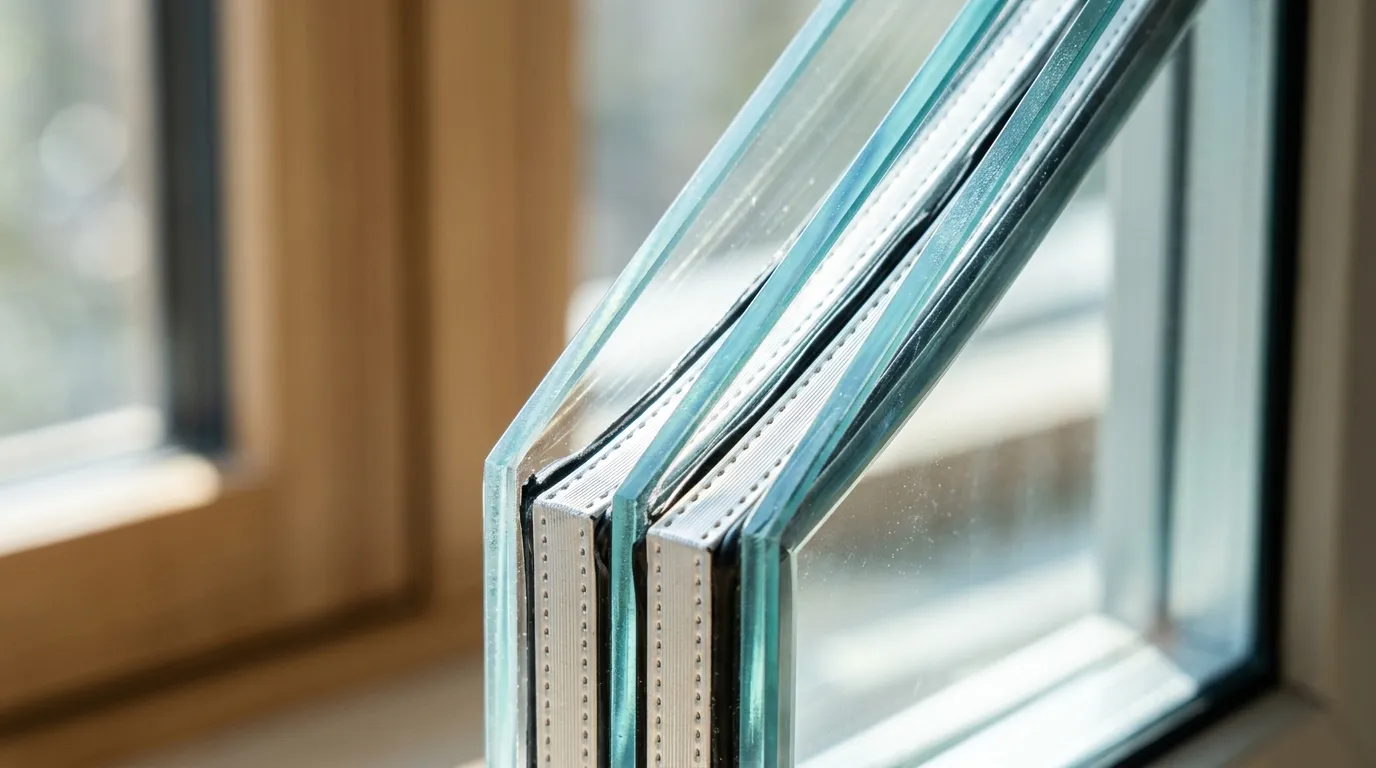
Glass surfaces in an insulating unit are numbered from the outside in. On a double-glazed window, surface #1 faces the weather, #2 is the inside of the outer pane, #3 is the outside of the inner pane and #4 faces the room. The coating can go on #2 or #3, and the choice changes how the window behaves in each season.
On surface #2, the coating intercepts solar radiation before it enters the cavity and reflects part of it back out, which is the ideal placement for solar-control coatings and the North American default. On surface #3, the coating is closer to the room and reflects interior heat back inside more effectively while letting more solar gain reach the inner pane, which slightly favours winter performance. The U-factor is almost identical either way; the SHGC shifts by a few points, and the interior glass surface runs a degree or two warmer with the coating on #3.
Triple-glazed units add surfaces #5 and #6, and the best Quebec triples carry two coatings, typically on #2 and #5, or on #2 and #4 in some configurations, to reach U-factors of 0.9 to 1.1 W/m²·K. A single-coated triple often performs no better than a good double, so if you are paying for the third pane, confirm that the unit has two Low-E surfaces. A fourth-surface Low-E, a hard-coat applied to the room side of the inner pane, is another option that lowers the U-factor but makes interior condensation more likely because the glass surface gets colder.
Tint, clarity and the daylight trade-off
Every silver layer takes a little daylight with it. A passive coating passes roughly 75 to 80 percent of visible light; a double-silver coating around 70 percent; a triple-silver around 60 to 65 percent. On a bright day nobody notices the difference. On a grey February afternoon in a north-facing kitchen, a 15-point drop in VT is the difference between switching the lights on at 3 p.m. or at 4 p.m.
Colour matters as much as quantity. Viewed from the outside, single-silver coatings are nearly neutral; double-silver coatings read faintly green or grey; triple-silver coatings show a distinct blue-green reflection, especially against a dark interior. Mixing coatings on the same facade produces a patchwork of reflections that is obvious from the street, which is why the plan for mixing glass types should follow the walls of the house, not individual rooms.
Ask to see the two glass samples side by side against the sky before deciding. A reputable dealer keeps physical samples of every coating they sell and will hold them up together; if they cannot, that is worth knowing before you sign.
Mixing coatings by facade: a practical plan
The most cost-effective approach for a Quebec house is to specify glass by orientation rather than by window. North and east faces get the passive coating, the cheapest soft-coat option and the best for winter. South faces get the passive coating too if there is a roof overhang, mature trees or a neighbour blocking the summer sun, and a double-silver coating if the wall is exposed. West faces almost always benefit from a double-silver coating, because the afternoon sun arrives when the house is already warm.
The price difference between coating grades is modest: it is charged per square foot of glass between a single-silver and a double-silver unit, so it stays small on a standard 30 by 48 inch window. On a full house of 14 windows, mixing coatings instead of defaulting to one everywhere adds little to the total and changes the comfort of the west-facing rooms permanently.
Write the coating for each opening on the order, with its SHGC and VT, and check the temporary label on each unit at delivery. Glass mistakes are invisible once installed and expensive to correct, and a two-minute check on the driveway is the cheapest insurance you will ever buy.
- North and east: passive single-silver Low-E, argon, warm-edge spacer
- South, shaded: passive single-silver; south, exposed: double-silver
- West: double-silver on every window; consider triple glazing with two coatings on large doors
Frequently Asked Questions
Is soft-coat Low-E worth the extra cost over hard-coat?
Almost always. Soft-coat cuts emissivity by three to five times, lowers the U-factor of a double unit from around 1.7 to 1.3 W/m²·K and has no haze. The premium is usually under 10 percent of the glass price and pays back within a few heating seasons.
Which Low-E is best for a Quebec home?
For most north, east and shaded south windows, a passive single-silver coating that keeps solar gain high. For exposed south and west windows, a double-silver coating that limits summer overheating. Mixing by facade gives the best combination of heating savings and comfort.
Does a Low-E coating make the glass look tinted?
Single-silver coatings are nearly neutral. Double-silver coatings show a faint green or grey reflection from outside, and triple-silver coatings a visible blue-green. Compare physical samples against the sky before ordering.
Should the coating be on surface #2 or #3?
Surface #2 is the standard and the best position for solar control. Surface #3 gives slightly more winter solar gain and a warmer interior pane. The U-factor is nearly identical, so the choice depends on the facade and what the manufacturer offers.
Do I need two coatings in a triple-glazed window?
To get the full benefit, yes. A triple with a single coating often performs no better than a good double. Two coatings, typically on surfaces #2 and #5, bring the U-factor down to 0.9 to 1.1 W/m²·K.
Can a Low-E coating wear off or fail?
A soft-coat sits inside the sealed cavity and never touches air, so it lasts as long as the seal. Hard-coat is fused into the glass and cannot wear off. If a window looks hazy or milky, the seal has failed, not the coating.