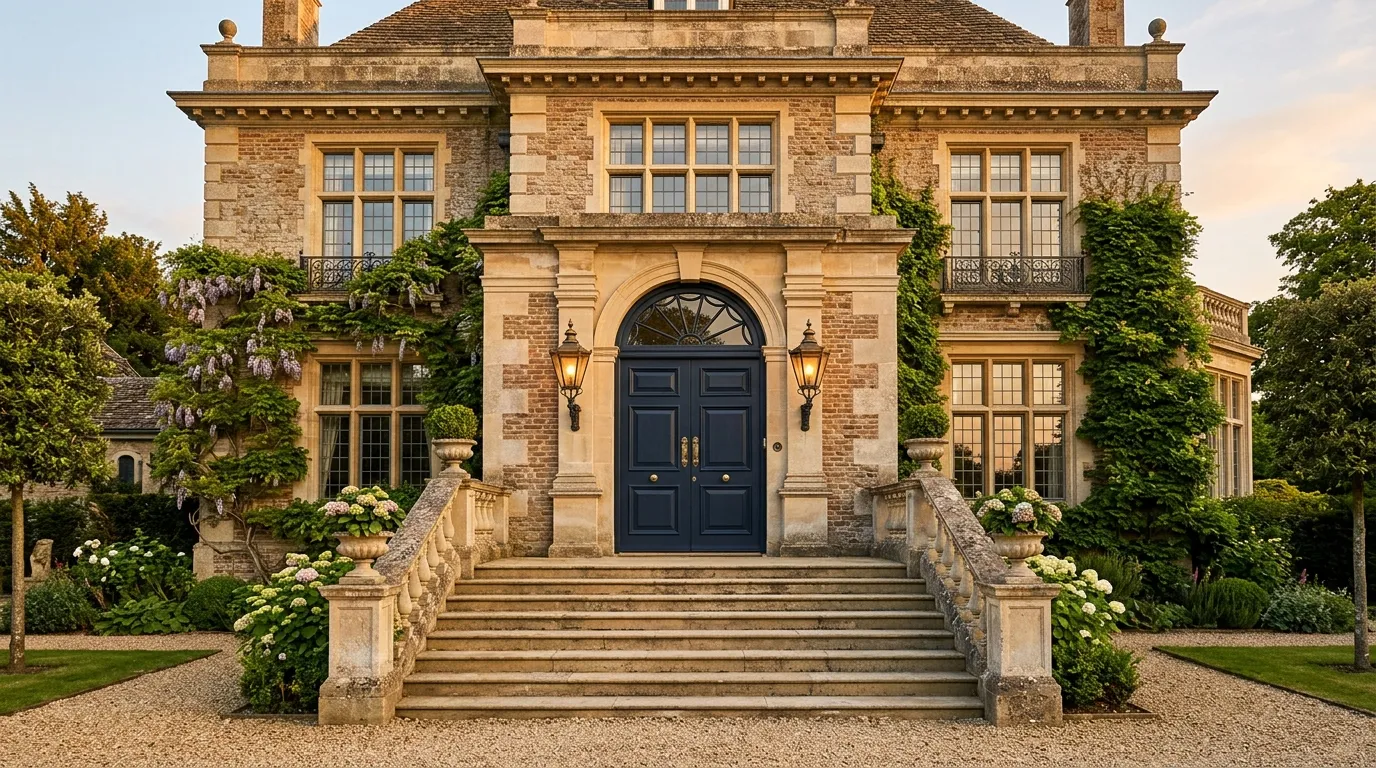
A pair of front doors says something before anyone rings the bell. On the right house they look inevitable; on the wrong one they look like a costume. And in Quebec, they bring an engineering question most brochures skip: two leaves meeting in the middle is one more joint for January to find. Here is how to decide whether double entry doors suit your facade, how they are built to seal and lock properly, and what they cost compared with a single door and sidelites.
Proportions First: Does the Facade Have Room?
A double door is typically 60 to 72 inches wide overall, plus the frame — roughly double the footprint of a standard 36-inch entry. On a facade, that width has to be balanced by something: a two-storey height, a wide front elevation, a covered porch or a symmetric window arrangement. The rule of thumb designers use is that the entry should read as about one-fifth to one-quarter of the front elevation's width. On a 40-foot-wide two-storey home in Brossard or Blainville, a 72-inch entry sits comfortably. On a 28-foot bungalow it swallows the front.
Height matters as much as width. Double doors under a standard 80-inch head look squat; most homes that carry them well use 96-inch (8-foot) doors, or 80-inch doors topped by a transom that brings the whole assembly to about 8 or 9 feet. Check that the wall above the opening has room for the taller header before you fall in love with a catalogue photo.
Finally, consider the approach. A grand pair of doors reached by a narrow walkway and three concrete steps feels mismatched; the entry looks best when the landing is at least as wide as the door assembly and there is a roof or canopy over it. If the porch is small, a single door with two sidelites often gives the same visual width with a more honest scale.
- Works well: two-storey centre-hall plans, symmetrical facades, homes with a covered entry porch, wide bungalows with a raised entry.
- Works poorly: narrow city lots, split-levels with an off-centre door, entries tucked beside an attached garage, facades under 26 feet wide.
- Alternative: a 42-inch single door with two 14-inch sidelites gives 70 inches of visual entry with only one operating leaf.
Active and Inactive Leaf: How a Pair Actually Operates
Despite the look, most double doors are not two equal doors. One leaf is active — it has the handle and the lock, and it is the one the family uses every day. The other is inactive: it is held to the frame at the top and bottom by flush bolts or a surface bolt and is only released when you need the full width, which for most households means moving a sofa or a refrigerator a few times a year.
That matters for how the door lives. An inactive leaf that is rarely opened must still be easy to release when it is needed; concealed flush bolts set into the edge of the door are cleaner than surface bolts but harder to operate with cold fingers, and cheap ones bind after a few winters of frame movement. Ask to see and operate the bolt hardware before buying. Some manufacturers offer a lever-operated release on the inactive leaf that throws both top and bottom bolts at once, which is worth the upgrade.
Decide which leaf is active based on how you enter. If you come from the driveway on the right, the right-hand leaf should be the working one so you are not walking around the swing. It also determines where the deadbolt strike lands — on the edge of the inactive leaf, which is why that leaf must be held firmly in the frame for the lock to mean anything.
The Astragal: Where Double Doors Win or Lose in Winter
The vertical strip where the two leaves meet is called the astragal. On the inactive leaf it carries weatherstripping that the active leaf closes against, and it houses the strikes for the latch and deadbolt. It is the single most important component of a double door in a cold climate, because it is a joint that a single door simply does not have — and unlike the hinge or lock sides, it is not backed by a rigid frame.
A poor astragal shows up as a draft you can feel with your hand in January, frost on the inside of the meeting edge and, over time, a door that will not latch because the leaves have moved relative to each other. Look for an astragal with two independent seals (typically a compression bulb plus a fin or a brush), a thermally broken aluminum or composite core rather than plain wood, and an adjustable strike so the active leaf can be pulled tight over the years.
Bottom sealing is the second weak point. Each leaf has its own sweep, and the astragal's flush bolt passes through the sill at the centre. A well-designed sill has a threaded or cam-adjusted cap that lets the installer raise it a fraction to meet both sweeps evenly. If your quote does not mention an adjustable sill, ask. In the Montreal area, we recommend fibreglass or steel leaves with a composite frame for double doors; wood pairs are beautiful but move more with humidity, and the astragal is where that movement shows first.
- Two seals on the astragal, one compression and one secondary.
- Thermally broken astragal core, not solid wood or plain aluminum.
- Adjustable strike and sill cap to take up seasonal movement.
- Extended sill nosing and a drip cap so meltwater does not sit at the centre joint.
Multipoint Locking on a Pair
On a single door, a good deadbolt is adequate. On a pair, the active leaf locks into the inactive one, so the security of the assembly is only as good as the bolts holding the inactive leaf to the frame. That is why quality double doors are sold with multipoint locking as standard: a lever-operated system that throws hooks or bolts at two or three points along the active leaf's edge, and ideally an inactive leaf with heavy-duty top and bottom bolts engaging steel keepers in the head and sill.
Multipoint locks also do something for comfort: they pull the leaf tight against the weatherstripping along its full height, not just at the latch. On a tall 8-foot leaf that can otherwise bow slightly in extreme cold, this is the difference between a sealed door and one that whistles at the top corner. Expect a good multipoint system to add a moderate premium per leaf over a standard cylindrical lock.
Smart locks fit double doors too, but confirm the model is compatible with the multipoint mechanism, as most retrofit smart deadbolts assume a single-bore door. Manufacturer-integrated electronic multipoint locks exist and are the cleanest solution if keyless entry is a priority.
Living With a Pair: Furniture, Kids and Daily Traffic
The practical argument for double doors is simple: a 60-inch or wider clear opening. Moving day, a new fridge, a piano, a hospital bed for an aging parent — everything that normally goes through the garage or gets angled through a 36-inch opening walks straight in. If you are building a home you plan to keep for decades, that flexibility is real.
The everyday reality is that the active leaf sees 100 percent of the traffic while the inactive one sits closed. That is fine, but it means the active leaf's hinges, sweep and closer wear like any single door while the inactive side's weatherstripping can stay compressed and take a set. Once a year, release the inactive leaf, open it fully and check the seals and bolts; it takes five minutes and keeps the door working when you need it.
Families with young children should note that a double door with the inactive leaf released is a very wide unguarded opening. Keep the flush bolts engaged by default and treat releasing them as a deliberate event, not a convenience.
Energy Performance: What the Numbers Look Like
An insulated fibreglass or steel leaf with a polyurethane core performs around R-5 to R-7 through the panel itself; add glass lites and the whole-unit U-factor rises. Two leaves plus the astragal means more perimeter per square foot of opening than a single door, and perimeter is where air leaks. A well-made pair with a quality astragal will typically test at an air leakage rating close to a single door of the same brand, but a cheap pair can leak two to three times as much.
For ENERGY STAR eligibility in Canada, the door assembly needs to meet the U-factor threshold for its glazing level and pass the air leakage limit. Ask for the whole-unit rating on the exact configuration — leaf, glass and astragal — not the panel-only figure, and check that the label in the quote matches the model being installed.
If the pair includes glass, specify the same Low-E and argon options you would choose for windows. A full-lite double door is essentially a large window that opens; triple-glazed lites are available and worth considering on a north-facing entry that gets no sun in winter.
Cost: Double Doors vs a Single Door With Sidelites
In the Montreal area, a quality insulated double entry door — fibreglass or steel, composite frame, multipoint lock, decent glass — is priced by height, glass and finish. A premium fibreglass pair with a wood-grain finish, decorative glass and an 8-foot height sits at the top of the range. A single 36-inch door of the same quality with two sidelites typically comes in well below a full pair. The exact figure depends on your opening, glass and hardware — request a free estimate.
The premium for the pair is mostly hardware and sealing: a second set of hinges, the astragal, flush bolts, the multipoint system on the active leaf and the extra labour to hang and align two leaves so they meet perfectly. Widening an existing opening to take a pair, if the house currently has a single door, adds structural work on top — a new header, brick cutting on a masonry facade and finishing on both sides.
Our honest advice: if your reason for wanting a pair is the look, compare it side by side with a single door and sidelites in the showroom, because the sidelite version gets you most of the visual width for less money and with fewer things to seal. If your reason is the clear opening — furniture, accessibility, a home you will keep — the pair is the right tool and the premium is justified. Browse the configurations on our exterior doors page and bring a photo of your facade to the consultation.
Frequently Asked Questions
How wide is a standard double entry door?
Most pairs are 60, 64 or 72 inches wide overall, made up of two 30-, 32- or 36-inch leaves. Heights are 80 or 96 inches, and a transom above can bring the assembly to 9 feet or more.
Do double doors let in more cold than a single door?
They can if the astragal is poor. A quality pair with a thermally broken, double-sealed astragal and an adjustable sill performs close to a single door of the same brand; a cheap pair can leak several times as much air.
Can I lock both leaves of a double door?
The active leaf locks into the inactive one, which is held to the frame by top and bottom bolts. Multipoint locking on the active leaf and heavy-duty bolts on the inactive leaf give the assembly real security.
Are double doors a good idea for a narrow Montreal lot?
Usually not. On facades under about 26 feet, a pair overwhelms the elevation. A 42-inch single door with sidelites offers similar visual width in better proportion.
What do double entry doors cost in Quebec?
The installed price of a quality insulated pair depends on height, glass and finish; a premium 8-foot fibreglass pair with decorative glass sits at the top of the range, and a single door with two sidelites typically comes in well below a full pair. The exact figure depends on your opening, glass and hardware — request a free estimate.
Which side should be the active leaf?
The side you naturally approach from — usually the one nearest the driveway or walkway — so you are not walking around the open door. The choice also sets where the deadbolt engages in the inactive leaf.