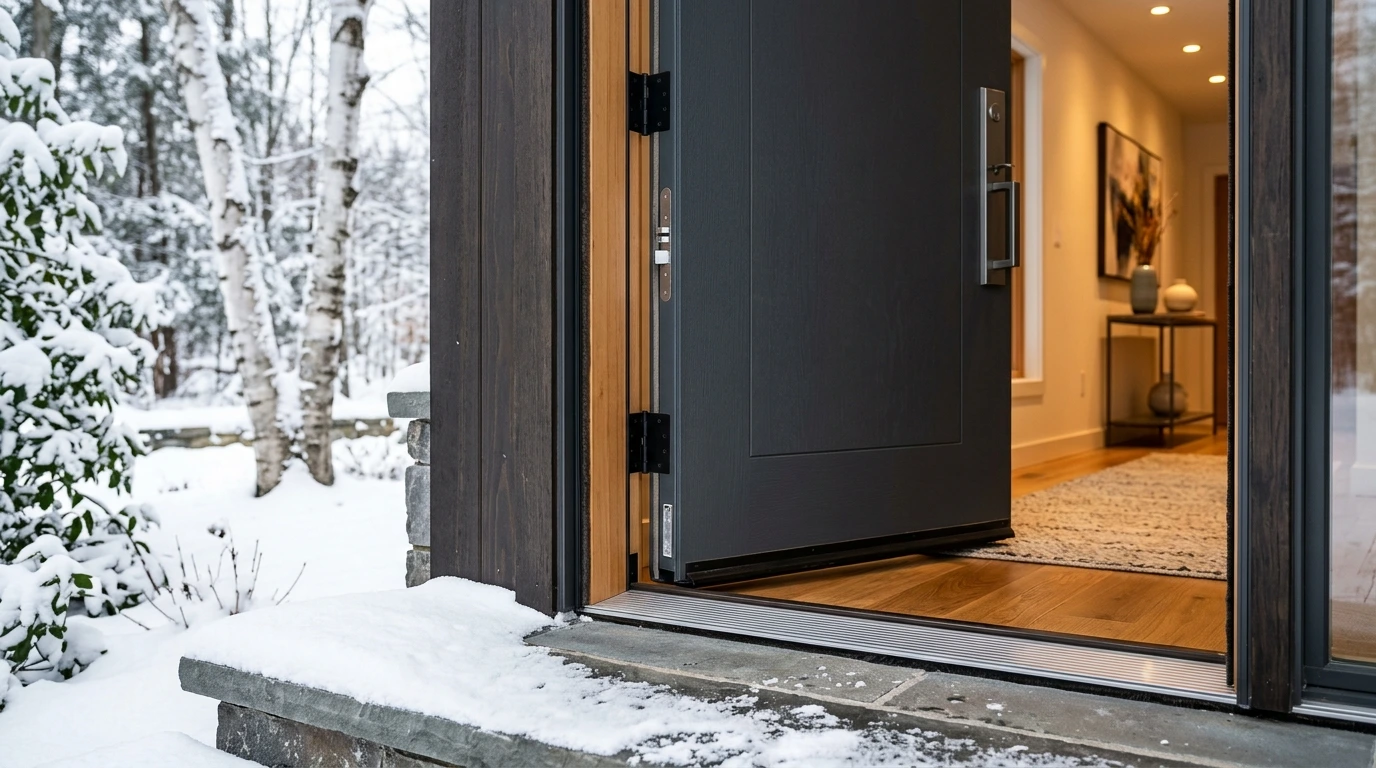
An energy efficient entry door is not just a thick slab with foam inside. It is a system of four parts that work together: the insulated core, the glass, the weatherstripping and the threshold. If one of them is weak, cold air finds it, and in a Quebec winter you feel it right away in the front hall. This guide explains what each part does, what to look for when you compare doors and how to tell where your current door is losing heat.
Why an Energy Efficient Entry Door Is a System
Windows get most of the attention in energy discussions, but the entry door is often one of the weakest points of a home's envelope. It is opened dozens of times a day, it faces wind and driving snow, and it has more moving joints than most windows. A door can have an excellent insulated slab and still feel cold if the seal along the latch side is worn or the sill lets air through underneath.
Think of the door as four layers of defence. The core slows heat moving through the solid part of the door. The glass, if there is any, conducts the most heat and collects frost first. The weatherstripping closes the gap between the slab and the frame, and the threshold seals the bottom, where cold air naturally settles and pushes in.
When you shop for a new door or evaluate the one you have, look at all four. Certifications and labels help, but they describe the door as tested in a lab. In your home, the result also depends on how the door is installed, how square the frame is and how well the space between the frame and the wall is insulated and sealed.
The Core: Steel, Fiberglass and What Is Inside
Most modern entry doors in Quebec are made of steel or fiberglass skins over an insulating core, usually polyurethane foam injected into the slab. Injected foam is meant to fill the cavity completely and bond to the skins, which keeps the door rigid and limits hollow spots. Some lower-end doors use foam boards glued in place, which can leave small voids along the edges.
The skin material matters less for insulation than many people think, because the foam does most of the work. What does matter is the edge of the door. Steel conducts heat, so a well-built steel door has a thermal break: a non-metal edge or stile that stops cold from travelling from the outside skin to the inside one. Without it, you may see frost or condensation lines along the edges of the slab on very cold days.
Fiberglass skins conduct less heat, resist denting and can imitate wood grain. Steel doors are strong and work well with magnetic weatherstripping. Both can be very efficient if the core is fully injected and the edges are thermally broken. If you can, ask to see a cut sample: it shows the foam, the edge construction and the skin thickness better than any brochure.
- Injected foam core: fills the slab completely and adds rigidity.
- Thermal break at the edges: important on steel doors to limit cold edges and frost.
- Reinforced lock and hinge areas: solid blocking gives hinge and lock screws something firm to hold.
Glass Inserts and Sidelites Without the Cold
Glass brings light into the entrance, but it is the part of the door that loses the most heat for its size. That does not mean you have to give it up. It means the glass should be built like a good window: a sealed insulated unit, ideally with low-emissivity glass and an insulating gas fill. Triple-glazed inserts are available for many door styles and help keep the inside pane warmer, which can reduce frost.
Decorative glass is often built as a sealed unit with the decorative panel protected between two clear panes. Check how the insert is mounted in the slab: the frame around the glass should be tight and sealed, with no gaps where cold can seep through. Older doors sometimes have single-pane decorative glass held by a simple moulding, which is a common source of drafts and condensation. Sidelites and transoms add more glass, so they deserve the same insulated construction.
Weatherstripping: Where Most Door Drafts Begin
Weatherstripping is the flexible seal between the slab and the frame. It is the most used and most worn part of an entry door, compressed every time the door closes and exposed to cold, sun and dirt. On an energy efficient door, the seal runs continuously along the top and both sides, with tight, well-formed corners where the vertical and horizontal pieces meet.
Steel doors often use magnetic weatherstripping on the latch side and top, which pulls the seal against the slab a little like a refrigerator door. Compression seals, such as foam-filled or bulb gaskets, are common on fiberglass doors. Both work well when the door closes with even pressure; trouble starts when the door sags, the frame shifts or the gasket hardens with age.
A simple test helps: close the door on a sheet of paper at several points around the frame. If the paper slides out easily, the seal is not compressed enough there. You can also look for light around the edges at night with the porch light on, or feel for cold air with the back of your hand on a windy day.
- Light visible around the slab when the door is closed
- Seals that are flattened, cracked, torn or missing at the corners
- Frost or ice forming on the inside edge of the door in winter
- A latch that must be forced to close, often a sign of poor alignment
The Threshold: Sealing the Bottom of the Door
The bottom of the door is where cold air pushes hardest, because it settles low and wind drives it under the slab. Two pieces work together here: the threshold, or sill, which is part of the frame, and the door sweep or bottom seal attached to the slab. When they meet properly, the sweep presses lightly and evenly on the threshold across the whole width.
Many modern thresholds are adjustable, which lets the cap be raised or lowered to meet the sweep as the house moves with the seasons. Look also for a threshold with a thermal break, so the sill does not carry cold into the floor of the entrance. A sill that slopes toward the outside helps water drain away instead of sitting under the door and freezing.
If you see light under the door, feel a draft at floor level or find ice building up on the inside of the sill, the bottom seal is the first thing to check. A worn sweep is often simple to replace, but a damaged or rotted sill usually points to a larger problem with the frame. In that case, have the whole frame inspected rather than only replacing the seal.
Installation: The Hidden Half of Door Efficiency
Even a well-built entry door performs poorly if it is installed out of square. A slab that is not perfectly aligned compresses the weatherstripping on one side and leaves a gap on the other. The frame must be plumb, level and square, properly shimmed and secured, especially on the hinge side, which carries the weight of the door.
The space between the door frame and the rough opening also matters. It should be filled with a suitable low-expansion insulation, sealed against air leaks and finished inside and out. Outside, flashing and sealant keep water from getting behind the frame. Our page on window installation explains the same principles, and they apply to doors as well.
When you compare proposals, ask the questions below; clear, specific answers are a good sign that the installation has been thought through. For a broader look at where a house loses heat, our guide to understanding energy efficiency is a good starting point.
- Is the whole unit replaced, including the frame and threshold, or only the slab?
- What type of insulation and air sealing is used around the frame?
- Is the threshold adjustable and thermally broken?
- Which weatherstripping comes with the door, and can it be replaced later?
Choosing Your Next Entry Door With a Free Estimate
Every entrance is different. Exposure to wind, the amount of glass you want, the style of the house and the condition of the existing frame all shape the right choice. A door suited to a sheltered porch may not suit a corner home facing north winds.
New weatherstripping or a sweep is often a reasonable first step. If the door is still drafty, frosty or hard to close afterward, or if the sill is soft or the frame is out of square, it is time for an assessment of the whole door, frame and threshold. You can browse our exterior doors to see the styles available, then request a free in-home estimate from Unisson Groupe, which manufactures and installs windows and doors in Saint-Laurent and serves homeowners across Greater Montreal.
Frequently Asked Questions
What is the most energy efficient type of entry door?
Steel and fiberglass doors with a fully injected polyurethane foam core are among the most efficient options. The skin material matters less than the core, the thermal break at the edges, the weatherstripping and the installation.
Does glass in a front door reduce energy efficiency?
Glass conducts more heat than an insulated slab, so more glass means more heat loss. Insulated glass inserts with a low-e coating and gas fill, or triple glazing in some models, reduce that difference noticeably.
How do I know if my entry door weatherstripping needs replacing?
Look for flattened, cracked or torn seals, light around the slab and frost on the inside edge in winter. The paper test also works: close the door on a sheet of paper and see if it slides out easily. If the seal looks fine but the door still leaks, the problem may be alignment.
Why is there frost on the inside of my front door?
Frost forms where cold reaches the inside surface: a steel edge without a thermal break, a poorly sealed glass insert or a worn seal. High indoor humidity makes it worse.
How much does an energy efficient entry door cost?
It depends on the project: the size of the opening, the material, the amount of glass, the frame condition and the installation details. A free in-home estimate, with the opening measured and the options compared, is the most reliable way to get an answer.