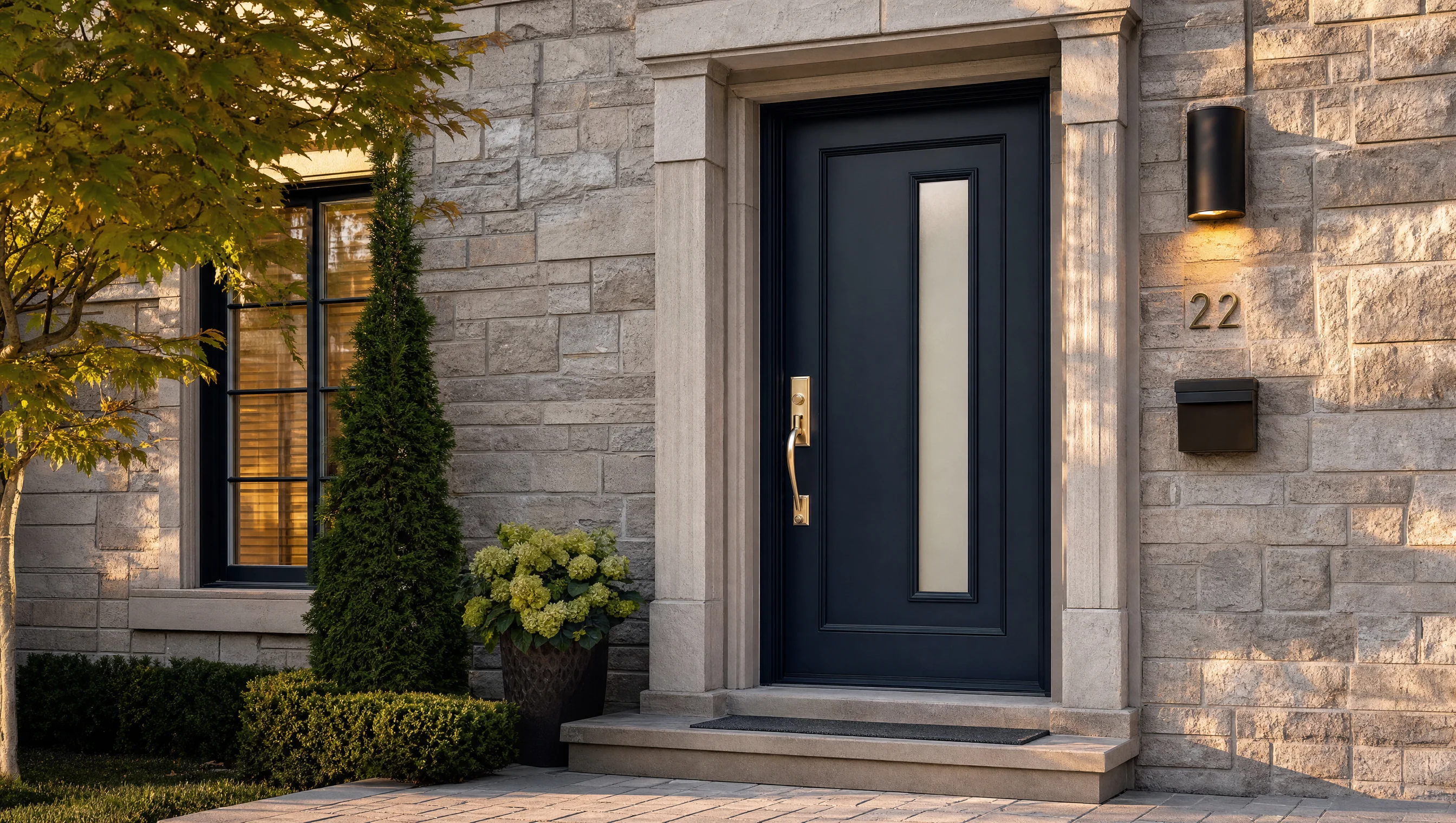
Your front door is the first thing a guest touches and the first thing a buyer notices from the sidewalk — it sets the tone for the entire facade. In 2026, Quebec homeowners are choosing doors that pair bold, confident color with the kind of insulation and security our winters demand.
What is Trending in 2026
Black and deep navy remain the dominant choices on Montreal streets, anchoring everything from Plateau greystones to new builds in the West Island. But warmer, more characterful tones are gaining real share this year — deep forest green, terracotta, and matte bronze read as both contemporary and timeless against brick and stone.
Glass inserts are now the default rather than an upcharge, with frosted and reeded privacy glass leading the way. They pull daylight into entry halls that are otherwise dark for much of the Quebec winter, without sacrificing the privacy you want on a street-facing door.
Hardware has shifted too. Long vertical pull bars in matte black or brushed bronze signal a modern entrance, while the larger glass-lite proportions and clean, shaker-style panel profiles continue to replace the busy six-panel colonial look that dominated the 2000s.
Material Choices
Material is the decision that matters most in our climate, because a door endures roughly 100 freeze-thaw cycles every winter plus driving summer sun. Each option carries a different balance of insulation, security, maintenance, and price.
- Fiberglass — the best all-around choice for Quebec; an insulated polyurethane core gives a high R-value, it convincingly mimics wood grain, and it never warps, swells, or rots through freeze-thaw cycles
- Steel — the most affordable and the highest raw security; it insulates well with a foam core but can dent, and the finish needs periodic repainting to fend off rust at scratches
- Wood — classic and premium, unmatched for heritage homes in Westmount or Outremont, but it demands regular refinishing and can move with humidity if not properly sealed
Energy Performance and Cold-Climate Comfort
An entry door is a surprisingly large hole in your thermal envelope, so its energy performance shows up directly on your Hydro-Québec bill. Look for an insulated polyurethane-core slab, a continuous magnetic or compression weatherstrip, and a thermally broken sill that resists the cold bridge where the threshold meets the floor.
If your door has glass, that glass should carry a Low-E coating and an argon fill, just like a quality window — otherwise the lite becomes the weakest point in the whole assembly. ENERGY STAR-certified door systems are widely available and, when installed as part of a broader envelope upgrade, can contribute toward Canada Greener Homes grants of up to $5,000.
Equally important is the install. Even the best-rated door drafts if the rough opening is poorly insulated and the threshold is not properly flashed. A door swept by wind off a Montreal corner lot deserves the same careful perimeter sealing and low-expansion foam treatment a window gets.
Security Features Worth Specifying
A handsome door is only as good as what holds it shut. Multi-point locking — which throws bolts at the top, middle, and bottom of the slab with a single turn — should be your baseline, because it spreads force across the frame and makes a kick-in dramatically harder than a single deadbolt.
Pair that with a reinforced strike plate anchored by long screws into the framing, not just the jamb, and a metal frame reinforcement around the lock area. These unglamorous details are what actually resist a forced entry, far more than the lock brand on the marketing brochure.
If you want app-controlled access for deliveries or family without keys, a smart deadbolt integrates cleanly with most modern entry systems. Just confirm it is rated for exterior cold-weather use, as some consumer smart locks struggle below −20 °C.
- Multi-point locking that engages top, middle, and bottom in one motion
- Reinforced strike plate with 75 mm (3 in.) screws driven into the structural framing
- Metal frame reinforcement around the deadbolt and handle zone
- Laminated insert glass that resists break-through far better than standard residential glass
- An exterior-rated smart deadbolt if you want keyless, app-controlled access
Sidelites, Transoms, and Configurations
A single slab is only one option. Adding a sidelite — a narrow fixed glass panel beside the door — or a transom above it transforms a dark vestibule and gives an entrance a more generous, custom presence, which is why these configurations are increasingly popular on Quebec semi-detached and detached homes.
Sidelites do come with a cold-climate trade-off: more glass means more potential heat loss, so insist on Low-E, argon-filled units and a properly insulated mull post between the door and the lite. A double-sidelite configuration looks striking but should be specified with the best available glazing to keep the entry comfortable in January.
Configuration also affects swing and clearance. Confirm early whether your door swings in or out and to which side — in Quebec, inward-swing is common so snow and ice cannot block the door from opening, but a tight vestibule or a storm-door pairing can change the right choice for your home.
- Single slab — the most thermally efficient and most affordable
- Door plus one sidelite — adds daylight while keeping glass area modest
- Door plus two sidelites — the most dramatic; specify premium Low-E glazing
- Transom above — raises perceived ceiling height and brightens the vestibule
- Confirm swing direction and handing early — inward-swing avoids snow blockage
See Models
The right combination of color, glass, and hardware should suit both your home’s architecture and the way you actually use your entrance. A single homeowner on a quiet Ahuntsic street and a busy family on a corner lot in Brossard will land on very different doors — and that is exactly the point.
Browse our exterior doors and executive panel collections to compare slab styles, glass options, and finishes. When you are ready, request a free estimation and we will measure your opening and recommend the best-performing door for your facade and budget.
Frequently Asked Questions
What is the best door material for cold climates?
Insulated fiberglass is the strongest all-around choice for Quebec. Its polyurethane core delivers a high R-value, and unlike wood it will not warp or swell through the roughly 100 freeze-thaw cycles a Montreal winter brings, while still convincingly mimicking real wood grain.
Do glass inserts make doors less secure?
Not with modern laminated insert glass, which bonds a tough interlayer between panes and is far harder to break through than standard residential window glass. For street-level doors, pair laminated glass with a multi-point lock for the best balance of light and security.
Should I match my door color to my windows?
Trending 2026 designs lean on contrast rather than matching — a deep black or forest-green door against white or light window frames creates a crisp focal point. Matching can work on monochrome modern builds, but contrast is what gives most Quebec facades their curb appeal.
How much does a quality entry door cost installed in Quebec?
A quality insulated fiberglass entry door with glass inserts and multi-point locking typically runs from about $2,500 to $5,500 installed in 2026, depending on size, glass, and hardware. Steel doors sit at the lower end, while wood and full-lite or sidelite configurations sit higher.
Are entry doors eligible for Quebec rebates?
Doors are not usually the headline item, but an ENERGY STAR-certified entry door installed as part of a broader envelope upgrade can count toward the Canada Greener Homes Initiative’s grants of up to $5,000. A licensed installer can confirm eligibility and help with the paperwork.
Which door color hides dirt and weathers best in Montreal?
Mid-to-deep tones like charcoal, navy, and forest green hide road salt, slush splash, and pollen better than pure white or very pale colors. Quality factory finishes on fiberglass also resist fading from UV far better than a field-painted door.