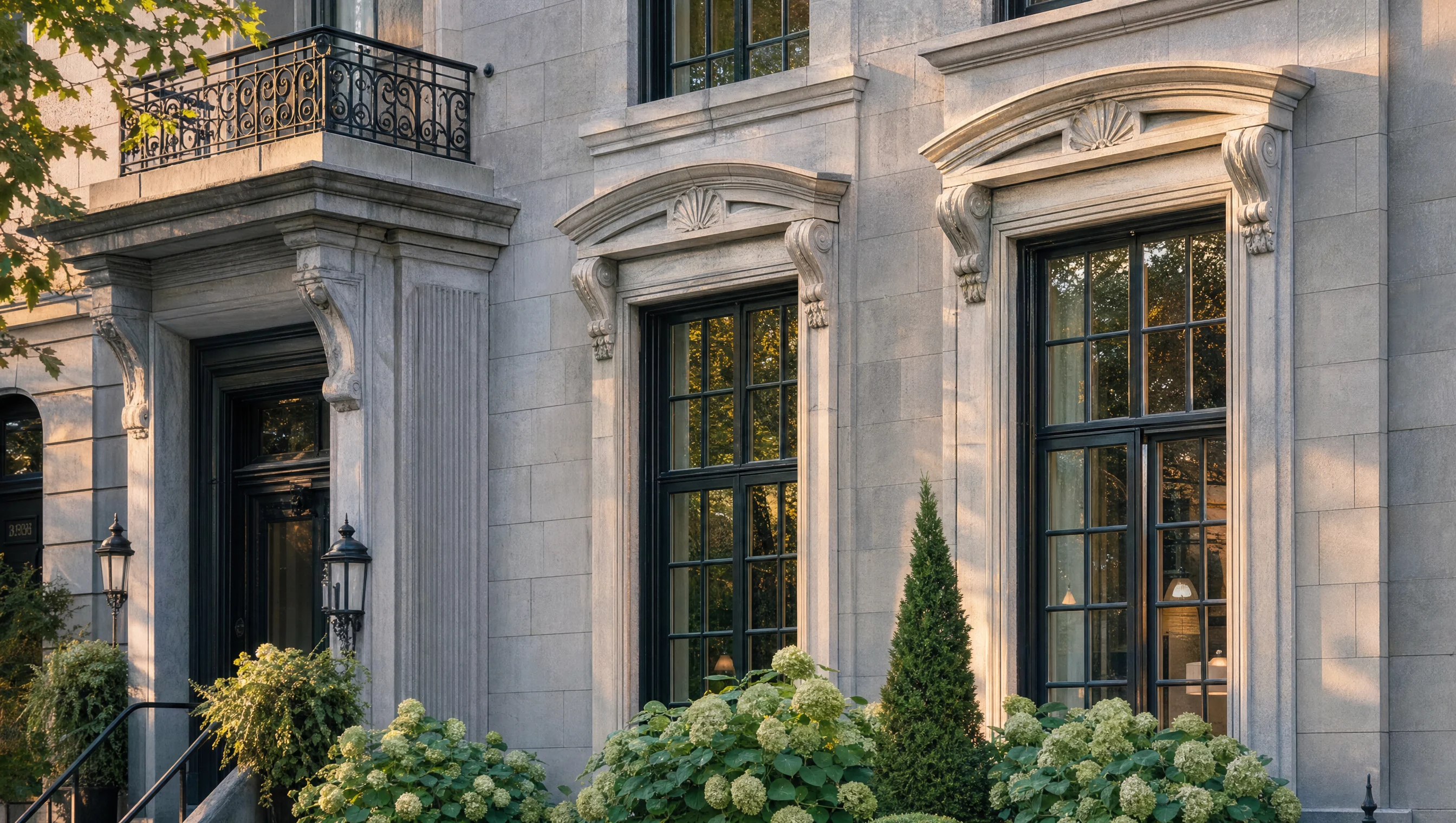
Replacing windows in a heritage Montreal home is a delicate balancing act between two goals that usually pull in opposite directions. On one side you want modern thermal performance that finally tames the −25°C draughts of a January cold snap; on the other, you owe it to the building — and often to the borough — to preserve the proportions, muntins, and silhouette that give a century-old greystone or Victorian its soul. Done right, the upgrade is invisible from the street and transformative inside.
Why Heritage Homes Need Special Care
Many of Montreal’s most beloved neighbourhoods — the Plateau-Mont-Royal, Outremont, Westmount, the Golden Square Mile, and Old Montreal — sit inside heritage or « site patrimonial » districts where window replacement is regulated by the borough or by the city’s urban-planning department. Swapping period sashes for off-the-shelf white vinyl with chunky frames can trigger a formal notice (« avis d’infraction »), force a costly do-over, and quietly erode the resale value of a property that buyers chose precisely for its character.
Beyond the rules, heritage homes are simply built differently. Original openings were sized for true divided-lite wood sashes, with deeper jambs, generous brick-mould trim, and proportions calibrated to the facade. A modern replacement that ignores those dimensions reads as wrong even to passersby who could never name why. The glass area shrinks, the muntins look pasted-on, and the rhythm of the wall is broken.
There is also a practical wrinkle: many of these walls are solid masonry — double-wythe brick or cut stone — rather than the wood framing of a post-war bungalow. That changes how a window is anchored, flashed, and insulated at the perimeter, and it is one more reason to work with an installer who has done genuine heritage work in Montreal rather than tract-housing volume.
Period-Appropriate Window Styles
The first decision is matching the operating style and grille pattern to the home’s era. Most Montreal heritage stock falls into a handful of recognizable periods, and each one has a window vocabulary that looks correct. Getting this right matters more than any single spec sheet, because the eye reads the pattern of the glass long before it reads the material.
Modern simulated-divided-lite (SDL) grilles, where slim bars are bonded to both faces of the glass with an internal spacer bar, reproduce the look of true divided lites while keeping a single sealed insulating glass unit. From the sidewalk they are indistinguishable from putty-glazed wood; from the inside they preserve the original light pattern. This is the detail that lets a borough sign off and an owner sleep warm.
- Double hung with simulated divided lites for Victorian, Second Empire, and Edwardian rowhouses
- Casement with grid muntins for Tudor revival and English country styles common in upper Westmount
- Picture windows with arched or segmental tops for Greystone and Italianate facades
- Specialty shapes — eyebrow, oval, gothic, and transom lites — to match irregular original openings
- Awning units discreetly placed where ventilation is needed without disturbing the main facade rhythm
The Details That Make or Break the Look
Three measurements separate a convincing heritage replacement from an obvious one: frame-profile depth, muntin (grille bar) width, and exterior-trim reveal. Original wood windows had narrow stiles and deep sashes; many budget vinyl units flip that, with fat frames and shallow depth that swallow glass and flatten the facade. Reputable manufacturers offer historical profile collections with deeper sashes, narrower sightlines, and putty-line grille profiles that cast the right shadow.
Colour and finish matter just as much. Crisp arctic white is rarely correct on a 1890s greystone; period palettes lean toward heritage cream, deep forest green, oxblood, charcoal, and bronze. Quality UPVC can be co-extruded or laminated in these tones with woodgrain textures, and exterior capping can be colour-matched to original brick-mould and sills so the new unit disappears into the wall.
Finally, think about how the glass itself reads. Genuine antique glass has a faint waviness and a slightly warmer cast; some premium lines offer restoration glass options or a low-iron, low-reflectance coating so the new units do not flash a hard blue-green mirror back at the street the way cheap Low-E sometimes does.
Marrying Old Looks With Modern Performance
The whole point of replacing rather than restoring is performance, and here the gains are dramatic. A single-glazed wood sash with a worn-out weatherstrip might have a U-factor north of 5.0 W/m²·K and leak air on every windy night. A modern heritage-profile UPVC unit with double or triple Low-E glazing and argon fill can reach an ENERGY STAR Zone D rating with a U-factor near or below 1.40 W/m²·K — a three- to four-fold improvement.
In practical terms, a Plateau triplex owner who replaces 20 tired single-pane openings can expect to cut heating energy meaningfully and, just as importantly, eliminate the cold downdraughts and condensation frost that plagued the old sashes. Triple glazing is worth considering on the windiest, north-facing elevations, while double glazing with a warm-edge spacer is often the sweet spot for street-facing windows where weight and sightlines matter.
Done thoughtfully, none of this is visible. The borough sees a period-correct facade; the owner sees a smaller Hydro-Québec bill and a quieter, draught-free interior. That is the entire promise of a good heritage upgrade.
- Target ENERGY STAR Zone D certification — the Canadian climate zone covering Greater Montreal
- Specify warm-edge spacers to reduce condensation at the glass perimeter
- Consider triple glazing on exposed north and west elevations for comfort and sound
- Ask for an air-tightness (A3) and water-resistance rating suited to driving Quebec rain
Permits, Approvals, and Timelines
In a designated heritage district you almost always need a transformation permit from the borough before a single window comes out. The borough’s planning advisory committee (CCU) may review drawings, colour samples, and grille details to confirm they respect the architectural character. Skipping this step is the single most common — and most expensive — mistake heritage owners make.
Realistically, allow 30 to 60 days for the permit process, and longer if your project goes before a committee that meets monthly. Start early, ideally before you finalize your order, because approval conditions can dictate the exact muntin pattern or exterior colour you are allowed to install. A good installer will prepare the documentation package and, where required, the site photos and elevations the borough wants to see.
It is also worth confirming whether your property carries a specific provincial classification under the Cultural Heritage Act, which can add another layer of review. When in doubt, a quick call to your borough’s permits counter before you shop will save weeks later.
Rebates and Tax Credits Heritage Owners Can Stack
Heritage owners are not on their own financially. Rénoclimat, administered through Transition énergétique Québec, pays up to $150 per rough opening when you replace single-pane or older double-pane windows with ENERGY STAR-certified models, after a pre- and post-work energy evaluation. On a 20-window heritage home that alone can offset a meaningful share of the project.
Federally, depending on the programs active in 2026, the Canada Greener Homes framework can layer additional support of up to several thousand dollars across windows, doors, and insulation when bundled with an eligible retrofit. On top of that, some Quebec municipalities offer dedicated heritage restoration grants or tax credits aimed precisely at preserving period facades — well worth asking your borough about, since they are often under-publicized.
A reputable, RBQ-licensed installer will help you sequence these programs correctly, since several require the energy evaluation to happen before work begins. Get the paperwork right and the combined incentives can cover a substantial slice of a heritage-grade window project.
Next Steps for Your Heritage Window Project
Start with an on-site assessment by someone who understands both Quebec’s climate and its heritage rules. The right partner will measure every opening, document the existing profiles and grille patterns, recommend period-correct details, and flag any borough approvals you will need before ordering.
If you own a character home in the Plateau, Outremont, Westmount, or anywhere across Greater Montreal, request a free estimation with the Unisson team. We manufacture our windows locally in Saint-Laurent, offer historical profile and colour collections, and back every installation with a long-term warranty — so you can modernize the comfort of your home without compromising the architecture that made you fall for it.
Frequently Asked Questions
Can I get triple-pane glass in a heritage profile?
Yes. Modern UPVC profiles can be shaped to mimic traditional wood sashes — narrow sightlines, deeper sashes, putty-line grilles — while housing a triple-pane Low-E insulating unit inside. From the street it looks period-correct; the performance is fully modern.
Are there heritage-specific rebates in Quebec?
Yes. In addition to Rénoclimat (up to $150 per rough opening) and federal programs, several Quebec municipalities offer heritage restoration grants or tax credits for preserving period facades. Check directly with your borough, as these are often under-advertised.
Should I restore or replace my old wood windows?
Restoration preserves original material and character but rarely matches modern thermal performance, even with storm windows. Many heritage owners replace with period-appropriate UPVC that reproduces the look while cutting heat loss three- to four-fold.
Do I need a permit to replace windows in a heritage district?
In most designated districts, yes — you need a transformation permit, and a planning committee may review grille patterns and colours. Budget 30 to 60 days, and confirm requirements with your borough before finalizing your order.
Will period-correct grilles hurt my energy rating?
No. Simulated divided lites are bonded to a single sealed glass unit, so they preserve the historic light pattern without breaking the seal or the insulating gas fill. Your ENERGY STAR rating is unaffected.
How much do heritage-grade replacement windows cost in Quebec?
Expect a premium over standard new-construction windows because of custom sizes, historical profiles, special colours, and grille work. Many heritage units land in the $1,200 to $2,500+ installed range each, before rebates, depending on size and shape.