Two window quotes can show the identical bottom-line total and yet deliver wildly different value once the installers leave. The gap hides in the fine print — the glazing package, how the frame is built, who does the install, and what the warranty actually covers. Here are the seven line items to compare before you sign anything in Quebec.
Start With the Pricing Structure
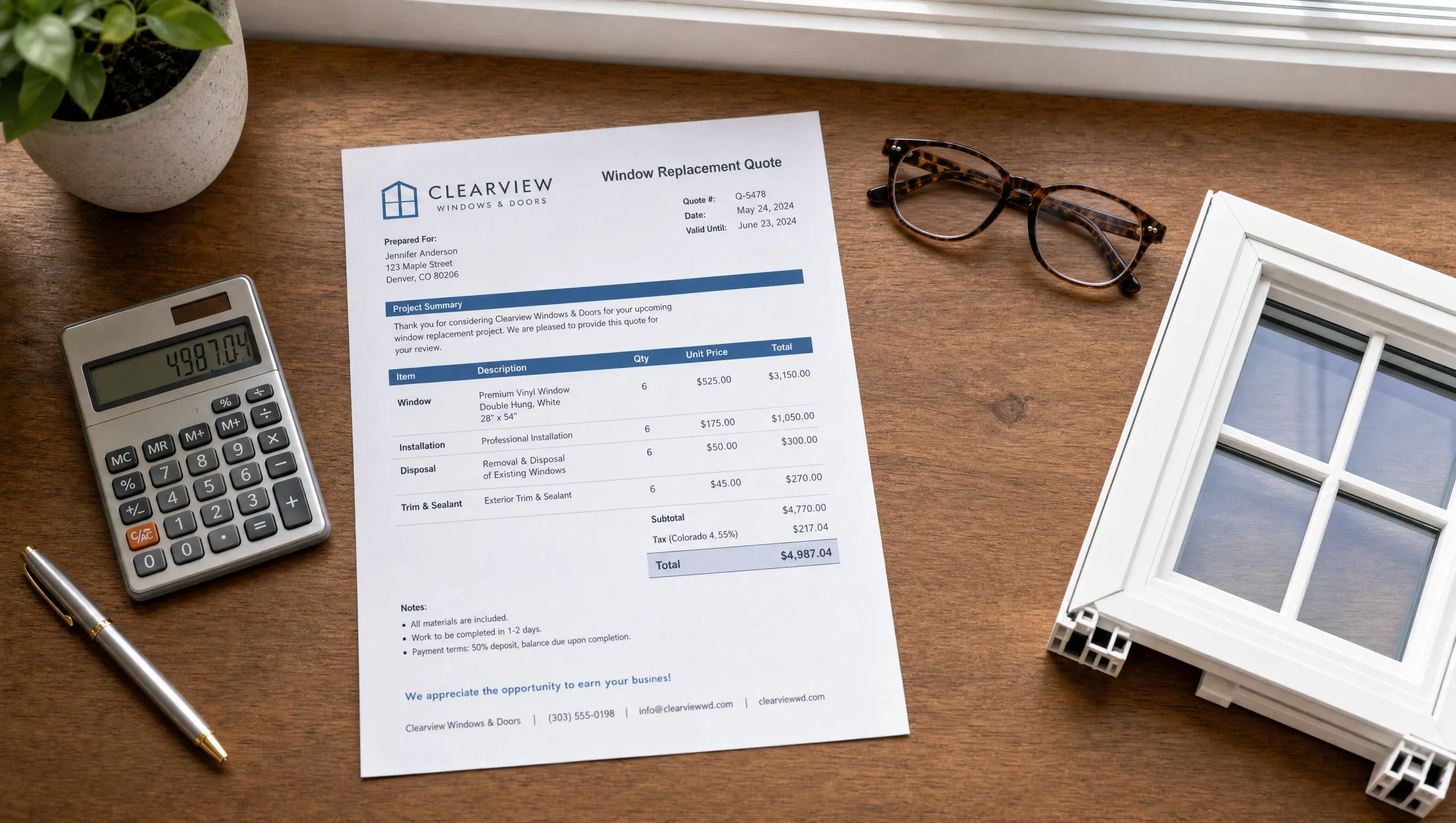
Before comparing any technical detail, confirm that both quotes are built the same way. A trustworthy Quebec quote is itemized: each window listed by location and size, with a unit price, an install price, and taxes (GST 5% + QST 9.975%) shown explicitly. A single lump sum with no breakdown makes it impossible to compare apples to apples and is a common way to bury a thin product behind a polished number.
Watch for what is included versus extra. Capping (the exterior aluminum trim), interior finishing, disposal of the old units, and permit fees are often where a « cheap » quote quietly omits cost that resurfaces as a change order later. Ask each contractor to confirm in writing that these items are inside the price, not on top of it.
Finally, check the deposit terms. For residential window work in Quebec, a deposit of around 30% is typical and reasonable; be cautious of any quote demanding 50% or more upfront before materials are even ordered. A balanced payment schedule — deposit, a payment at delivery, and a final payment on satisfactory completion — protects you and signals a contractor confident in their cash flow.
- Itemized: each window by size and location, with separate product and install lines.
- Inclusions: confirm capping, finishing, old-unit disposal, and permits are in the price.
- Deposit: ~30% is normal; treat 50%+ upfront as a red flag.
1. Glazing Specification
Glazing is where the biggest performance — and price — differences live, and it is the easiest spec to fudge. A quote should state the number of panes (double or triple), the low-emissivity (low-E) coating, the gas fill (argon is standard, krypton is premium), and the spacer type. « Energy-efficient glass » with no specifics tells you nothing; insist on the actual numbers.
For Quebec, the meaningful benchmark is ENERGY STAR certification for Climate Zone D, which covers most of southern Quebec including the greater Montreal area. Look for a low U-factor (lower is better insulation) and an appropriate Solar Heat Gain Coefficient for the orientation — higher SHGC on south walls to capture free winter sun, lower on west walls to limit summer overheating. Triple glazing meaningfully cuts heat loss and noise on busy streets, but adds cost and weight.
Also confirm the spacer is a « warm-edge » design rather than plain aluminum. Warm-edge spacers reduce condensation at the glass perimeter — a real issue during a cold Quebec January when interior humidity is high. Learn more on our low-emissivity glass page, then make sure both quotes specify the same package before you compare prices.
- Panes: double vs triple — confirm which, in writing.
- Coating & fill: low-E type, argon vs krypton, warm-edge spacer.
- Ratings: ENERGY STAR Zone D, U-factor, and orientation-appropriate SHGC.
2. Frame Construction
The frame material and how it is built drive longevity in our freeze-thaw climate, which can cross the 0°C line more than 30 times in a single shoulder season. The three common choices are vinyl (PVC), hybrid (vinyl with an aluminum exterior or reinforced sash), and fibreglass. Each has a different price and lifespan, and a quote should name the material and the series, not just « PVC window ».
On vinyl, ask whether the corners are fusion-welded (one solid, watertight joint) or mechanically fastened — welded corners are stronger and far less prone to leaking over 20 winters. Ask about internal reinforcement for larger sashes, which keeps big casements from sagging and sealing poorly. These details rarely appear unless you ask, yet they separate a 15-year window from a 30-year one.
Compare like with like: a budget builder-grade vinyl unit and a premium reinforced series are not the same product even if both say « vinyl ». Request the manufacturer and model line on each quote so you can verify wall thickness, chamber count, and air-infiltration ratings rather than trusting a generic label.
- Material: vinyl, hybrid, or fibreglass — named with series, not generic.
- Corners: fusion-welded beats mechanically fastened for watertightness.
- Reinforcement: confirm internal reinforcement on large casements and sliders.
3. Hardware Quality
Hardware is the part you touch every day, and it is the first thing to fail on a cheap window. Compare the operators (the cranks on casements and awnings), the locks, the hinges, and the weatherstripping. Multi-point locking that secures the sash at several points improves both security and the airtight seal — a single central lock often leaves the corners loose and drafty.
Ask about the grade and brand of the hardware, and whether it is corrosion-resistant. Quebec road salt and high winter humidity are hard on metal; stainless or coated components last far longer than bare zinc. On casements, a quality steel operator with a smooth gearbox will still crank effortlessly after a decade, while a flimsy one stiffens and strips.
Weatherstripping is the quiet hero. Look for dual or triple weatherstripping and confirm it is replaceable — sealing materials wear, and a window whose weatherstrip can be swapped will stay tight for decades. A quote that lists hardware brand and weatherstrip detail signals a contractor who knows the product; vague hardware language usually means a cost-cut hiding somewhere.
- Locks: multi-point for security and a tighter seal.
- Operators & hinges: corrosion-resistant, smooth, named brand.
- Weatherstripping: dual/triple and replaceable for long-term tightness.
4. Installation Method
The best window installed poorly will underperform a modest window installed well — installation is at least half the result. The two main approaches are a retrofit (insert) install, where the new unit fits inside the existing frame, and a full-frame (brick-to-brick) install, where everything is removed down to the rough opening. Each has its place, but they are not interchangeable, and the quote should state which one you are getting.
Full-frame installs cost more but let the installer inspect and replace rotten framing, add proper insulation around the unit, and reseal the entire opening — the right call when the old frames are deteriorated or the home is older. Retrofit installs are faster and cheaper but shrink the glass area slightly and only work when the existing frame is sound. A quote that does not specify the method may be quietly assuming the cheaper retrofit.
Drill into the air-sealing and insulation detail: low-expansion spray foam around the perimeter, a proper interior air barrier, and exterior flashing or capping to shed water. Ask how the gap between the unit and the rough opening is insulated — this is where heat quietly leaks. See our window installation process for what a correct job looks like step by step.
- Method: retrofit (insert) vs full-frame (brick-to-brick) — stated clearly.
- Sealing: low-expansion foam, interior air barrier, exterior flashing/capping.
- Condition: full-frame when old framing is rotten or the home is older.
5. Warranty Detail
A warranty is only as good as its terms, and « lifetime warranty » on a banner means little until you read what is covered, for how long, and by whom. Separate the manufacturer warranty (on the window itself — frame, glass seal, hardware) from the installer warranty (on the labour and the seal of the installation). The two are distinct, and a gap between them is where disputes happen.
Check the specifics: how many years on the sealed glass unit against fogging, how many on hardware, and whether the coverage is prorated (declining payout over time) or full. Confirm whether labour to perform a warranty repair is included or billed separately — a free part is small comfort if you pay $200 in labour to install it. Also verify the warranty is transferable, which adds resale value.
Finally, make sure the warranty is backed by a company likely to be around to honour it. A long paper warranty from a contractor who may not exist in five years is worth less than a solid one from an established manufacturer. Our guide on what to look for in a Quebec window warranty breaks down the clauses that matter.
- Two warranties: manufacturer (product) and installer (labour/seal) — get both.
- Terms: glass-seal years, hardware years, prorated vs full, labour included or not.
- Transferable: coverage that passes to the next owner adds resale value.
6. Rebate Eligibility
A quote that ignores rebates may be leaving real money on the table. In Quebec, the provincial Rénoclimat program offers grants tied to each qualifying rough opening — up to roughly $150 per rough opening for eligible high-efficiency windows — provided an energy evaluation bookends the work. Across a whole-home replacement, that adds up quickly.
Federally, the Canada Greener Homes stream has historically supported window and door upgrades within a package worth up to $5,000 in grants, again contingent on meeting efficiency thresholds and following the evaluation process. Some utilities and municipal programs layer additional incentives, and Hydro-Québec periodically runs efficiency initiatives worth asking about for your specific situation.
The catch is that eligibility depends on the product meeting ENERGY STAR Zone D criteria and on following the program steps in order — pre-work evaluation, qualifying product, post-work evaluation. A good contractor will confirm in writing that the proposed windows qualify and will help you sequence the paperwork. If a quote is silent on rebates, ask directly, because the difference can be thousands of dollars.
- Rénoclimat: up to ~$150 per qualifying rough opening, with energy evaluations.
- Canada Greener Homes: up to $5,000 in grants for a qualifying package.
- Hydro-Québec / municipal: ask about additional efficiency incentives in your area.
7. Lead Time and Schedule
Price and product matter, but so does when the work actually happens. Custom windows in Quebec are typically manufactured to order, and lead times commonly run 6 to 12 weeks from deposit to installation — longer in the spring and fall rush. A quote with a clear, realistic timeline lets you plan; one with no date, or an implausibly fast promise, deserves scrutiny.
Ask how the install is sequenced if you are replacing many windows: how many days on site, whether the home stays sealed each night, and how weather delays are handled. Quebec's climate matters here — installers avoid full-frame work in deep cold when foam and sealants cure poorly, so a January quote promising same-week brick-to-brick work may be overpromising.
Confirm the contractor's credentials before scheduling anything: a valid RBQ licence number, proof of liability insurance, and CCQ-compliant labour where applicable. An itemized quote, an RBQ number, an insurance certificate, and clear warranty documentation are the four documents every legitimate Quebec installer should hand you without hesitation.
- Lead time: expect 6–12 weeks for custom units; longer in peak season.
- On-site plan: days required, nightly sealing, and weather contingencies.
- Documents: RBQ licence number, insurance certificate, itemized quote, warranty paperwork.
Next Steps
Once you understand these seven items, the cheapest quote often stops looking like the best one. Compare the actual specs side by side, not just the totals, and ask each contractor to put inclusions and the install method in writing.
Ready to get a quote you can read line by line? Review how financing windows and doors works in Quebec and book a transparent, itemized free estimate with our team.
Frequently Asked Questions
Should I always pick the lowest quote?
Never on price alone — missing items in the cheap quote, like capping, disposal, or a thin glazing package, often resurface as extra charges later. Compare the seven line items and the cheapest total frequently turns out to be the worst value.
What documents should the installer provide?
An itemized quote, a valid RBQ licence number, a certificate of liability insurance, and complete warranty documentation. Any legitimate Quebec installer should provide all four without hesitation.
Is a 50% deposit standard?
No — around 30% is more typical and reasonable for residential window work. Be cautious of any quote demanding 50% or more upfront before materials are even ordered.
How long does a window order take in Quebec?
Custom units are usually built to order, so expect roughly 6 to 12 weeks from deposit to installation, and longer during the busy spring and fall seasons. A reputable quote includes a realistic, written timeline.
What is the difference between retrofit and full-frame installation?
A retrofit (insert) fits the new window inside the existing frame — faster and cheaper, but it slightly reduces glass area and requires a sound old frame. A full-frame (brick-to-brick) install removes everything to the rough opening, allowing rot repair and full resealing, which is the right call for older homes.
How do I know if windows qualify for rebates?
Eligibility hinges on the product meeting ENERGY STAR Zone D criteria and following the program steps — pre-work and post-work energy evaluations for Rénoclimat and Canada Greener Homes. Ask the contractor to confirm qualification in writing before signing.