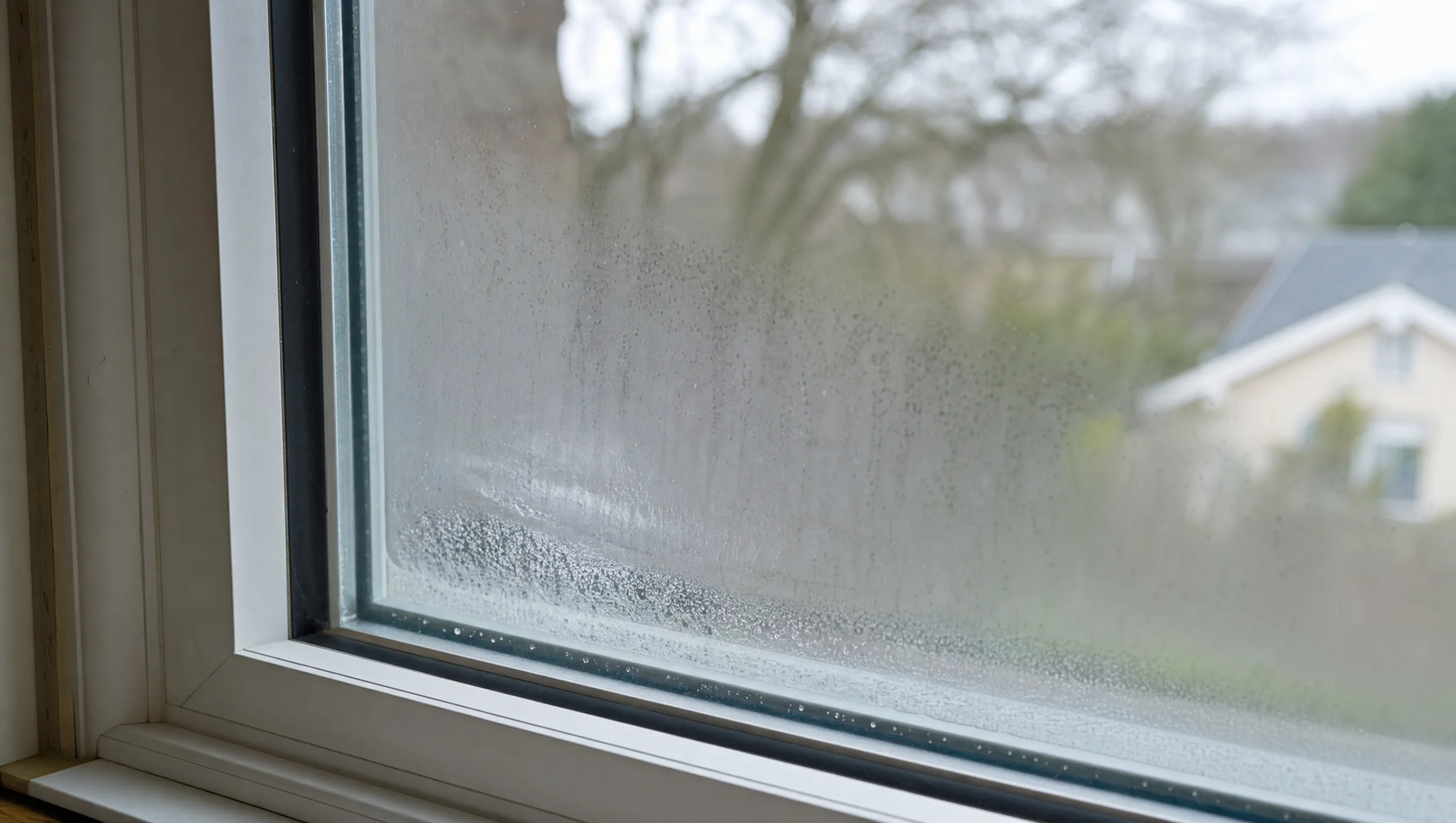
Persistent fog trapped between two panes of glass is the unmistakable sign of a failed window seal — and once it starts, it never clears on its own. In Quebec’s deep freeze-thaw climate, a broken seal also means you have quietly lost the insulating gas that was keeping your heating bill down. Here is how to confirm the diagnosis, understand what actually broke, and choose the most cost-effective fix in 2026.
Three Signs Your Seal Has Failed
A failed seal is one of the few window problems you can diagnose yourself with confidence, because the symptoms are visible and distinctive. The key is that the moisture sits between the panes, in a sealed cavity you cannot wipe or reach.
Watch the window over a few days and across temperature changes. Condensation that appears on the room-side surface on a cold morning and wipes away is normal indoor humidity, not a seal failure. Fog that lives inside the glass and shifts with the weather is the real thing.
- Permanent fog or haze between the panes that no amount of wiping clears
- A white, chalky, or rainbow-tinted residue etched onto the inner glass surface from repeated condensation cycles
- A noticeable cold spot or temperature difference between this window and its neighbours
- Fog that comes and goes with the weather — appearing on humid or cold mornings, fading by afternoon
What Actually Failed Inside the Glass
Modern windows are not single sheets of glass — they are insulated glass units, or IGUs. Two (or three) panes are separated by a spacer bar around the perimeter, and the cavity between them is filled with an inert, heavy gas, usually argon or sometimes krypton, that slows heat transfer far better than ordinary air.
That spacer is bonded to the glass with a sealant, and the whole assembly is what holds the gas in and keeps moisture out. Over years of expansion and contraction, the seal can fatigue and crack. When it does, the insulating gas leaks out and humid outdoor air seeps in to replace it.
Here is why it never clears : that humid air is now trapped. On a cold Quebec morning the inner glass drops below the dew point, the trapped moisture condenses into fog, and it has nowhere to escape. Cycle after cycle, minerals in the water etch a permanent haze onto the glass.
Quebec’s climate accelerates the whole process. Seals endure roughly 100 freeze-thaw cycles per year in the Montreal region, and that relentless expansion and contraction is exactly what fatigues the sealant. It is why local windows often fail sooner than the same units installed in milder climates.
How to Confirm It Before You Call Anyone
Before assuming the worst, rule out simpler explanations. Wipe the interior and exterior glass surfaces clean and dry. If the fog disappears, it was surface condensation or dirt, not a seal failure. If the haze remains untouched no matter how hard you scrub, it is between the panes.
A second quick test : shine a flashlight at an angle across the glass at night, or check the window in bright low-angle sun. A failed unit often shows a milky film, water droplets, or mineral streaking that catches the light from inside the sealed cavity.
Note which windows are affected and their orientation. Seal failures often cluster on the south and west elevations that take the most sun and thermal stress, and documenting the pattern helps your installer quote accurately.
Your Three Options
Once you have confirmed a failed seal, you have three realistic paths. The right one depends almost entirely on the condition of the frame, not the glass — if the frame and hardware are sound, you rarely need to replace the whole window.
- IGU (insulated glass unit) replacement — replace only the foggy sealed glass and keep your existing frame. The most common and cost-effective fix, typically $300–$700 per window in 2026 depending on size and glass spec
- Full window replacement — the better choice if the frame is also rotting, warped, drafty, or the hardware is failing, since a new IGU in a tired frame is money half-spent
- Live with it — not recommended; a failed unit loses 30–50% of its insulating value, drives up heating costs, and is flagged as a deficiency the moment you try to sell
The Real Cost of Ignoring It in Quebec
It is tempting to live with a foggy window, especially in a back bedroom. But the math works against you in our climate. A failed IGU has lost its argon fill and often has a compromised low-e performance, so its U-factor degrades sharply — the window now bleeds 30 to 50% more heat than it did when sealed.
Across a long Montreal heating season, that adds up. With Hydro-Québec electric heating, several failed units on a cold elevation can add a meaningful amount to your winter bills, and the discomfort of a persistent cold spot near the glass is impossible to ignore once you notice it.
There is also a resale cost. Home inspectors in Quebec routinely list failed thermos units as deficiencies on inspection reports, giving buyers a documented reason to negotiate the price down — usually by far more than the repair would have cost you.
Can You Prevent Seal Failure?
You cannot make a seal last forever, but you can avoid the things that shorten its life. The biggest controllable factor is heat. Dark exterior films, sun-trapping interior coverings tight against the glass, and reflective surfaces that bounce sunlight back onto the pane all raise temperatures and stress the seal.
Keep weep holes at the bottom of the frame clear so water drains instead of pooling against the spacer, and manage indoor humidity in winter so condensation does not constantly sit on the glass. Both protect the sealant over the long run.
Finally, quality at purchase matters most. A well-built triple-pane unit with a warm-edge spacer and a proper sealant system simply lasts longer in our freeze-thaw climate. When you do replace, choosing the right unit is the best prevention — see how triple glazing performs in our region.
- Keep frame weep holes clear so meltwater drains away from the seal
- Avoid pressing dark blinds or films tight against the glass, which trap heat
- Control winter indoor humidity to reduce constant condensation
- Choose units with warm-edge spacers and a quality sealant when replacing
Is It Covered Under Warranty?
Before paying for anything, dig out your original paperwork. Most quality vinyl windows from reputable manufacturers carry a 20-year warranty specifically on the IGU against seal failure — and seal fogging is exactly the defect that coverage is designed for.
Warranties do come with conditions. Coverage usually requires that the window was installed by a qualified, often RBQ-licensed contractor, and that you can show proof of purchase and original ownership. Glass-only warranties typically cover the replacement unit but may not cover the labour to install it, so read the fine print.
If you are unsure what your coverage includes, our guide on what to look for in a window warranty walks through the terms that matter most in Quebec.
Frequently Asked Questions
Can I clean the fog from inside a sealed window?
No. The fog sits inside a factory-sealed cavity between the panes that you cannot open or access without destroying the unit. If wiping both glass surfaces does not clear it, the moisture is trapped between the panes and the unit needs replacing.
How long does IGU replacement take?
The on-site work is usually under an hour per window once the new glass arrives. The longer part is fabrication — a custom-sized sealed unit typically takes one to three weeks to be manufactured to your exact dimensions.
Does a foggy window really affect home value?
Yes. Home inspectors in Quebec routinely flag failed insulated units as deficiencies, which gives buyers leverage to negotiate. The price reduction they ask for is almost always larger than the cost of simply replacing the glass.
Should I replace just the glass or the whole window?
Replace only the glass if the frame, sash, and hardware are still sound — it is far cheaper. Replace the whole window if the frame is rotted, warped, drafty, or the hardware is failing, because a new sealed unit in a worn frame is a poor investment.
Will a failed seal get worse over time?
Yes. Once humid air enters, every freeze-thaw cycle deposits more moisture and minerals, so the haze and etching steadily worsen. The insulating gas is already gone, so the energy penalty is immediate and does not recover.
Why do my windows fog up only in winter?
A failed seal shows fog most dramatically in winter because the inner glass drops below the dew point and the trapped humidity condenses. In summer the same unit may look almost clear, which is why people often misjudge how many windows are actually affected.