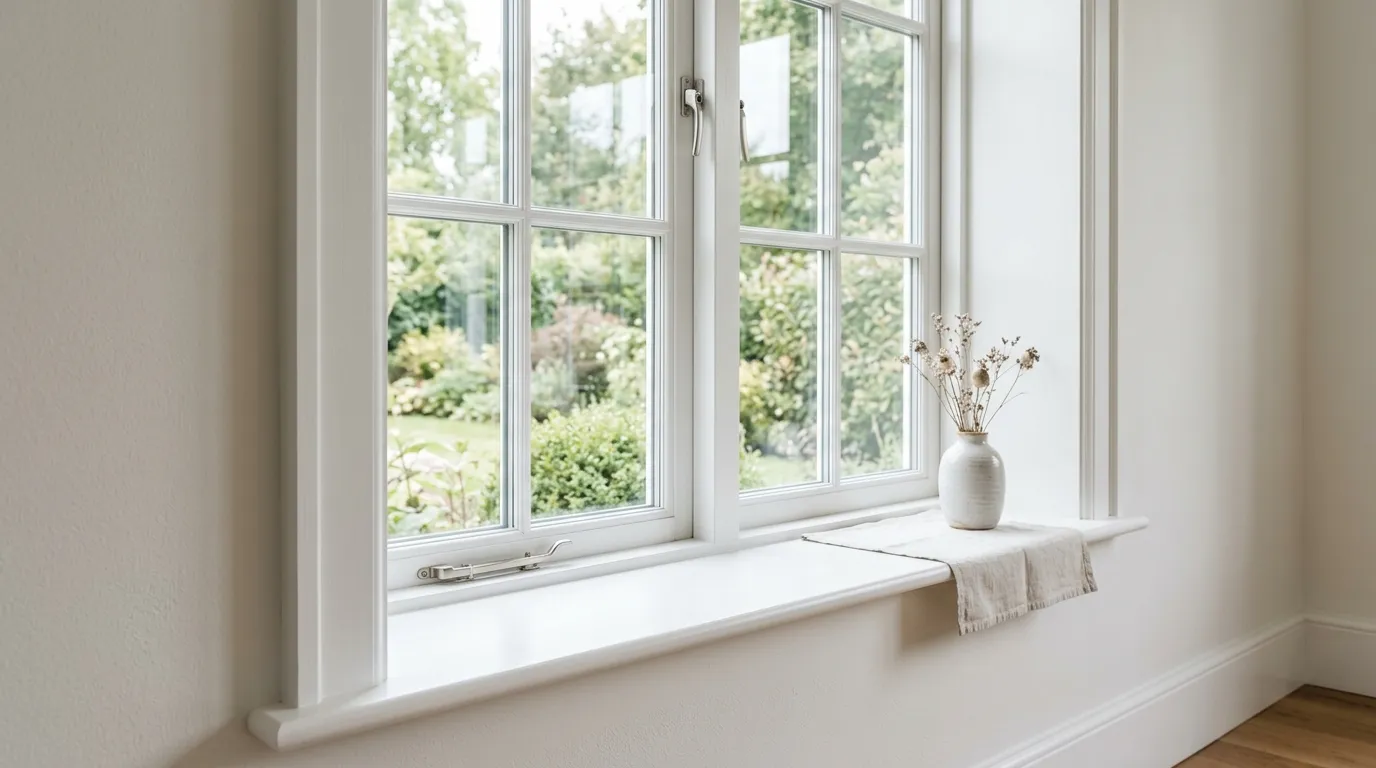
The window itself is only half of what you see from inside. The other half is the finishing: the jamb extension that bridges the frame to the wall, the casing that frames it, the sill or stool you set a plant on. It is the part of a replacement most homeowners never discuss until the installer asks 'what do you want us to do inside?' on the day. Here is what the options are, what they cost in Quebec, what suits a 1920s Plateau flat versus a 2010 Laval build, and who is responsible for which part.
What a Jamb Extension Is and Why Your Wall Needs One
A window frame is only as deep as the manufacturer makes it — typically 3¼ inches for a PVC or hybrid window. A wall is deeper: a 2×4 wall with drywall and sheathing is about 4½ inches, a 2×6 wall about 6½, and an old Montreal solid-brick wall with furring can be 8 inches or more. The jamb extension is the flat board that fills that gap on all four sides, running from the edge of the window frame to the face of the finished wall so the casing has something to land on.
Get the depth right and the finishing looks like it was always there; get it wrong and you see a step or a gap behind the casing. Quality manufacturers offer factory-applied extensions in standard depths that click or screw onto the frame, in PVC to match the window or in wood to be painted or stained. The installer measures wall depth at each opening before ordering, because it varies from room to room in most older homes and can vary within a single wall.
Factory extensions are priced per window by depth and material, and they save an hour of site carpentry each. Site-built extensions, ripped from primed board or MDF, are the fallback when the depth is unusual or when the interior finish will be stained wood matched to existing trim.
Casing Profiles: Colonial, Flat Modern, Craftsman and More
Casing is the trim that frames the window on the wall. Its profile sets the tone of the room more than most people expect, and the three families most of our Quebec clients choose from are colonial, flat modern and craftsman. Colonial casing has a stepped, curved profile, typically 2¼ to 3½ inches wide, and is what most Montreal-area homes built from the 1960s to the 2000s already have. It is inexpensive, available everywhere in primed finger-jointed pine and MDF, and mitred at the corners.
Flat modern casing is a plain board — usually 2½ to 4 inches wide, ¾ inch thick — with square or eased edges, mitred or butt-jointed. It suits contemporary and renovated spaces, works beautifully painted the same colour as the wall for a near-invisible look, and pairs with black window frames. Craftsman casing uses flat side pieces with a thicker, wider head piece (sometimes with a small cap moulding) and a stool with an apron below; it reads as substantial and handmade and suits 1910s to 1940s homes as well as new builds aiming for that character.
Beyond those three: Victorian and Queen Anne profiles with rosettes at the corners for pre-1910 homes in Westmount, Outremont or Old Longueuil; simple ranch or clamshell casing on mid-century bungalows; and backband casing, where a second moulding wraps the outer edge of a flat board for extra depth. Bring a photo or a short offcut of your existing trim to the consultation and the match can usually be sourced or milled.
- Colonial: stepped profile, mitred corners, 2¼ to 3½ in wide; the default in most 1960 to 2000s homes.
- Flat modern: square-edge board, 2½ to 4 in; paint-grade, pairs with black frames.
- Craftsman: flat legs, wider head, stool and apron; suits early-century homes and new builds with character.
- Victorian with rosettes: for pre-1910 homes; usually custom-milled to match.
Drywall Return vs Wood Trim: Two Different Looks
A drywall return, sometimes called a wrapped opening, does away with casing entirely. The drywall turns the corner into the opening and runs to the window frame, finished with a corner bead and a bead of paintable caulk where it meets the frame. The result is a clean, minimal opening with no trim to paint or dust, common in new condos and contemporary builds across the Montreal area.
It has trade-offs. A drywall return requires a precisely square, plumb opening; any wave in the framing shows in the corner bead. It does not tolerate movement well, so the caulk line at the frame will need touching up every few years as the house moves. And if you ever replace the window again, the drywall must be cut back and refinished, whereas a cased window just needs the casing removed. Many builders now use a drywall return on the head and sides with a wood or PVC stool at the bottom, which gives a shelf for plants and a durable edge where hands and objects land.
Wood or PVC casing, by contrast, covers the joint between wall and window, hides small irregularities in the opening and can be removed and reinstalled. It costs more in material and labour, adds a visual element to the room, and is the appropriate choice in any home where the other openings — doors, closets — are already cased.
Painted vs Stained: Choosing the Finish
Painted trim is the default in most Quebec homes today. It allows inexpensive materials — primed finger-jointed pine, MDF, PVC — and the colour can be changed with the room. White or off-white casing against a coloured wall is the classic look; casing painted the wall colour recedes; a dark casing against a light wall is a current trend that pairs with black or dark bronze window frames.
Stained trim shows the grain and reads as warmer and more traditional. It requires solid wood — clear pine, poplar for lighter tones, oak, maple or walnut for richer ones — and it must match, or deliberately contrast with, the existing stained trim, floors and doors. Matching an existing stain in a 1950s NDG home is a skill: the original may have darkened for seventy years, and a new board finished with the same can of stain will look wrong for a decade. A good finisher tones the new pieces to match the aged colour.
Material and labour costs follow the choice. Painted MDF colonial casing installed and finished is the economical option in the Montreal area. Stained solid oak craftsman casing with a stool and apron, installed and finished, costs considerably more per window, largely because of the finishing time.
PVC, MDF or Wood: Which Material Where
MDF is the most common casing material in Quebec because it is smooth, stable, cheap and comes pre-primed. Its weakness is water: an MDF stool under a window that condenses in January swells at the edges and never recovers, and once the paint film cracks, moisture wicks in. It is fine for casing on the head and sides of a window in a living room or bedroom; it is a poor choice for the stool, and a bad choice anywhere in a bathroom, kitchen or laundry room.
PVC — either cellular PVC boards or extruded PVC casing matched to the window — is immune to water. It is the right material for stools, for bathrooms and basements, and for any home where condensation on windows has been an issue. It costs more than MDF, is slightly harder to work, and cannot be stained, but painted PVC looks identical to painted wood and stays that way. Many manufacturers, including our own lines, offer PVC jamb extensions and casing in the window's colour, which eliminates painting altogether.
Solid wood is the choice for stained finishes and for period-correct restorations. Finger-jointed primed pine is a good paint-grade wood for casing in dry rooms; poplar and clear pine take stain in lighter tones; oak, maple and walnut suit traditional homes. Wood moves with humidity, so in a home without central humidification, expect small gaps at mitres to open in winter and close in summer.
- Living rooms and bedrooms: MDF or wood casing, PVC or wood stool.
- Kitchens, bathrooms, laundry: PVC casing and stool, or a drywall return with a PVC stool.
- Basements: PVC throughout; concrete walls and window wells keep humidity high.
- Stained period trim: solid wood, toned to match existing finishes.
Matching Existing Trim in Older Montreal Homes
Plateau triplexes, NDG semis, Verdun duplexes and Ahuntsic bungalows each have a trim vocabulary, and a new window that arrives with generic colonial casing beside four original openings with 4-inch fluted Victorian casing looks like a repair rather than an improvement. The first question is whether the existing trim can be saved. A careful installer can remove original casing with a flat bar and a putty knife, set it aside, and reinstall it after the new window and jamb extension are in; a few pieces may crack and can be replaced with matching stock.
When the original trim is too damaged or the new window depth changes the geometry, the profile can be reproduced. Several Montreal millwork shops keep knives for common heritage profiles and can grind a custom knife from a sample for a one-time charge, after which the casing is milled at a per-foot price. Rosettes and plinth blocks for Victorian openings are available from specialty suppliers. Budget more time than money: custom millwork adds two to four weeks to the schedule.
Old plaster walls add another wrinkle. Plaster over wood lath is thicker and less uniform than drywall, so jamb extensions must be scribed to the wall rather than cut square, and the casing may need to be back-bevelled so it sits flat. This is skilled work and the reason a replacement in a 1915 building costs more to finish inside than the same window in a 2005 house.
Who Does What During Installation
Responsibilities vary between companies, and it is the number-one source of misunderstanding on installation day. In a typical Quebec window replacement, the installer removes the old window and interior trim, installs and insulates the new window, applies the exterior finishing (capping or brickmould and sealant), and installs the jamb extension and interior casing when they are included in the contract. What is not usually included: drywall repair beyond minor patching, painting or staining the new trim, and reinstalling window coverings.
Read the quote for the words 'interior finishing' and what follows them. 'Supply and install PVC jamb extensions and casing' means the opening will be trimmed and ready for paint. 'Interior finishing by others' means the installer leaves a foamed, insulated window in a raw opening, which is the correct choice when a general contractor or a finish carpenter is handling the room anyway, but a surprise if nobody is. If your old trim is to be saved and reinstalled, that should be written down too, along with the understanding that fragile pieces may not survive removal.
For drywall returns, the sequence is different: the installer sets the window and insulates the gap, and a drywall contractor returns later to wrap the opening, bead, tape and mud it, followed by the painter. Coordinate the three trades ahead of time so the window does not sit unfinished for weeks. Our page on window installation walks through what happens on the day, including the interior steps.
Frequently Asked Questions
Do I need jamb extensions on every window?
Almost always, yes. The window frame is shallower than the wall, and the extension bridges the difference so the casing or drywall return has a flat surface to meet. The only exception is a wall whose depth matches the frame exactly, which is rare.
Can my old casing be reused with new windows?
Often. A careful installer can remove original trim intact and reinstall it once the new window and jamb extension are in. Some pieces may crack, and if the new frame depth changes the geometry, the profile may need to be milled to match. Ask for this in writing.
What is the cheapest interior finish for new windows?
A drywall return with no casing or a painted MDF colonial casing are the least expensive options, installed and finished, in the Montreal area. Factory PVC extensions and casing in the window's colour cost a little more but need no painting.
Is MDF trim okay in a bathroom?
Not recommended. MDF swells when it gets wet and does not recover, and bathroom windows see condensation for months a year. Use PVC casing and stool, or a drywall return with a PVC stool, in bathrooms, kitchens, laundry rooms and basements.
Does the window installer paint the trim?
Usually not. Most window contracts cover installing the jamb extension and casing but leave painting or staining to the homeowner or a painter. Factory PVC trim in the window's colour is the way to avoid painting altogether.
Which casing style suits a modern renovation?
Flat square-edge casing, 2½ to 4 inches wide, painted the wall colour or a contrasting dark tone, or a drywall return with a PVC stool. Both pair well with black or dark bronze window frames.