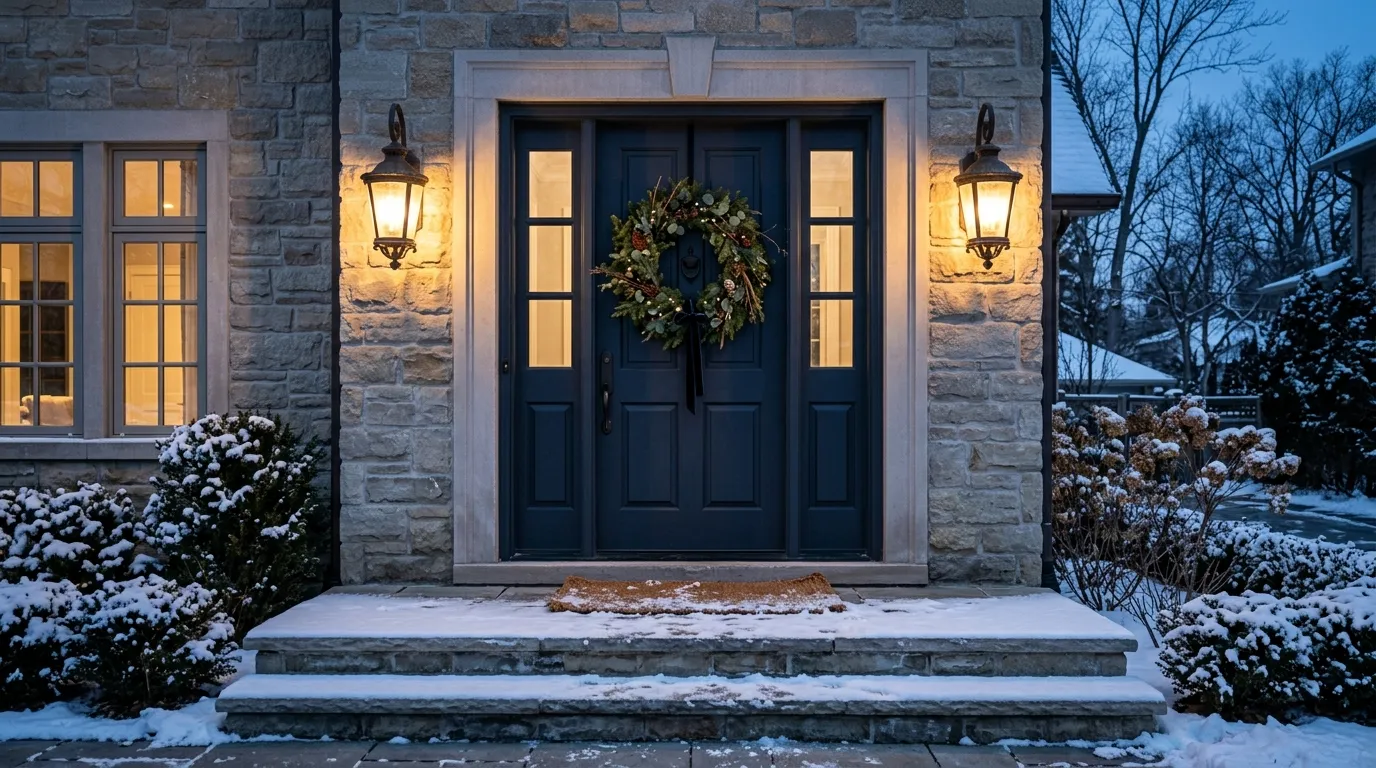
Your front door is opened more often than any window in the house, and it takes the full force of every storm, freeze and thaw. Most of its problems show up gradually and are easy to ignore in September, until the first cold snap turns a small gap into a frosted lock and a draft you can feel from the couch. Here are eight signs to check now, which ones a simple adjustment will fix and which ones tell you the door has reached the end of its life.
How to Inspect Your Door in Ten Minutes
The best time to check an entry door is a cool evening, when the difference between indoor and outdoor temperatures is large enough to make leaks obvious. Turn off the lights in the entrance, close the door and look around its whole perimeter. If there is daylight or porch light visible anywhere, outside air is getting in there too.
Bring a flashlight, a screwdriver and a sheet of paper. Close the door on the paper at several points along the latch side, hinge side and top; if the sheet slides out with no resistance, the seal is not making contact there. Then open and close the door slowly a few times, listening and feeling for rubbing, scraping or a latch that needs a shove.
Finally, go outside and look at the bottom of the door and frame, the sill and the hardware. Most of the eight signs below can be spotted in those ten minutes, and catching them in September leaves time to act before the ground freezes and the snow piles up against the threshold. Write down what you find at each point so you can compare next year or show an advisor.
Signs 1 and 2: Light Around the Slab and Frost on the Lock Side
Sign 1: light around the door slab. A thin line of light at the top corner on the latch side is the most common finding. It usually means the door has sagged slightly on its hinges or the frame has shifted, so the slab no longer sits evenly against the seal. If the gap is even and small, adjusting the hinges or the strike plate often closes it. If light shows along a long stretch or the gap is wider at one end than the other, the door or frame is out of square.
Sign 2: frost on the lock side. In a Quebec winter, a band of frost or ice building up on the interior face of the door near the lock and deadbolt is a classic symptom. Warm, humid indoor air meets a cold spot where outside air is leaking past the seal or where the metal lock hardware conducts cold straight through the door. A little frost on the hardware during a deep cold spell is common on older steel doors; a thick band on the slab edge or frame means air is flowing through.
Both signs start as nuisance drafts and turn into bigger problems. Frost that melts every afternoon wets the frame, and the lock mechanism can freeze solid, leaving you with a key that will not turn on a February morning. Deal with the cause in the fall and neither problem has time to develop.
Signs 3 and 4: Sticking in the Cold and a Warped Steel Skin
Sign 3: the door sticks when it gets cold. A door that closes easily in July but has to be pushed or pulled hard in November is reacting to temperature. Wood frames and wood-core doors swell and shrink with humidity, and a steel or fibreglass slab exposed to a large temperature difference between its two faces can bow slightly. Sticking on the latch side at the top corner is often a hinge or sag problem that can be adjusted; sticking that changes from week to week points to movement in the materials themselves.
Sign 4: the steel skin is warped, dented or rusting. Insulated steel doors are durable, but their skin can bow outward after years of sun exposure, especially on dark-coloured doors facing south or west. You can see it by sighting along the face of the door or by holding a straight edge against it. A bowed slab no longer presses evenly on its weatherstripping, so no adjustment will fully seal it. Rust along the bottom edge or around the glass insert means water has been getting under the paint, and the foam core behind it may be damp.
Minor dents are cosmetic. A skin that has separated from the core, bubbled or rusted through, or a slab that no longer sits flat in its frame, is a replacement sign. A modern slab hung on a stable composite frame will stay flat far longer.
Signs 5 and 6: Rotten Frame Bottoms and Loose Hinges
Sign 5: soft or rotten wood at the bottom of the frame. The lower ends of the jambs, where they meet the sill, sit in the path of melting snow, rain and de-icing salt year after year. Push a screwdriver into the wood a few centimetres above the sill on both sides. If it sinks in easily, the wood is rotting, often from the inside out where you cannot see it. Paint that keeps peeling in the same spot or dark staining are early warnings.
Small areas of rot can sometimes be cut out and repaired with epoxy filler, but rot that reaches into the jamb or the subfloor below the sill is a structural problem. At that point, a new pre-hung door with a composite or PVC-clad frame that cannot rot is usually the durable answer. Replacing only the slab on a rotting frame simply moves the problem to the next winter.
Sign 6: loose or worn hinges. Open the door halfway and lift the handle gently. If the slab moves up and down or the hinge screws wiggle, the hinges have loosened. Replacing short hinge screws with longer ones that reach the wall framing often solves both sagging and the light gap at the top corner. Hinges that are bent, worn at the knuckle or pulling out of stripped wood need more than a screwdriver.
Signs 7 and 8: Sill Leaks and Stiff Hardware
Sign 7: water or cold air at the sill. Look for water stains on the floor inside the door after rain, swollen flooring at the threshold or a sill that feels loose underfoot. The sill has to shed water outward and seal against the bottom of the door at the same time. An adjustable threshold can often be raised with its screws to meet the door again. A cracked sill, a sill sloping toward the house or signs of water in the subfloor mean the whole unit needs attention.
Sign 8: hardware that is stiff, loose or hard to lock. A handle that wobbles, a deadbolt that only turns if you push or pull the door, or a key that catches in the cylinder are all signs of misalignment or wear. Often the strike plate has simply moved out of line with the bolt as the door sagged, and adjusting it restores smooth locking. Cold makes all of these problems worse, because lubricants thicken and metal parts contract.
Lubricate the lock cylinder with a dry graphite or Teflon-based product, not oil, which gums up in the cold. Tighten handle screws and check that the deadbolt slides fully into the strike without effort. If the lock still binds after lubrication and alignment, the cylinder itself may be worn and need replacement.
Adjustment or Replacement? How to Tell
Many front door problems are adjustments, and a homeowner can handle several of them in an afternoon. The key question is whether the door and frame are still straight, solid and dry. If they are, alignment and hardware work will usually get you through another winter comfortably.
If the slab is warped, the frame is rotting or several signs show up at once, adjustments turn into a yearly battle. A new insulated entry door, installed square with a proper sill and seals, solves the whole list at once rather than one symptom at a time. The list below sums up how we usually classify each sign.
- Usually an adjustment: small even light gap, sagging from loose hinge screws, strike plate out of line, adjustable threshold too low, stiff lock that needs lubricant.
- Could go either way: frost on the lock side, sticking only in the coldest weeks, small localized rot that can be repaired.
- Usually a replacement: warped or bowed steel skin, rust-through or delamination, rot reaching into the jamb or subfloor, cracked sill, frame out of square, several signs at once.
Ordering Before the Deep Cold
Entry doors are made to measure, and Unisson builds each one in our Saint-Laurent factory to fit the exact opening. That means the order has to be placed before the door can be delivered and installed, and in Quebec the fall is the busiest time of year for entry doors. Homeowners who check their door in September and decide early get the widest choice of installation dates before the deep cold sets in.
Doors can be installed in winter, and our crews do it routinely, working quickly so the house is open to the cold for as little time as possible. Still, a door installed in October means you go into winter already sealed, rather than living with frost on the lock until the new door arrives. You can browse styles, glass and colours in our exterior doors collection.
The cost of a new entry door depends on your project, the size, glass, hardware and whether the frame needs to be replaced as well. To get an exact figure, request a free estimate: a Unisson advisor will check the eight signs with you on site and tell you honestly whether an adjustment or a new door is the right call. The visit comes with no obligation.
Frequently Asked Questions
Why is there frost on the inside of my front door near the lock?
Warm, humid indoor air is meeting a cold spot, either where outside air leaks past the seal or where metal lock hardware conducts cold through the door. Light frost in a deep cold spell is common on older steel doors; a thick band on the edge means air is leaking through.
My door sticks only in winter. Does it need to be replaced?
Not necessarily. Seasonal sticking is often caused by sagging hinges or a strike plate out of line, which can be adjusted. If the sticking changes week to week or the slab is visibly warped, replacement is more likely.
Can a warped steel door be fixed?
Generally no. A bowed steel skin no longer presses evenly on its seals, and no adjustment will fully correct it. Replacing the slab or the complete pre-hung door is the usual solution.
How do I know if the bottom of my door frame is rotten?
Push a screwdriver into the wood a few centimetres above the sill. If it sinks in easily, the wood is rotting. Peeling paint and dark stains in the same spot are early signs.
Can a front door be installed in winter in Quebec?
Yes. Crews install entry doors year-round and work quickly to limit how long the house is open. Ordering in early fall simply gives you more choice of installation dates before the deep cold.
How much does a new front door cost?
The exact figure depends on your project, the size, glass, hardware and whether the frame is replaced. Request a free estimate for a precise quote from a Unisson advisor.