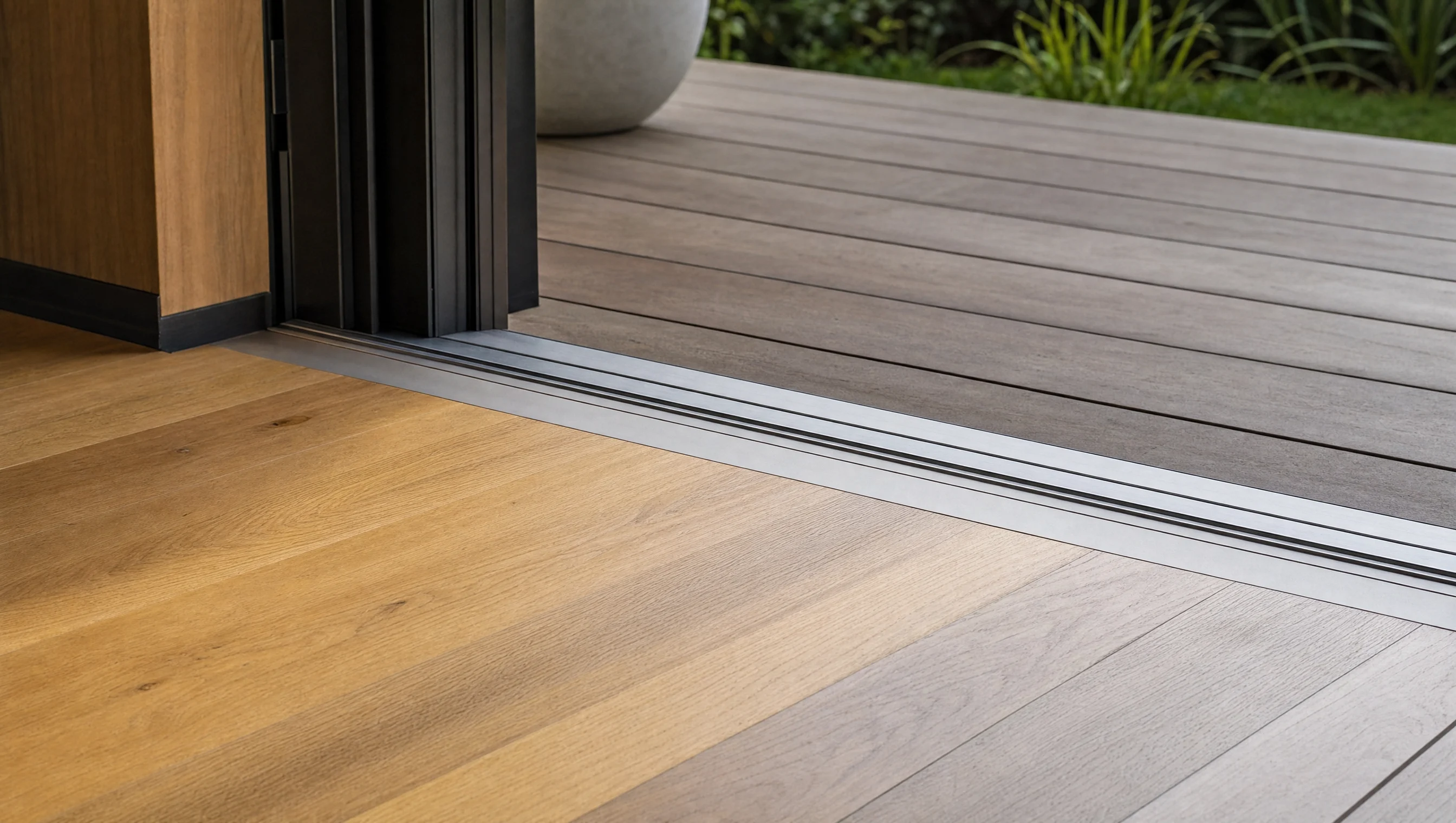
The threshold is the narrow strip at the bottom of every patio door, easy to overlook until it becomes a problem. Yet this small component quietly decides three big things: whether rain and snowmelt stay outside, whether a wheelchair or walker can roll through smoothly, and how much heated air leaks out across a Quebec winter. Choosing the right one is one of the most consequential details in any patio door project.
Why the Threshold Punches Above Its Weight
Most homeowners spend their decision energy on glass, frame colour, and hardware, then accept whatever threshold comes standard. That is a mistake in our climate. The threshold is the single point where the door meets the floor, the deck, and the weather all at once, which makes it the most demanding junction in the entire opening.
In Quebec, the threshold has to manage extremes that milder climates never see: wind-driven rain in the shoulder seasons, snow piling against the door, ice forming in the track, and a 50-degree swing between a January night and a July afternoon. A threshold that performs beautifully in Vancouver can leak air, trap meltwater, or heave with frost here. That is why this choice deserves real attention before you sign a quote.
Three Common Threshold Types
Patio door thresholds fall into three families, and each trades one priority for another. There is no universally “best” option — the right pick depends on whether you weight water resistance, accessibility, or a flush modern look most heavily.
- Standard threshold — raised 25–38 mm with a built-in weatherstrip, offering the best water resistance and the tightest air seal, ideal for most Quebec retrofits
- ADA / accessible threshold — raised a maximum of 13 mm so a wheelchair, walker, or stroller can roll across, essential for aging-in-place and barrier-free homes
- Recessed (flush) threshold — sits flat between the interior floor and the exterior deck for a seamless, modern transition, but demands careful exterior drainage
Threshold Impact on Energy and Air Sealing
On any patio door, the threshold is the part most prone to air leakage because it must accommodate the sliding or swinging action of the panel while still sealing tight. A standard raised threshold has the easiest job: its height lets it carry a deep, continuous weatherstrip that the door compresses firmly when closed, which is why it consistently posts the best air-tightness numbers.
Lower-profile ADA thresholds make the job harder. With only 13 mm of height to work with, they cannot use a tall weatherstrip, so they rely on precise installation and high-quality compression seals to stay tight. Done well by an experienced installer, the energy penalty is modest; done carelessly, an accessible threshold can become a noticeable cold-air path in February.
Recessed thresholds sit lowest of all and depend almost entirely on engineered drainage channels and multiple seal lines to keep weather out. When specified and installed correctly they perform well, but they leave the least margin for sloppy workmanship — another reason to insist on an RBQ-licensed installer who has done them before in our climate.
Water and Weather Control in Quebec
Water management is where thresholds earn their keep, and Quebec stresses them in ways few regions do. A standard raised threshold acts like a low dam, keeping rain runoff and melting snow on the exterior side where it belongs. For a door that opens onto an exposed deck or faces prevailing weather, this height is a genuine advantage.
Recessed and flush thresholds remove that dam, so the surrounding hardscape has to do the work instead. The deck or patio surface must be sloped to drain water away from the door, and an engineered channel or trough at the threshold is essential to capture what does reach it. Skipping this planning is the fastest way to get water under the door during a spring thaw.
Then there is the uniquely Quebec problem of ice. Snow that drifts against a low threshold can melt against the heated interior, refreeze overnight, and form an ice dam right at the sill. A protective overhang, regular snow clearing, and proper exterior drainage all help, but for heavily exposed entries a standard threshold simply gives you more forgiveness through a hard winter.
When to Choose Each Threshold
The decision usually comes down to who uses the door and where it sits. Match the threshold to the real-world situation rather than to a single priority, and you will rarely regret it.
- Aging-in-place or wheelchair households — an ADA threshold removes the trip hazard and keeps the home accessible as needs change
- New builds with proper drainage planning — a recessed threshold delivers the clean, flush look while the slope and channels are engineered in from day one
- Most retrofits and replacements — a standard threshold is the safe, weather-tight default that works on existing decks without rebuilding the surface
- Exposed or weather-facing doors — lean toward a standard raised threshold for the extra water and ice protection
Planning for Accessibility Down the Road
Accessibility is not only about wheelchairs today — it is about the home working for you in twenty years, for visiting parents, for a stroller, or after a temporary injury. With Quebec’s aging population, more homeowners are choosing barrier-free thresholds proactively rather than retrofitting under pressure later, and it is far cheaper to build it in at installation than to modify afterward.
If you love the seamless look but worry about Quebec weather, a low-profile threshold paired with a covered or recessed entry, a quality compression seal, and an exterior drain channel is a strong compromise. An experienced installer can also add a sloped exterior sill pan that drains water away while keeping the interior transition nearly flush.
The key is to discuss your long-term plans before ordering, because the threshold type influences the rough opening, the sill detailing, and the drainage approach. To weigh the options for your specific door and exposure, see our patio doors page for the full range.
Get the Right Threshold for Your Home
The smartest move is to decide on the threshold at the same time you choose the door, not after, so the rough opening and drainage are detailed correctly from the start. A good installer will look at your floor height, deck slope, exposure, and who uses the door before recommending a type.
Unisson manufactures patio doors locally in Saint-Laurent and our team installs every threshold type to suit Quebec conditions. Request a free estimation and we will assess your opening and recommend the threshold that balances accessibility, water control, and winter comfort for your home.
Frequently Asked Questions
Can ADA thresholds work in Quebec winters?
Yes — with the right compression seal and an exterior drain channel, an accessible 13 mm threshold performs well even in our climate. The key is professional installation, since the low profile leaves less room for error in both air sealing and water management.
Are recessed thresholds more expensive?
Yes, typically 10 to 20 percent more than a standard threshold, mostly because of the additional drainage planning, engineered channels, and the more demanding installation. The seamless flush look and the accessibility benefit are what justify the premium for many homeowners.
Can I add a threshold ramp to an existing door?
Yes — aftermarket aluminum threshold ramps are an effective short-term solution for wheelchair or walker access without replacing the door. For a permanent, weather-tight result, though, a purpose-built accessible threshold installed with the door is the better long-term choice.
Which threshold is best for water resistance?
The standard raised threshold wins on water resistance because its 25 to 38 mm height acts as a barrier against rain runoff and snowmelt. For exposed entries that face prevailing weather in Quebec, it offers the most forgiveness against leaks and ice.
Will a flush threshold leak more air than a standard one?
It can if it is poorly installed, because it relies on engineered seals and drainage rather than a tall weatherstrip. Specified and fitted correctly by an experienced installer with quality compression seals, a recessed threshold performs well, but it leaves less margin for error than a standard one.
Do thresholds affect rebate eligibility?
The threshold type itself does not determine eligibility — what matters for programs like Rénoclimat is that the patio door is ENERGY STAR certified for Zone D and installed by an RBQ-licensed contractor. Choosing a well-sealed threshold simply helps the door deliver the efficiency the rebate rewards.