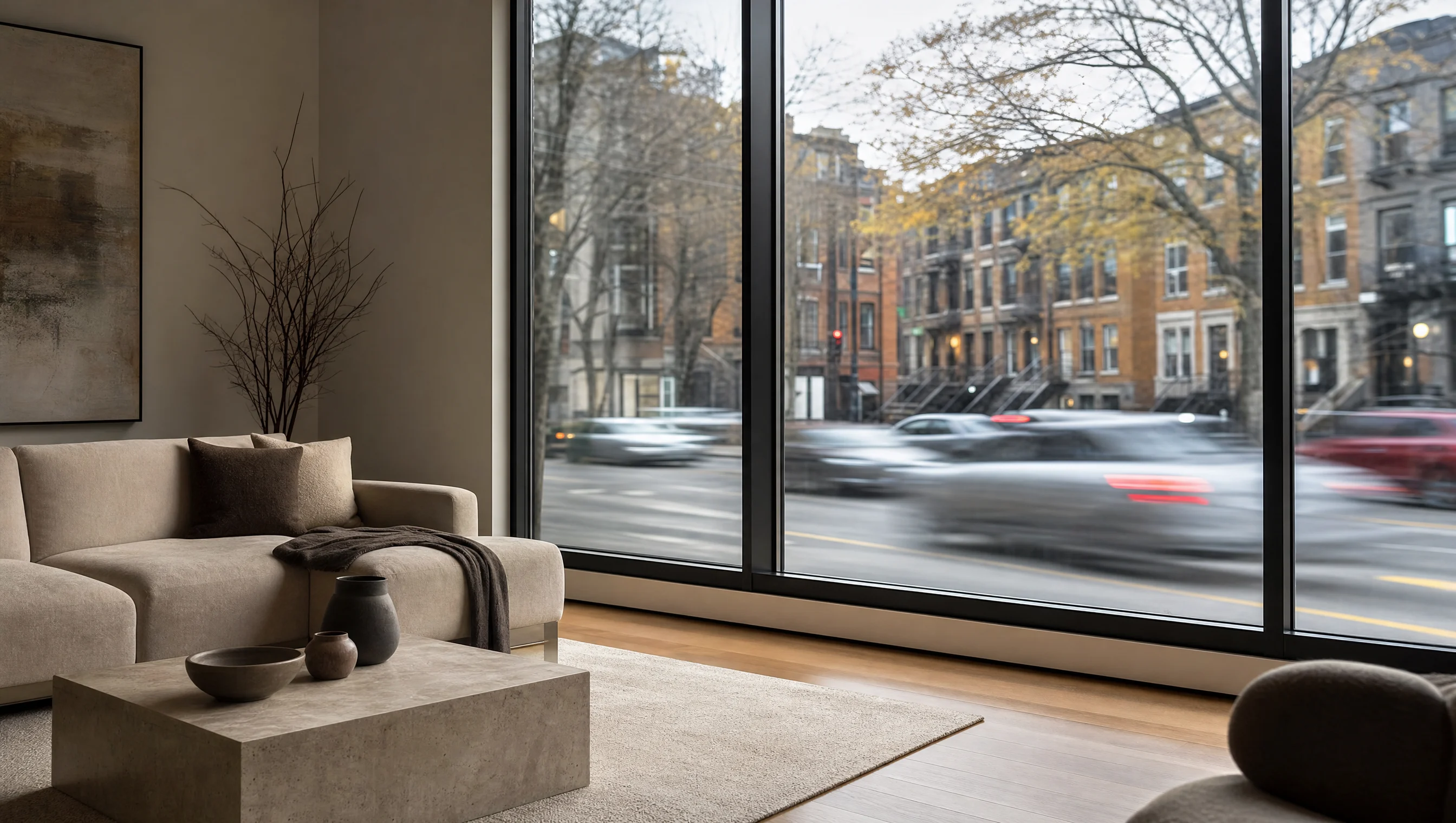
Traffic on Sherbrooke, the 3 a.m. rumble of a snow-removal convoy, the constant hum of the Metropolitan — living in Montreal means living with sound. The good news is that the window is the single weakest acoustic link in most homes, which also makes it the place where the right upgrade delivers the biggest, most noticeable improvement.
Understanding STC Ratings
Sound Transmission Class (STC) is the standard North American measure of how much airborne noise an assembly blocks across a range of frequencies. Every additional point on the scale represents roughly one decibel of reduction, and because human hearing is logarithmic, a 10-point STC gain is perceived as cutting the loudness of a noise roughly in half.
A typical builder-grade double-pane window rates STC 26 to 28 — about the same as a hollow interior door. Well-engineered acoustic windows reach STC 38 to 45, which translates to a perceived noise reduction of 60 to 75 %. In practical terms, that is the difference between hearing every bus brake and hearing a muffled background murmur you stop noticing within a week.
STC alone does not tell the whole story for city living. It is weighted toward speech frequencies and underrates the low-frequency rumble of trucks, buses, and aircraft. For those sources, look for an OITC (Outdoor-Indoor Transmission Class) figure as well; an OITC of 30 or higher is a strong result for a Montreal facade exposed to heavy traffic.
Where the Noise Actually Gets In
Before spending money on exotic glass, it helps to understand that sound behaves like water: it finds the easiest path. A single 3 mm gap around a sash can leak more noise than the entire glazed surface combined, which is why a perfectly sealed mid-grade window often outperforms a premium window installed sloppily.
In older triplexes across Rosemont, Verdun, and Villeray, the worst offenders are usually worn weatherstripping, shrunken caulking, and aluminum frames that transmit vibration directly through the wall. Addressing the perimeter is the highest-value first step in any noise project, and it is the part homeowners most often skip.
- Perimeter air gaps and failed caulking — the number-one leak in older Montreal housing stock
- Compressed or brittle weatherstripping that no longer presses against the sash
- Thin, single-thickness glass that resonates at traffic frequencies
- Operable styles with loose closures — sliders and old single-hung sashes seal poorly
- Rigid frame materials that conduct structure-borne vibration into the room
What Actually Works
Once the perimeter is airtight, the glazing package does the heavy lifting. The most effective acoustic strategies all aim at one thing: interrupting the path a sound wave takes as it tries to vibrate through the glass and into your living room.
- Laminated glass — a thin PVB or acoustic vinyl interlayer bonded between two panes turns the glass into a damper, killing vibration; this is the single biggest upgrade you can make
- Mismatched pane thickness (e.g. 4 mm paired with 6 mm) — the two panes resonate at different frequencies, so neither lets sound through cleanly
- Wider air or gas gaps (16 to 20 mm) — the larger cavity decouples the panes and outperforms the tight 10 to 12 mm gaps used in standard sealed units
- Argon or krypton gas fill — denser than air, it slows wave transmission while also boosting the U-factor for our winters
- Tight, continuous perimeter seals — a casement or awning that compresses against a full weatherstrip beats any slider on both noise and heat
Why Window Style Matters as Much as Glass
The operating mechanism determines how tightly a window can close, and that closure is what stops both drafts and decibels. Casement and awning windows use a crank and multi-point hardware to pull the sash hard against a continuous gasket, creating a compression seal that sliders and single-hung windows simply cannot match.
Sliding and double-hung windows rely on the sash brushing past a track or jamb, which always leaves a friction-fit path for air and sound. If acoustic comfort is a priority — a bedroom facing De Maisonneuve, a home office over a bus route — specifying a casement or awning frame is often worth more than upgrading the glass thickness.
For a fixed pane where ventilation is not needed, a quality picture window with laminated glass is the quietest option of all, since there is no operable joint to leak through. Many homeowners pair a fixed acoustic picture unit with a small operable awning for fresh air without sacrificing the bedroom’s overall sound rating.
Match the Solution to Your Noise Source
Not all city noise is the same, and the most cost-effective upgrade depends on what is actually outside your wall. High-frequency sounds — squealing brakes, car alarms, voices — are blocked well by laminated glass and tight seals, so a standard acoustic package solves most residential streets.
Low-frequency rumble is the harder problem. The drone of the Metropolitan, idling delivery trucks on a commercial strip, or aircraft on approach to Trudeau all sit in the bass range, where you need the combination of a laminated pane, a clearly mismatched second pane, and the widest gas-filled cavity available to make a real dent.
If your noise is intermittent but extreme — a fire station, a club district, a rail line — it is worth treating the whole opening, not just the glass. Upgrading to a compression-seal casement, adding interior sealing at the trim, and confirming the wall around the window is insulated together yield more than any single glazing change.
- Traffic and voices (high frequency) — laminated glass plus tight seals; the most common and most affordable fix
- Highway and truck rumble (low frequency) — laminated plus mismatched panes plus a wide argon gap
- Aircraft and rail — treat the full opening: casement frame, trim sealing, and wall insulation together
- Intermittent extremes (sirens, nightlife) — prioritize bedrooms first, where quiet matters most
Best Picks for Montreal Apartments
Casement and awning windows with a laminated outer pane deliver the best real-world performance in noisy boroughs like the Plateau, Mile End, and the corridors around De Maisonneuve and the Metropolitan. Specifying an asymmetric glazing package — laminated 6 mm outside, 4 mm inside, with a wide argon-filled gap — reliably pushes a residential unit into the STC 38 to 42 range.
For a typical Montreal bedroom, budget on roughly a 25 to 40 % premium over a standard double-pane window in the same style and size. Because the upgraded units are still ENERGY STAR Zone D certified, they qualify for the same Rénoclimat support of up to $150 per rough opening, and they stack toward the Canada Greener Homes Initiative’s grants of up to $5,000.
If you would like a room-by-room acoustic assessment for your home, request a free estimation with our team. We manufacture our windows locally in Saint-Laurent and can build a custom laminated glazing package matched to the exact noise source outside your wall.
Frequently Asked Questions
Do triple-pane windows reduce noise?
Modestly. The extra pane adds mass, but three equal-thickness panes can actually resonate together at certain frequencies. Mismatched pane thickness and a laminated outer pane do far more for noise than simply adding a third sheet of glass.
What about secondary glazing inserts?
Interior acoustic inserts are effective and reversible, which suits heritage buildings where you cannot replace the original window. The trade-off is reduced daylight, an extra surface to clean, and a busier sightline; for most homeowners, a full replacement is the better long-term investment.
How much do acoustic windows cost in Quebec?
Expect roughly 25 to 40 % more than a standard double-pane window of the same style and size in 2026. The laminated glass and wider gas-filled cavity are the main cost drivers, but both also improve thermal performance.
Which is quieter, a casement or a slider?
A casement, clearly. Its crank-and-lock hardware compresses the sash against a continuous gasket, while a slider leaves a friction-fit gap that leaks both air and sound. For a bedroom facing traffic, the style choice often matters more than the glass.
Will soundproof windows also save on heating?
Yes. The same features that block sound — laminated glass, wider argon-filled gaps, tight compression seals — also lower the U-factor and reduce heat loss, so an acoustic upgrade pays back partly through your Hydro-Québec bill.
Can I make my existing windows quieter without replacing them?
Up to a point. Replacing worn weatherstripping, re-caulking the perimeter, and sealing the trim can recover several decibels for very little cost. If the glass itself is single-thickness or the frame is old aluminum, however, replacement is the only way to reach acoustic-window performance.