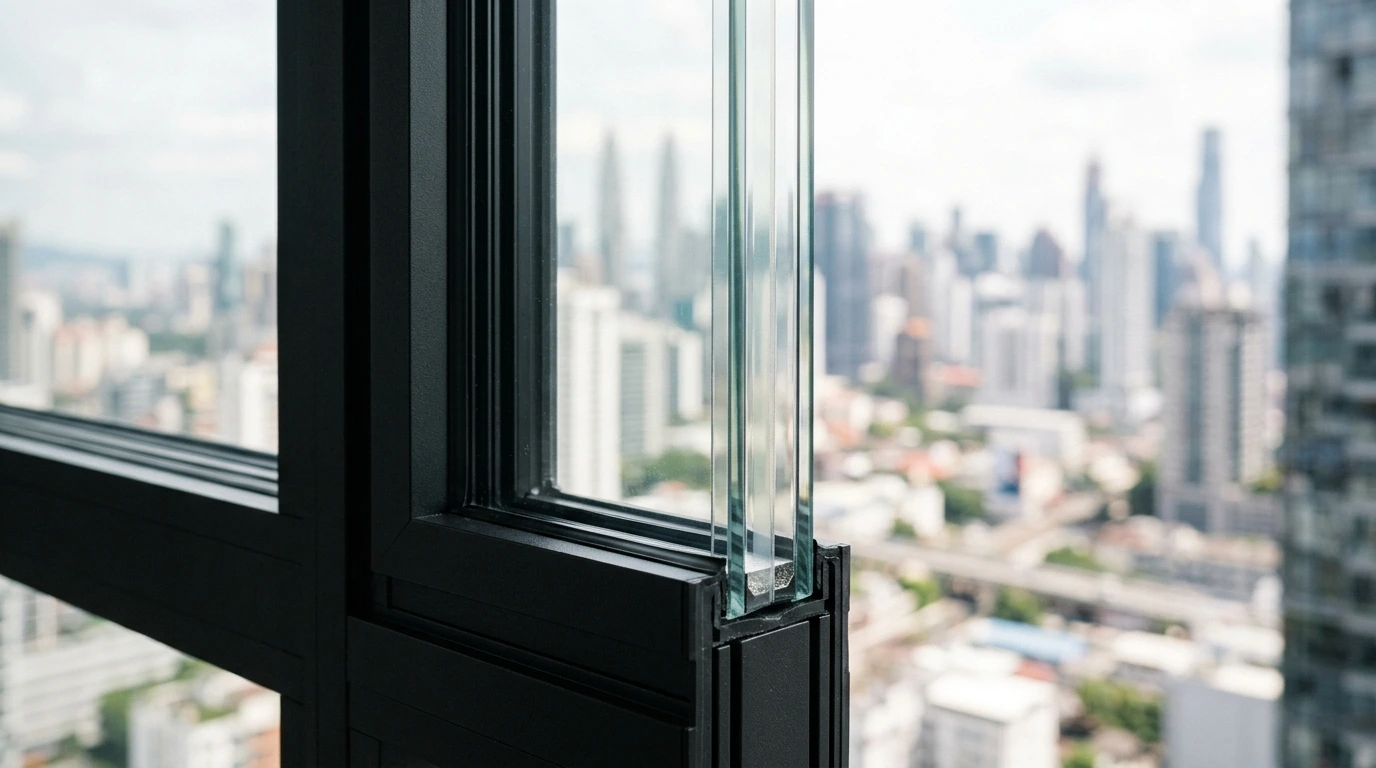
Tempered vs laminated glass is a question that comes up as soon as you look at a patio door, a glass entry door or a window facing a busy street. Both are called safety glass, but they are made differently, break differently and solve different problems. Tempered glass is about avoiding injury, while laminated glass adds noise control and resistance to break-ins. This guide explains how each one works, where each is usually used and how to choose the right glass for each opening in your home.
How Tempered and Laminated Glass Are Made
Tempered glass starts as an ordinary pane that is cut to its final size, heated until it softens and then cooled very quickly with jets of air. This process leaves the surfaces in compression and the core in tension, which makes the glass much stronger than ordinary glass against impacts and temperature differences. Because of that internal tension, tempered glass cannot be cut or drilled afterward, so every pane is made to measure.
Laminated glass is a sandwich. Two or more panes are bonded together with a clear plastic interlayer under heat and pressure, so they behave as a single sheet. The glass itself is not necessarily stronger, but the interlayer holds everything together when the glass breaks.
In a modern window or door, either type can be part of a sealed insulated unit. A unit may combine a laminated pane on one side and a tempered pane on the other, along with low-emissivity coatings and argon, so in most cases you do not have to give up energy performance to gain safety.
How Each One Breaks, and Why It Matters
The real difference shows up when the glass breaks. Tempered glass shatters all at once into small, rounded granules rather than long, sharp shards. That greatly reduces the risk of serious cuts, which is why it is used where people might fall against or walk into the glass. Once broken, however, the opening is empty.
Laminated glass cracks in a spider-web pattern but stays in the frame, because the fragments remain stuck to the interlayer. The opening stays closed, keeping out weather and making it harder for someone to get through. This is the same principle used in car windshields.
- Tempered: breaks into small granules, reduces injuries, leaves an open hole.
- Laminated: cracks but holds together, keeps the opening closed.
- Tempered: high resistance to impact and to heat stress on large sunny panes.
- Laminated: added benefits for noise, security and ultraviolet filtering.
Where Safety Glass Is Usually Required
Building codes require safety glass in locations where people could accidentally impact the glass. Typical examples include glass in doors, panels beside doors, large panes close to the floor, glass near stairs and glass around bathtubs and showers. The exact requirements depend on the code that applies to your home and the specific location, so the details should be confirmed with your manufacturer, installer or municipality.
In most of these locations, tempered glass is the usual choice because it meets the safety purpose and is widely used in residential doors and windows. Laminated glass can also qualify as safety glass and is often preferred for overhead glazing, such as skylights, because it stays in place if it breaks.
You can usually recognize tempered glass by a small mark etched or printed in one corner of the pane. If you are replacing a single pane in an existing door or sidelite, make sure the new glass is the right type, since ordinary glass is not a safe substitute.
Laminated Glass and Noise From the Street
The plastic interlayer in laminated glass dampens vibrations, which is why laminated glass reduces sound better than a single pane of the same thickness. Some interlayers are designed specifically for acoustic performance. For a bedroom facing a busy street, a bus route or a train line, a laminated pane in the sealed unit can make a noticeable difference.
Glass is only part of the answer, though. Sound passes through any gap, so a tight installation, good weatherstripping and well-adjusted sashes matter as much as the glass. Combining panes of different thicknesses in the same unit also helps, because each pane vibrates at a different frequency.
It is rarely necessary to use laminated glass everywhere. Focus on the facade and the rooms where noise disturbs sleep or concentration, and keep standard insulated glass elsewhere.
Security: What Laminated Glass Does and Does Not Do
For security, laminated glass has an advantage. Breaking it takes repeated blows, and even then the interlayer resists tearing, so making an opening large enough to reach a lock or climb through takes time and noise. That can be a useful deterrent on ground-floor windows, basement windows, the glass of a patio door and the sidelites next to an entry door.
Laminated glass is not unbreakable, and it is only one part of a secure opening. A sturdy frame, a multipoint lock, solid hinges and a door or window that is properly fastened to the structure are just as important. Tempered glass, by contrast, is strong but disappears entirely once broken, so it offers little resistance after the first successful hit.
Laminated glass also blocks most ultraviolet rays, which can help reduce the fading of floors, furniture and fabrics near large windows. It is a useful side benefit for sunny rooms.
Tempered vs Laminated Glass: Choosing Room by Room
The right choice depends on what each opening needs to do. Start by listing your doors and windows, then note for each one whether the priority is safety, noise, security or simply energy performance. Many homes end up with a mix rather than a single type of glass throughout.
- Entry doors and sidelites: safety glass is the norm; laminated adds protection near the lock.
- Patio doors: tempered for safety, with laminated considered on ground-level doors facing a yard or lane.
- Street-facing bedrooms: laminated or acoustic laminated glass to reduce noise.
- Basement and ground-floor windows: laminated for added resistance to break-ins.
- Large windows near the floor: safety glass often required, as with a low picture window.
- Skylights and overhead glass: laminated, so broken glass stays in place.
Getting Advice on Glass Options and a Free Estimate
Choosing between tempered and laminated glass is easier with someone who can look at each opening, its size, its location and what you want to improve. It is a good idea to ask a professional if a pane in a door, a sidelite or a low window is cracked or has no visible safety mark, if street noise keeps you from sleeping, or if you are planning to replace windows or a patio door anyway and want the glass chosen opening by opening. The cost of a project depends on the glass, the size of the units and the windows or doors chosen, so it is best assessed on site rather than in general terms.
Unisson Groupe manufactures and installs windows and doors and serves homeowners across Greater Montreal from Saint-Laurent. If you are thinking about safety, noise or security glass for your home, you can request a free in-home estimate to review your openings and discuss the glass options that suit them.
Frequently Asked Questions
What is the difference between tempered and laminated glass?
Tempered glass is heat-treated to be stronger and breaks into small granules that reduce injuries. Laminated glass is made of panes bonded with a plastic interlayer that holds the pieces together when it breaks. Tempered focuses on safety, while laminated adds noise control and security.
Is laminated glass better for noise reduction?
Generally yes, because the interlayer dampens vibrations. Acoustic interlayers and panes of different thicknesses can improve the effect further. A tight installation and good seals are just as important as the glass.
Can a burglar break laminated glass?
Laminated glass can be cracked, but the interlayer makes it slow and noisy to create an opening. It can be a deterrent, but it works best together with a solid frame and good locks.
How can I tell if my glass is tempered?
Tempered glass usually has a small mark etched or printed in one corner. If there is no mark, a glass professional can confirm it. Never replace a tempered pane in a door or near the floor with ordinary glass.
Can a window have both tempered and laminated glass?
Yes. A sealed insulated unit can combine a laminated pane on one side and a tempered pane on the other, along with low-emissivity coatings and argon. The combination depends on the location and the goals for each opening.