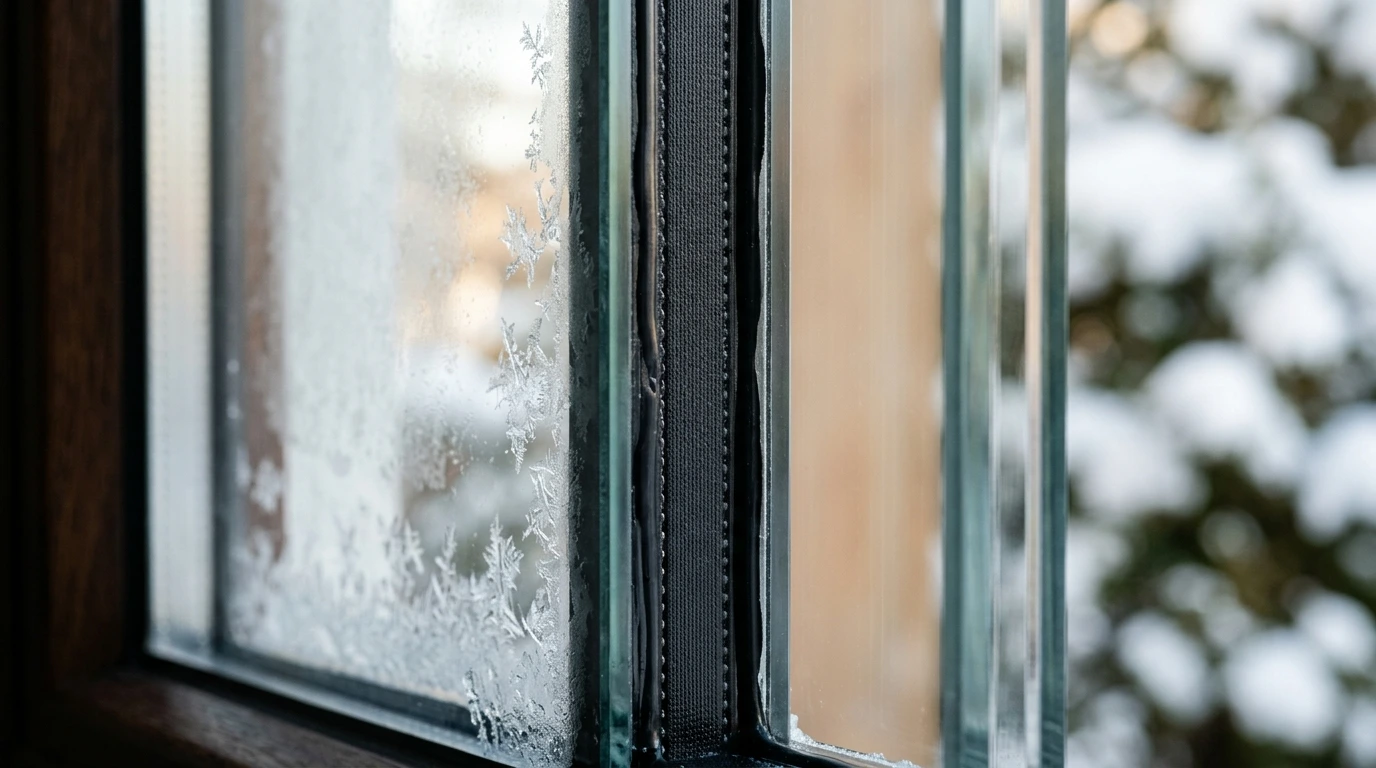
When people compare windows, they look at the glass, the frame and the price, and almost never at the thin strip around the edge of the glass. Yet in a Quebec winter, warm edge spacer windows can make a visible difference: less frost along the bottom of the pane, less water on the sill and a more comfortable spot near the window. This guide explains what a spacer does, why the edge of the glass is its weakest point and what to ask about it before buying.
What a Window Spacer Is and Where It Sits
Modern windows use sealed glass units, made of two or three panes held apart by a spacer that runs all around the edge. The spacer keeps the panes at a precise distance, creating the insulating space that is often filled with argon. The spacer is usually filled with a desiccant that absorbs moisture trapped inside, which helps keep the unit clear between the panes.
The spacer is also part of the seal. Sealants on its sides and around its outer face bond it to the glass and keep the gas in and the humidity out. When you look closely at the edge of a window, the spacer is the strip you see between the panes, just inside the frame or the sash.
Because it touches both the inner and the outer pane, the spacer is a direct path between the warm side and the cold side of the window. What it is made of determines how much heat travels along that path.
The Cold Edge: Why Aluminum Spacers Frost Up in Winter
For a long time, spacers were made of aluminum, a strong and inexpensive metal that is also an excellent conductor of heat. In a sealed unit, an aluminum spacer acts as a thermal bridge: it pulls heat from the warm interior pane toward the cold exterior pane. The result is a band of glass along the edge that is noticeably colder than the centre of the window.
On a cold January morning, that band is where condensation appears first. Warm, humid indoor air meets the cold edge and leaves a line of water or frost along the bottom of the pane, sometimes even when the rest of the glass is clear. Over a winter, that water runs down onto the sill, where it can stain wood, feed mould on the caulking or damage the finish.
The colder the outdoor temperature and the higher the indoor humidity, the more visible the effect. That is why the problem is familiar in many Quebec homes, especially in bedrooms, kitchens and bathrooms.
Types of Warm Edge Spacers
A warm edge spacer is simply a spacer that conducts less heat than aluminum. Several technologies exist, and manufacturers choose them according to the type of window and the level of performance they target. All of them aim at the same thing: keeping the edge of the inner pane closer to room temperature.
Foam spacers, such as the one described on our Super Spacer page, are among the best known. Because they contain no metal, they reduce heat transfer at the edge and stay flexible as the glass expands and contracts with temperature swings.
- Structural foam: a flexible silicone foam with no metal, very low heat conduction at the edge.
- Stainless steel: a thin metal profile that conducts far less heat than aluminum while staying rigid.
- Thermoplastic: a spacer applied directly to the glass as a continuous bead during manufacturing.
- Hybrid: a plastic body with a very thin metal layer that acts as a vapour barrier.
What Warm Edge Spacer Windows Change in a Quebec Winter
The most visible benefit of a warm edge spacer is a warmer glass edge on the inside, which means less condensation and frost along the bottom of the pane. You will notice it on the coldest days, when older windows show a wet or icy band and windows with a warm edge are more likely to stay clear. Drier sills can also mean less maintenance and less risk of mould around the window.
Comfort can improve too. Cold glass, and especially a cold edge, creates a downdraft of cool air that you feel when sitting nearby. A warmer edge reduces that effect, which makes the space next to a large window more pleasant in winter.
A warm edge spacer works best as part of a complete package. It complements low-emissivity glass and argon, which improve the centre of the glass, while the spacer improves the edge. It does not replace good humidity control: if indoor humidity is very high, some condensation can still form on the coldest days.
Warm Edge Spacers With Triple Glazing and Different Frames
In a triple-glazed unit, there are two spacers, one between each pair of panes. Because the centre of a triple-glazed window insulates very well, the edge becomes proportionally more important, and an aluminum spacer would undermine part of the benefit. That is why triple-glazed windows are generally paired with warm edge spacers.
The frame and sash also play a role. A deeper sash that covers the edge of the glass protects the spacer zone from the cold, and a well-insulated PVC frame helps avoid creating a second thermal bridge right next to it. When comparing windows, look at the whole unit rather than a single component, since the spacer, the glass and the frame work together.
How to Check the Spacer on Your Windows or on a Quote
You can often identify the spacer in your current windows just by looking. A bright, shiny silver strip between the panes is often aluminum, although stainless steel can look similar, while matte black or grey profiles are more likely to be warm edge materials. When in doubt, the manufacturer's documents or a professional can confirm it. Some spacers have the manufacturer's name or the year printed on them, which also helps date the sealed unit.
When you compare quotes for new windows, the spacer should be named, not just described as standard. Ask for the type of spacer, the glass and the gas fill, and for the performance of the whole window rather than the centre of the glass alone.
- Look for a line of frost or water along the bottom edge of your current windows on cold mornings.
- Check the colour and finish of the strip between the panes.
- Look for printing on the spacer that names the manufacturer or the date.
- Ask which spacer is used in each window you are quoted, including triple glazing.
- Ask for the rating of the complete window, not only the glass.
Choosing Warm Edge Windows: Get a Free Estimate
If you wipe a line of water off the bottom of the same windows every winter morning, see frost along the edge of the glass or find stains and mould on the sills, it is worth having the windows looked at: the cause may be the spacer, a failing sealed unit, the frame or indoor humidity, and each calls for a different answer. The right combination of spacer, glass and frame depends on your home, the orientation of each room and how much condensation you see today. The cost of a project likewise depends on the number of windows, their size and the options chosen, so it is best assessed on site rather than in general terms.
Unisson Groupe manufactures and installs windows and doors and serves homeowners across Greater Montreal from Saint-Laurent. If frost along the edge of the glass is part of your winter routine, you can request a free in-home estimate to look at your windows and discuss glazing options that suit your home.
Frequently Asked Questions
What is a warm edge spacer in a window?
It is the strip that separates the panes of a sealed glass unit, made of a material that conducts less heat than aluminum. It keeps the edge of the inner pane warmer in winter. Common types include structural foam, stainless steel, thermoplastic and hybrid spacers.
Why does condensation form at the bottom of my windows?
The edge of the glass is usually one of the coldest parts of the window, especially with aluminum spacers, and cold air flows down the pane toward the bottom. When warm, humid indoor air meets that cold zone, it condenses. Warm edge spacers and reasonable indoor humidity both help.
Can I add a warm edge spacer to my existing windows?
The spacer is part of the sealed glass unit, so it cannot be changed on its own. It can be upgraded when the sealed unit or the whole window is replaced. An assessment can show which option makes sense for your windows.
Do triple-glazed windows need warm edge spacers?
They are generally recommended. The centre of a triple-glazed unit insulates very well, so a cold aluminum edge would become the weak point. Triple-glazed windows are commonly built with warm edge spacers; ask which one is used.
Are warm edge spacer windows more expensive?
The cost of a window depends on many factors, including the frame, the glass, the size and the options chosen. Rather than comparing a single component, ask for a free in-home estimate that describes the complete window.