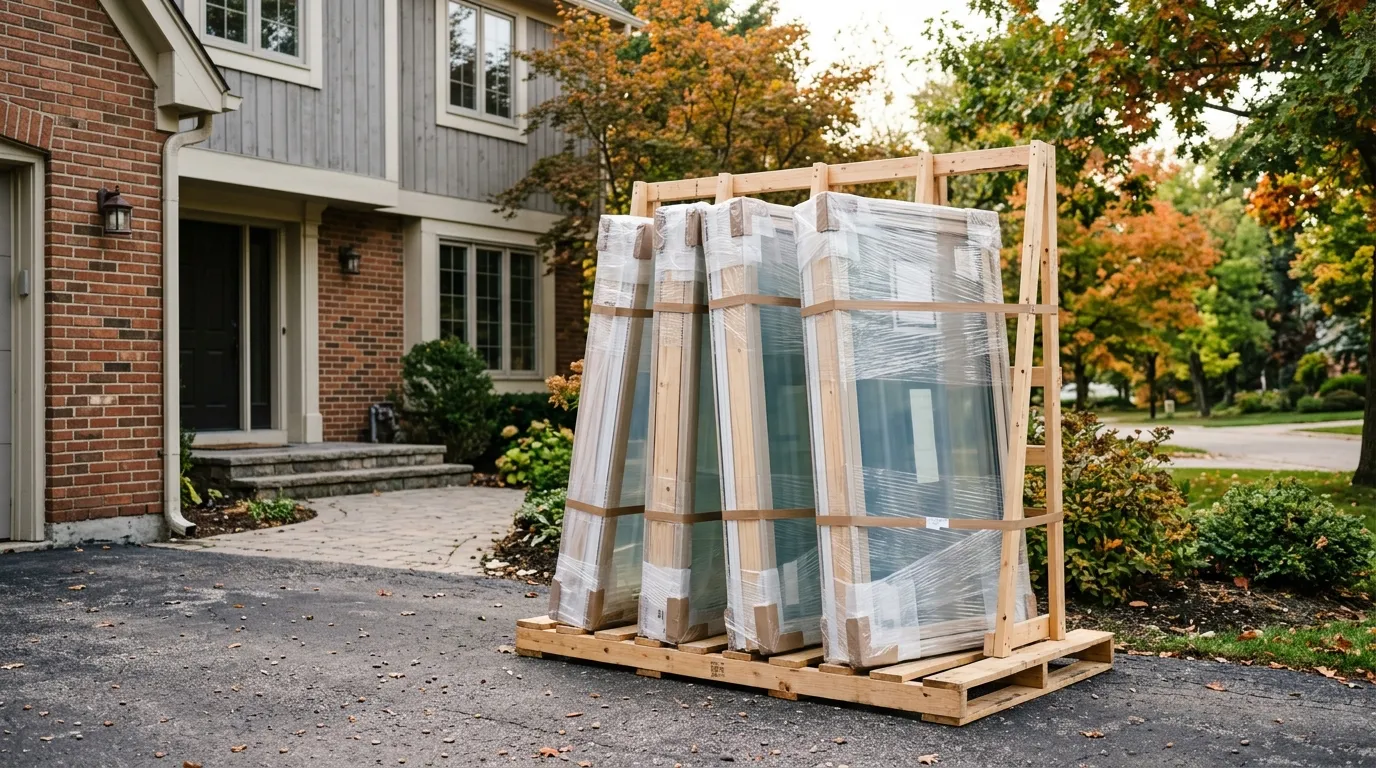
The most common question after a quote is not about price — it is about when. Homeowners picture a truck pulling up the following week; the reality is a chain of steps that runs six to twelve weeks from the first visit to the last bead of sealant. Here is what happens at each stage, how long it genuinely takes in the Montreal area, what causes delays, and why an order placed in September is the one that lands before the snow.
The Full Timeline at a Glance
A typical replacement project for a house in Laval, Montreal or the South Shore follows the same sequence regardless of the manufacturer: an initial consultation, a measurement visit, a written quote, a signed order with deposit, manufacturing, a scheduling call, and the installation itself. Some of these steps overlap and some depend entirely on how quickly the homeowner responds, which is why two neighbours ordering the same windows can see very different calendars.
For standard white vinyl or hybrid windows with clear glass, the manufacturing portion alone runs about four to six weeks from order confirmation. Custom exterior colours, wood interiors, oversized units, specialty shapes, triple glazing with specific coatings, or entry doors with decorative glass push that to eight to twelve weeks. Add one to two weeks at the front for measurement and quoting, and one to three weeks at the back for scheduling, and the realistic span from first contact to finished install is six to sixteen weeks.
The numbers below assume a manufacturer that builds locally, as Unisson does in Saint-Laurent. Imported products or brands that subcontract manufacturing add shipping time and a second layer of scheduling, which is one reason lead times quoted by resellers are often longer and less predictable than those from a factory-direct supplier.
- Consultation and measurement visit: 3 to 10 days after first contact.
- Quote delivered: 1 to 5 days after measurement.
- Order confirmed: whenever you sign and pay the deposit — the clock starts here.
- Manufacturing: 4 to 6 weeks standard; 8 to 12 weeks for colours, wood, specialty shapes or decorative doors.
- Scheduling and installation: 1 to 3 weeks after the units are built; one to three days on site.
Step 1: The Measurement Visit
Nothing is ordered from a phone estimate. A technician comes to the house, measures each opening in at least three places for width and height, checks the diagonals for square, notes the wall construction, the depth of the existing frame, the interior finish and the exterior cladding, and photographs anything unusual. This visit typically takes forty-five minutes to two hours depending on the number of openings, and it is the single most important step for a clean installation — a unit that is 10 mm too wide cannot be installed, and one that is 20 mm too narrow will never seal properly.
Book this visit as early as you can. In the Montreal area, measurement appointments are usually available within three to ten days in spring and fall, and a bit faster in mid-winter. Have a rough idea of what you want before the technician arrives — window style, whether you want a full-frame or insert replacement, colour preferences — so the quote that follows reflects real choices rather than placeholders that need to be revised.
Requesting a free estimate online gets this visit onto the calendar. The sooner it happens, the sooner the rest of the chain can start; the measurement visit, not the day you first call, is when the project genuinely begins.
Step 2: The Quote — and the Part That Depends on You
A detailed quote follows within a few business days: each opening listed with its dimensions, window or door type, glass package, colour, hardware, installation method and price. Take the time to read it against what you asked for, because every change after the order is placed either restarts the manufacturing clock or is simply not possible once the frames are cut. This is also the moment to confirm energy ratings if you plan to apply for a Rénoclimat or other incentive.
Here is where timelines diverge. Some homeowners sign the same day; others compare two or three quotes, consult a spouse, or wait for a bonus. All of that is reasonable, but none of it is manufacturing time, and it is the most frequent reason a project that could have been done in October slides into December. If you are gathering multiple quotes, book all the measurement visits in the same week so the comparison is fast.
The order is confirmed when the contract is signed and the deposit is paid, typically 30 to 50 percent of the total. At that point the manufacturer verifies the dimensions once more, sometimes with a second quick site check on complex openings, releases the order to production, and gives you an estimated build completion date. Everything before this moment was preparation; the lead time proper starts now.
Step 3: Manufacturing — Why Four to Eight Weeks
A window is not pulled from a shelf. Each unit is built to the exact dimensions of your opening: the vinyl or aluminum profiles are cut and welded, the sealed glass unit is ordered or fabricated to size with the specified low-E coating, spacer and gas fill, the hardware is fitted, the screen is made, and the whole assembly is checked before it is wrapped. Glass alone accounts for a large share of the schedule, since insulating glass units are produced in batches and must cure before they can be installed in a frame.
Standard products move fastest because the components are stocked: white or common exterior colours, clear or standard low-E glass, common sizes. Anything that requires a custom-painted profile, laminated colour film, an exotic glass package, a wood interior, a curved or angled unit, or a matching set of decorative door lites adds steps and outside suppliers. That is the difference between four weeks and ten.
Seasonal demand also plays a role. Factories across Quebec are busiest from May to October, with the peak in late summer as homeowners rush to beat the cold. Orders placed in July compete with everyone else's; orders placed in February are often built in three weeks. If your timing is flexible, ordering in the off-season buys a shorter wait and sometimes a better price.
Step 4: Permits and Municipal Rules
Most like-for-like window and door replacements in Quebec municipalities do not require a permit, but there are enough exceptions that it is worth checking before the order is placed. Enlarging an opening, adding a window where there was none, changing a window to a door, or modifying the exterior appearance of a building in a heritage district or a sector governed by a PIIA (site planning and architectural integration program) all typically need municipal approval. Montreal boroughs such as Outremont, Plateau-Mont-Royal and Westmount are strict about window style, material and colour on street-facing facades.
A simple permit takes one to three weeks in most municipalities; a PIIA review can take four to eight weeks because it goes before a committee that meets monthly. This runs in parallel with manufacturing only if the approval is not needed to finalize the product specification — if the borough may require a different style or colour, the order cannot be released until the answer comes back.
Condominium co-ownerships add a similar layer. The syndicate usually has a say in the exterior appearance of windows and doors, and its approval process ranges from an e-mail to a board vote. Sort this out during the quote stage, not after the deposit.
Step 5: Scheduling and Installation Day
When the units are built and inspected, the scheduling office calls to book the install. Crews are booked one to three weeks out during the busy season and a few days out in winter. A typical house with eight to twelve windows and one or two doors takes one to two days; a full-frame replacement with exterior trim work, or a large project with twenty-plus openings, takes three to five. The crew removes and installs one opening at a time, so the house is never open to the weather for more than the time needed to swap a single unit.
Weather affects the schedule less than most people expect. Installers work through rain and cold; what stops them is high wind, which makes handling large glass units dangerous, and temperatures so low that sealants will not cure — roughly below -15 °C for most exterior products. A late-fall install date may move by a day or two for a storm, but it is rarely cancelled outright.
Prepare the house before the crew arrives: clear a metre or so around each window inside, take down blinds and curtains, move fragile items, and make sure the driveway is accessible for the truck. On installation day, one person on site who can answer questions about placement of a door swing or a screen saves time. The last step is a walk-through where you operate every window and door, check the sealant lines and sign off.
Why an Order Placed in September Lands Before Winter
Count backward from the first hard freeze. In the Montreal area, sustained daytime temperatures below zero usually arrive in the second half of November, and sealant-friendly conditions become unreliable by early December. An installation that must happen before then needs the units built by early November, which means the order must be released to production by mid-to-late September for a standard product, and by late August for a custom colour or a decorative entry door.
That is why September is the quiet deadline in this industry. Measurement visits booked in the first two weeks of the month, quotes signed by the third week, and orders in production by the end of it will be installed in late October or early November with margin to spare for a weather delay. The same order placed in mid-October will most likely be installed in December or held until spring — not because the factory is slow, but because the calendar is full.
If you have missed the September window, all is not lost. Winter installation is entirely feasible with the right techniques, and many homeowners deliberately choose it for shorter lead times. But if you want the certainty of a fall install and a warm house on the first cold night, the measurement visit should be on the calendar this month.
What Actually Delays Orders
Most delays happen before manufacturing, not during it. The order sits unsigned while quotes are compared; the deposit is paid but a colour is still undecided; a borough permit is requested after the order instead of before; the co-ownership board meets only once a month. Each of these adds one to four weeks, and none of them shows up in the manufacturer's quoted lead time because the clock has not started.
Changes after the order is released are the second big source of delay. Switching a window from a casement to an awning, adding a grille pattern, or changing an exterior colour after production has begun can mean scrapping cut profiles and restarting that unit — a two-to-four-week setback for the entire delivery if the installer prefers to bring all units at once. Confirm every detail on the signed quote and resist the urge to revise it a week later.
On the supply side, the true risks are specialty glass and hardware from outside suppliers, custom paint runs that are batched only every few weeks, and, occasionally, a unit that fails final inspection and must be rebuilt. A responsible manufacturer will tell you about those risks when the order is placed and will flag any slip as soon as it is known. The measurement-to-install chain is predictable when every link is handled in order; the surprises come from skipping ahead.
- Undecided choices: colour, glass, hardware or grille pattern left open after signing.
- Late permits: PIIA or heritage reviews requested after the order instead of before.
- Post-order changes: any modification once profiles are cut restarts that unit.
- Peak-season backlog: orders placed July to early October wait longest.
- Outside components: specialty glass, decorative door lites and custom paint runs.
Frequently Asked Questions
How long does it take to get new windows in Quebec?
From the first measurement visit to installation, plan on six to ten weeks for standard vinyl or hybrid windows and ten to sixteen weeks for custom colours, wood interiors or specialty shapes. Manufacturing itself is four to eight weeks; the rest is quoting, decision time and scheduling.
When does the lead time actually start?
When the contract is signed and the deposit is paid. Measurement visits and quotes are preparation; the manufacturer releases the order to production only after confirmation, so a quote that sits for three weeks adds three weeks to the project.
Do I need a permit to replace windows or doors?
Usually not for a like-for-like replacement, but enlarging an opening, changing a window to a door, or altering a street-facing facade in a heritage or PIIA sector does require municipal approval. Check with your borough or municipality before the order is placed, and with your syndicate if you are in a condominium.
Why are custom colours slower than white?
White and common colours use profiles kept in stock. Custom exterior colours require a separate painting or laminating run that is batched every few weeks, and a wood interior or specialty glass involves outside suppliers, each adding two to six weeks.
Can I still get windows installed before winter if I order in October?
Sometimes, for a standard product with a fast-moving factory, but the installation calendar is usually full by then and a slip to December or spring is likely. Orders released to production in September are the ones that reliably land in late October or early November.
What can I do to keep my project on schedule?
Book the measurement visit early, decide colours and glass before signing, ask about permits and co-ownership approval during the quote stage, pay the deposit promptly and avoid changes after the order is released. Most delays come from these steps, not from the factory.