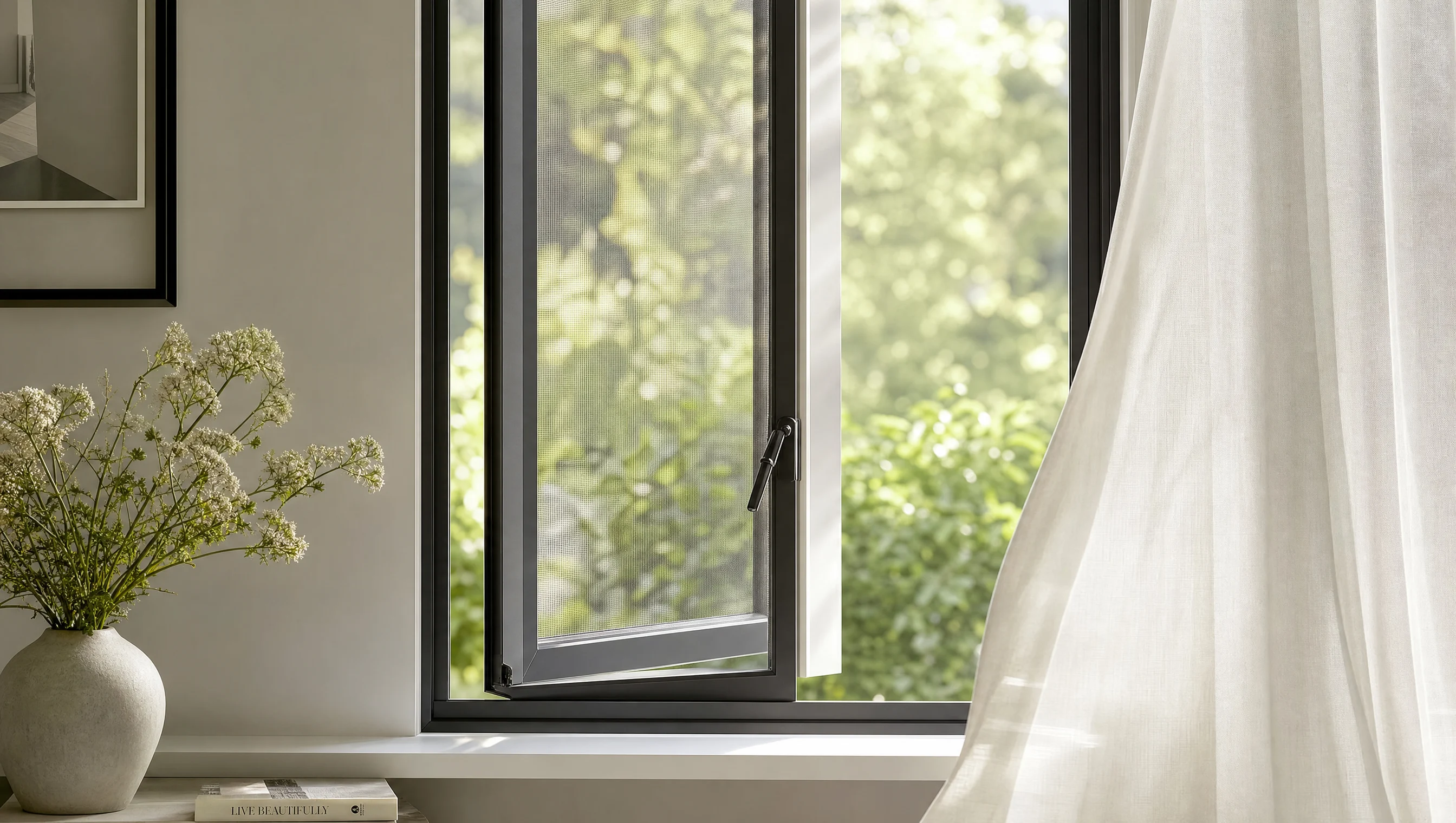
Window screens are the easiest part of a window to overlook — right up until the first warm June evening, when a single mosquito turns an open window into a battlefield, or until an August heat wave bakes a south-facing living room into the high 30s°C. The good news is that the modern screen is far more capable than the sagging grey mesh you remember from a 1990s patio door. Here is everything a Quebec homeowner should know about insect, solar-control, heavy-duty, and retractable screens before the next season.
Standard Insect Screens
Charcoal fiberglass mesh is the workhorse of Quebec windows, and for good reason: it is inexpensive, flexible enough to survive being popped in and out each spring, and woven tightly enough to stop mosquitos (les maringouins), blackflies, and most airborne pollen. Through the short, intense Quebec bug season — roughly late May through August, peaking near the Saint-Jean — it is the difference between a livable bedroom and a sleepless one.
Fiberglass is not forever. Over five to seven years it stretches, the weave loosens at the corners, UV makes it brittle, and the spline (the rubber cord holding it in the frame) hardens and pops out. A screen with a visible bulge or a frayed edge is letting bugs in even when it looks ‘mostly fine.’ Re-screening a standard frame is one of the cheapest home repairs there is.
If you are sensitive to seasonal allergies, ask about tighter pollen-grade weaves; they trap finer particles but cut airflow noticeably, which matters on still summer nights when you are relying on the window for ventilation rather than air conditioning.
Solar-Control Screens
Solar screens are the upgrade most Quebec homeowners have never heard of and wish they had. Woven from a denser, darker yarn, they block roughly 70 to 90 % of solar heat and UV before it ever reaches the glass — stopping the heat at the exterior rather than letting it in and trapping it. On a west- or south-facing room that turns into a greenhouse from 3 p.m. onward, the difference in comfort is immediate and measurable.
Because they intercept solar gain outside the window, solar screens take real load off your air conditioning during a Montreal heat wave, and they sharply reduce the UV that fades hardwood floors, area rugs, leather sofas, and artwork over time. From inside they read a touch darker, like a very light sunglass tint, but daytime views to the outside stay clear; from outside they add privacy by cutting the view in.
The trade-off is that the densest weaves reduce natural daylight and breeze, so they are best matched to the elevations that actually overheat — not every window in the house. A 70 % screen is a good all-round choice; 90 % suits unshaded west walls and rooms with serious afternoon glare.
Heavy-Duty Pet and Storm Screens
Standard fiberglass is no match for a determined Labrador or a cat that treats the screen as a scratching post. Heavy-duty screens use thicker polyester (often vinyl-coated) or fine stainless-steel mesh that shrugs off claws, beaks, hail, and the stray ball off the back deck. If you have large dogs, indoor-outdoor cats, or kids, this is the upgrade that saves you from re-screening every single year.
These screens are also a smart pick on ground-floor and patio-level openings where impacts are simply more likely — a screen door onto the yard takes a daily beating that an upstairs bedroom window never sees. Pet-grade polyester mesh can be up to seven times stronger than standard fiberglass while still passing plenty of air.
Quebec’s freeze-thaw cycle and occasional summer hailstorms are hard on any exterior component, so the reinforced frames and tougher mesh of heavy-duty screens often outlast the cheaper option by years — a case where spending a little more up front genuinely pays off.
- Pet-resistant polyester mesh — up to 7× stronger than standard fiberglass
- Stainless-steel mesh — the most durable option, also more secure against forced entry
- Reinforced aluminum frames that resist warping through freeze-thaw cycles
- Ideal for ground-floor windows, patio screen doors, and homes with pets or kids
Retractable Screens
Retractable screens roll away into a slim side or top cassette when you are not using them, then pull across only when you want to ventilate. They are the elegant solution for windows where a permanent screen would spoil the view — large picture windows, casements with a prized view of Mont-Royal, or a patio door you open only on the nicest evenings.
Because the mesh is protected inside its housing for most of the year, retractable screens tend to stay cleaner and last longer than fixed screens left exposed to nine months of Quebec weather. They are especially popular on casement and awning windows, and on doors leading to a deck.
The trade-off is cost and complexity: retractable systems are more expensive and are not a do-it-yourself install. The roller mechanism and tension spring need to be fitted correctly, which is a job for the manufacturer or installer rather than a weekend project.
Screens and the Quebec Off-Season
Quebec only has a true screen season of about four to five months, which shapes how you should treat them the rest of the year. Many homeowners pop out fixed insect screens for the winter, both to let in a bit more precious daylight during our short December days and to spare the mesh from snow load and ice. Store them flat and labelled by window so spring re-installation is painless.
Leaving screens in over winter is not catastrophic, but it does trap snow and reduce solar heat gain through the glass when you actually want it — a minor but real energy consideration during a long heating season. Solar screens are the exception worth thinking about: their summer benefit is large, and many owners leave them up year-round, accepting a slightly dimmer winter for a much cooler summer.
Whatever you choose, give the frames and tracks a quick clean at the changeover — grit in the channel is what grinds down rollers and tears mesh over time.
Buying Tips
The single best move is to order your screens with your new windows so they are built to the exact rough opening. Aftermarket and big-box screens are cut to generic sizes, which is why they so often gap at the corners, rattle in the wind, and fail a season or two early. A factory-matched screen sits flush, seals at the perimeter, and simply works.
Match the screen type to the room, not the whole house: standard fiberglass for most bedrooms, solar mesh on the rooms that overheat, heavy-duty mesh where pets and kids are hard on things, and retractable where the view is the priority. Mixing types is normal and gets you the best result for the least money.
When you are planning new windows or doors, raise screens early so they are part of the quote rather than an afterthought. Discuss the right combination for your home during your free estimation with the Unisson team in Saint-Laurent.
Frequently Asked Questions
Do solar screens replace blinds or curtains?
Only partly. Solar screens block most of the heat and UV but still let you see out, so they do not provide full nighttime privacy or total room-darkening. Most homes pair them with blinds — the screen handles the heat, the blind handles privacy and blackout.
Can I install or replace screens myself?
Re-screening a standard fiberglass frame is an easy DIY job with a spline roller and a few dollars of mesh. Retractable and many heavy-duty systems, however, need professional fitting because of their roller mechanisms and frame tolerances.
What about pollen and allergies?
Standard fiberglass mesh blocks larger pollen grains, but fine pollen still passes. Specialty pollen-grade or allergy screens use a much finer weave that traps more particles, at the cost of reduced airflow — a worthwhile trade for sensitive households.
How often should screens be replaced in Quebec?
Standard fiberglass typically lasts five to seven years before it sags, tears, or goes brittle from UV. Heavy-duty polyester and stainless steel last considerably longer, and retractable mesh, protected in its cassette most of the year, can last a decade or more.
Should I take my screens out for winter?
It is optional. Removing fixed insect screens lets in a bit more winter daylight and solar heat and protects the mesh from snow and ice, but leaving them in causes no real harm. Store removed screens flat and labelled by window for easy spring reinstallation.
Do solar screens really lower cooling costs?
Yes. By stopping 70 to 90 % of solar heat at the exterior of the glass, they reduce the load on your air conditioner during Montreal heat waves and cut the afternoon overheating in west- and south-facing rooms noticeably.