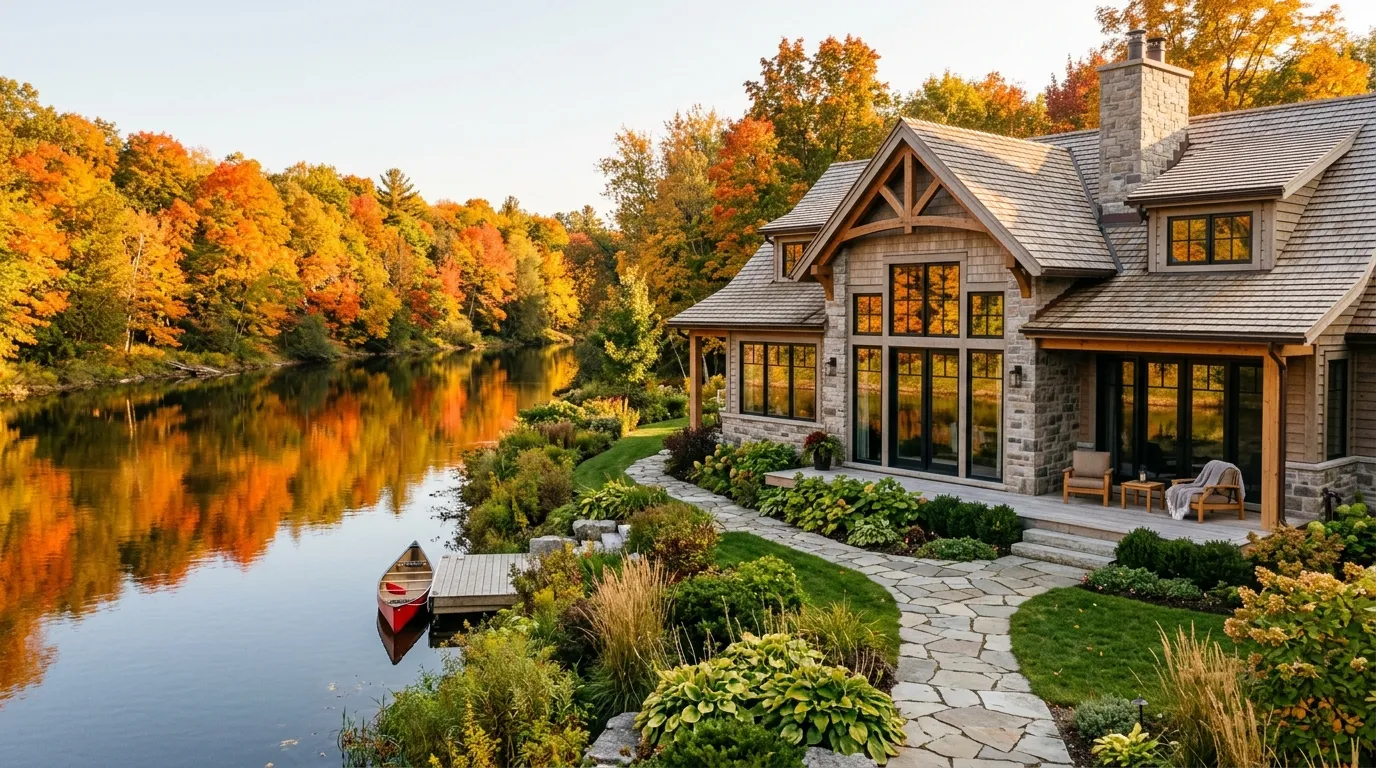
Casselman grew up around a sawmill on the South Nation River in the 1840s and never lost its river-town feel: a compact village of roughly 4,000 people, its own interchange on the 417, a VIA Rail stop on the Montreal–Ottawa line, and about seven residents in ten with French as their mother tongue. Unisson Groupe now serves Casselman with windows and doors built at our own factory in Saint-Laurent and installed by our own crews. Here is how that fits a home by the river.
Why Unisson now serves Casselman — and what factory-direct means
Casselman sits almost exactly halfway between Montreal and Ottawa on the 417, roughly an hour and a half from our factory in Saint-Laurent. It is also the most distinctly francophone community in the Ottawa area, which is one reason a Montreal manufacturer that works in French every day feels at home here. The Ottawa–Hawkesbury corridor along the Ottawa River is the natural extension of what we have done across greater Montreal for years, and Casselman is one of its anchors.
Factory-direct is the point. Unisson is a manufacturer, not a dealer: windows and doors are built on our own lines in Saint-Laurent — welded UPVC or hybrid aluminum-UPVC frames, sealed units, hardware — and the people who measure, deliver and install work for us. A dealer sells someone else's product and hires an installer; when something needs attention after the first winter, you are between two companies. With us, you are dealing with one.
It also lets the estimate be honest about what the factory can do: an oddly proportioned opening in a 1920s village house, a basement window that must meet egress, a specific exterior colour. The in-home estimate is free, with no obligation, and in French or English — say which at the door.
- Manufacturer, not dealer: product built at our own factory in Saint-Laurent, Montreal
- Own crews: measurement, delivery and installation by Unisson employees
- One warranty: product and workmanship covered by the same company
- Service in French: natural for a Montreal company, and a real advantage in Casselman
Homes in Casselman: river-side core, post-war streets, new edges
Casselman's housing runs in rings. The oldest homes stand near the river and the church: village houses from the early 1900s through the 1930s, many with deep porches, wood siding or brick, and original wood windows somewhere under the layers. Around them are the post-war and 1960s–70s bungalows, then the 1980s–90s streets of raised bungalows and split-levels, and on the edges the newer subdivisions that came with the village's steady growth. Each ring has its own window generation, and its own way of failing.
In the older core, the failures are wood: rotted sills on the weather side, sash that has been painted shut, storm windows that no longer fit, and single-pane basement windows that sweat all winter. The 1980s–90s homes typically carry aluminum or first-generation vinyl sliders that ice along the track and leak at the meeting rail. The newest streets have builder-grade double-glazed units that start to fog between the panes at 10 to 15 years. What they all share is the river: humidity is simply higher near the South Nation, and moist indoor air meeting a cold pane is why so many Casselman windows show condensation and black staining on interior sills.
The climate and the ground finish the job. Eastern Ontario winters bring nights near -30 °C and dozens of freeze-thaw cycles a season; summers are humid; and the flat land around Casselman is heavy clay from the old Champlain Sea floor, which moves with moisture. Older openings near the river are rarely square when we measure them, and a window that was shimmed loosely decades ago has had a long time to rack.
Which windows and doors make sense by the river
Condensation is the Casselman problem, and the fix starts with glass that stays warm on the inside. Every Unisson window is ENERGY STAR certified under Canada's single national specification in force since 2020 — a U-factor of 1.22 W/m²·K or lower, or an Energy Rating of 34 or higher — and triple glazing with two low-E coatings, argon fill and warm-edge spacers pushes the interior glass temperature high enough that ordinary indoor humidity no longer fogs it. That, more than any gadget, is what keeps sills dry in a river town.
Frame choice follows the house. Our welded UPVC windows suit the post-war and newer streets: no rot, no paint, and joints that ride out freeze-thaw cycles. In the older core, our hybrid windows put a UPVC interior behind an aluminum exterior available in dozens of colours, so a 1920s house can keep its character while gaining a modern seal; grilles and traditional proportions are available. Awning windows are worth considering for a humid summer — they ventilate in the rain — and basement units can be sized to meet egress.
For doors, we build insulated steel and fibreglass entry doors with multi-point locks and adjustable sills, and patio doors with insulated thresholds that stop the cold draft at floor level. Browse our windows page or ask the estimator to bring samples.
- Triple glazing with warm-edge spacers — the real answer to condensation near the river
- Welded UPVC casements and awnings for post-war and newer streets
- Hybrid aluminum-UPVC with grilles to respect the older core's character
- Basement windows sized for egress, entry doors with multi-point locks, patio doors with insulated thresholds
Ontario specifics: building code, rebates and permits
Ontario's Building Code sets minimum energy performance for new housing through its SB-12 supplement; in the Ottawa-area climate zone that means a window U-factor in the region of 1.6 W/m²·K, depending on the compliance package. ENERGY STAR product clears it easily. The Code's egress rule for bedroom windows — an unobstructed opening of roughly 0.35 m² with no dimension under about 380 mm — is the one that most often comes up when a Casselman homeowner finishes a basement or turns an attic into a bedroom.
Rebates are a moving target, so this is a snapshot. At the time of writing, Ontario's Home Renovation Savings Program, delivered under Save on Energy with Enbridge Gas for gas-heated homes, offers a per-opening rebate on ENERGY STAR certified windows and doors, subject to minimum quantities and program dates. The federal Greener Homes Grant is closed to new applicants, though an affordability stream exists for eligible lower-income households. We supply the ENERGY STAR certification numbers and itemized invoice the application asks for; confirm the current terms before you count on it.
Permits are handled by the Municipality of Casselman. Like most Ontario municipalities, it generally treats a window replaced in its existing opening as maintenance that does not need a building permit, while enlarging an opening, adding a window or changing a bedroom egress window usually does. If your home is in the older core and carries any heritage designation, check that first as well. We flag anything that crosses those lines during the estimate.
How it works from Montreal: measurement to installation
It starts with a free in-home estimate. Our estimator measures every opening, checks sills and framing — especially in older homes near the river — talks through styles, colours and glass, and leaves a written, itemized quote. No obligation, no pressure, and in French or English.
After signing, the order goes to our Saint-Laurent factory. Production typically takes a few weeks, longer in the spring and fall rush, and we confirm delivery and installation dates before anything ships. Our own trucks bring the units down the 417 to Casselman and our own crews install them; most single-family homes are finished in one to three days, old units removed and the site cleaned.
Because one company builds and installs, one company carries the warranty on both product and workmanship, and service calls come from the people who did the work. Financing is available to spread the cost — details on our financing page. Start by booking your free estimate.
- Step 1: free in-home measurement and itemized written quote, in French or English
- Step 2: production at our Saint-Laurent factory, typically a few weeks
- Step 3: delivery on a confirmed date by our own trucks
- Step 4: installation by Unisson crews, usually one to three days
- Step 5: single warranty, single point of contact, financing available
Frequently Asked Questions
Why do my windows sweat so much in Casselman, and will new ones fix it?
Indoor humidity near the river is naturally higher, and an old double-glazed or single-pane window has a cold inside surface where that moisture condenses. Triple glazing with warm-edge spacers keeps the inside glass much warmer, which eliminates most condensation at normal indoor humidity. Extreme humidity still needs ventilation, but new windows remove the cold surface that makes it visible.
Do I need a permit from the Municipality of Casselman?
Generally not for a like-for-like replacement in the existing opening, which is usually treated as maintenance. Enlarging an opening, adding a window or changing a bedroom egress window typically requires one; confirm with the municipal building department before work starts.
Can you keep the look of my older house near the river?
Yes. Our hybrid windows pair a UPVC interior with an aluminum exterior in dozens of colours, with grilles and traditional proportions available, so a 1920s village home keeps its character while gaining modern sealing and triple glazing.
How long does the whole project take?
A few weeks of production after you sign, longer in peak spring and fall season, then a confirmed installation date. Most Casselman homes are installed in one to three days by our own crews.
Is everything available in French?
Yes — estimate, contract, factory paperwork and the crew on site. Casselman is a strongly francophone village and we are a Montreal company; you choose the language and we simply work in it.