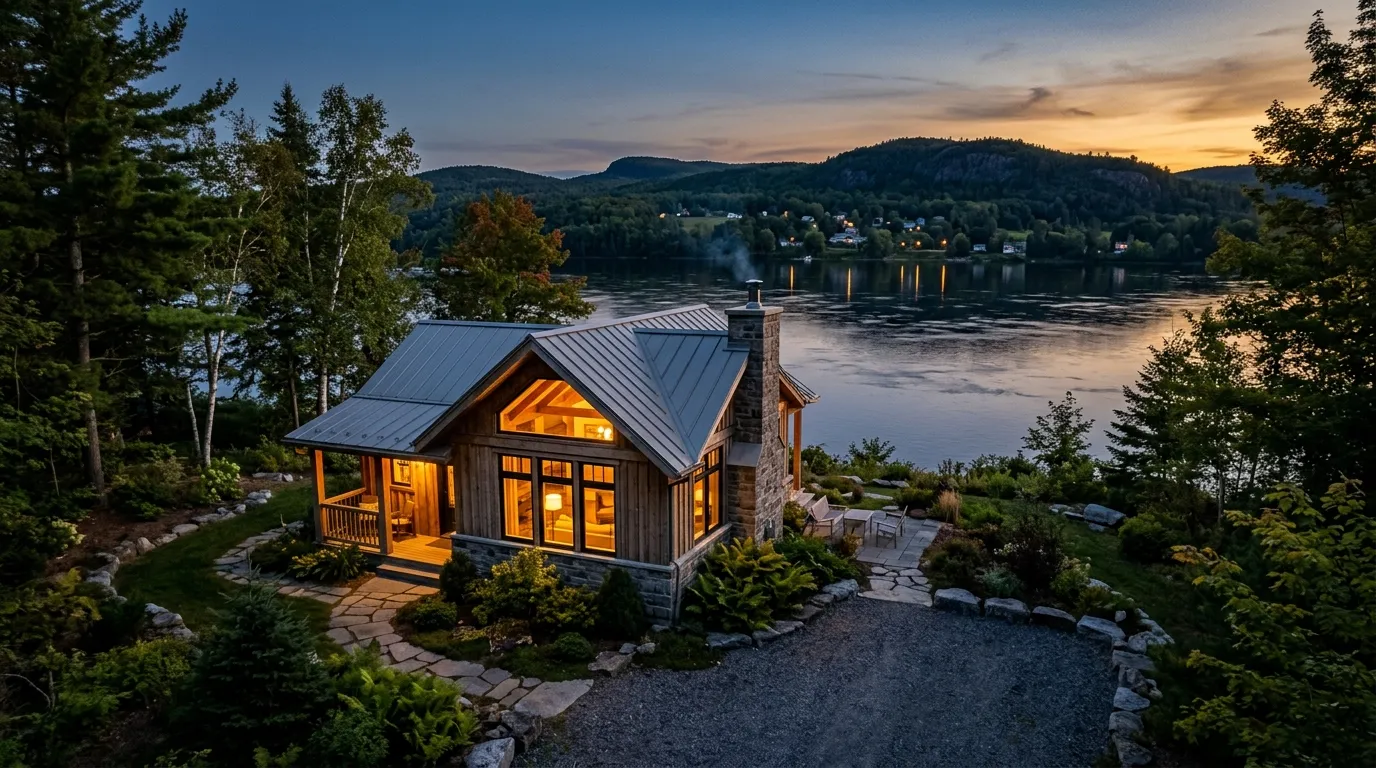
Of all the communities Unisson Groupe now serves in Eastern Ontario, Chute-à-Blondeau is the one closest to home. This riverside village in East Hawkesbury township sits a few minutes from the Quebec line, which puts it barely an hour from our factory in Saint-Laurent — closer than some parts of the Montréal region we already serve. Here is what factory-direct windows and doors mean for a home on the Ottawa River, from the rapids that gave the village its name to the humidity that comes with living beside all that water.
Why Unisson now serves Chute-à-Blondeau
Chute-à-Blondeau is a small village on the south shore of the Ottawa River, strung along Front Road east of Hawkesbury, with Voyageur Provincial Park next door and the Quebec border a short drive beyond it. The name recalls a set of rapids — the chute — that formed part of the Long Sault, a stretch of white water once bypassed by a chain of small military canals in the 1820s and 1830s. The rapids themselves have essentially disappeared under the widened river since dams at Carillon raised the water level, so today the village looks out over a broad, calm reach that behaves more like a lake than a river.
For us, geography is the whole story. From our plant in Saint-Laurent, Chute-à-Blondeau is roughly 100 kilometres by Highway 40 and the 417 — about an hour and five minutes in normal traffic, which is less than the drive to some of our customers on the South Shore or in the Laurentians. That is why Chute-à-Blondeau and its neighbours in East Hawkesbury were natural first stops when we extended service along the Ottawa River corridor toward Ottawa. Our estimator can be at your door for a morning appointment and back at the factory by lunch.
Factory-direct means we are the manufacturer, not a dealer: the same company measures your openings, builds the units to those measurements, delivers them and installs them with its own crews, under RBQ licence 5670-0248. There is no distributor margin in the price and no second company to call if something needs adjusting. And because East Hawkesbury is one of the most francophone corners of Ontario, our bilingual crews and paperwork are not a bonus here — they are simply how business gets done.
- About 100 km and roughly 1h05 from our Saint-Laurent factory
- Manufacturer, not dealer: measured, built, delivered and installed by one company
- Bilingual service in French or English, from the estimate to the warranty
Homes in Chute-à-Blondeau: village houses, river lots and humidity
The housing along Front Road and the side streets is a modest mix. There are older village houses from the late 1800s and early 1900s — wood-frame, often re-clad in siding, with the tall window openings of their period — and a good number of bungalows and split-levels from the 1960s through the 1990s. Toward the water, cottages built for summer use have been winterized over the years and are now lived in year-round, and newer homes have gone up on river lots with large windows aimed at the view. Farmhouses on the concession roads inland round out the picture.
Each type fails in its own way. The winterized cottages are the most consistent problem: they were built with single-pane or early double-pane windows on light framing, and the windows that were fine for July are wildly undersized for January. Bungalows from the 1970s and 1980s show the usual fogged sealed units and cold aluminum frames, and sliders on the river side leak air at the meeting rail. In the older village houses, the wood sashes have been repaired past the point of sealing, and the frames have moved with the house.
The river is what makes Chute-à-Blondeau different from a village a few kilometres inland. That wide, slow water keeps the air humid well into the fall and again from spring thaw onward, and in winter the wind crosses it with nothing in the way. Cold snaps of −30 °C combined with indoor humidity produce condensation, then frost, on any glass that is not properly insulated, and the spring freeze-thaw cycle works water into every joint. A window on a river lot here needs to be specified for a harder job than the same window in town.
Products that fit Chute-à-Blondeau homes
For river-facing walls, we recommend triple glazing with Low-E coatings and argon fill as the default rather than the upgrade. The extra pane keeps the interior glass surface warmer, which is what stops condensation and frost in a humid house, and it noticeably reduces the radiant chill you feel sitting near a large window in January. All of our standard units meet the single national ENERGY STAR specification in force across Canada since 2020 — a U-factor of 1.22 W/m²·K or lower, or an Energy Rating of 34 or higher — and the triple-glazed configurations exceed it with a comfortable margin.
Our UPVC windows suit most of the bungalows and cottages: multi-chamber frames, fusion-welded corners, and a finish that needs nothing more than a rinse. Where a large picture window or a dark exterior colour faces the afternoon sun off the water, our hybrid windows — aluminum-clad outside, UPVC inside — hold their colour and their shape. Casement and awning windows seal best against wind off the river; a fixed picture window flanked by casements is the classic answer for a room built around the view. For the older village houses, tall casements or UPVC hung windows with exterior grilles keep the look of the period.
For doors, a sliding patio door with a low-E glass package and a multi-point lock is the usual choice onto a deck facing the water, and a garden door suits a narrower opening. At the front, an insulated steel or fibreglass entry door with a proper threshold and weatherstripping fixes the draft that so many winterized cottages live with. Every model is described on our windows page.
- Triple glazing, Low-E and argon as the default on river-facing walls
- UPVC windows for bungalows and winterized cottages; hybrid for large or dark units in the sun
- Picture window with flanking casements for rooms built around the view
- Sliding or garden patio doors and insulated entry doors with multi-point locks
Ontario rules: building code, rebates and permits
Chute-à-Blondeau is in Ontario, so the Ontario Building Code applies even though the Quebec line is only minutes away. For a replacement in the existing rough opening with no change to size or structure, a building permit is generally not required; enlarging an opening, adding one, or altering a bedroom window in a way that affects egress normally does require one. The Township of East Hawkesbury's building department is the authority, and a short call to confirm is always worth it. Properties near the water may also be subject to conservation authority or shoreline rules for structural work — not usually for a straight window swap, but we mention it so nothing surprises you.
On rebates, we deliberately hedge, because programs change. At the time of writing, Ontario's main residential program is the Home Renovation Savings Program, delivered by Enbridge Gas and Save on Energy with support from the Ontario government. It has offered a fixed rebate per ENERGY STAR certified window or door opening, conditional on a home energy assessment and on completing at least two categories of upgrade in the same project — windows alone have generally not qualified. Homes heated with oil, propane or electricity, which describes many houses here, have been eligible alongside gas customers. Confirm the current terms and deadlines directly with the program before budgeting around them.
Federal programs that homeowners may remember, such as the Canada Greener Homes Grant, are closed to new applicants. Our estimators will tell you plainly what is open the week we visit, and will not build a sales pitch on a rebate that no longer exists.
How it works from Montréal: measurement to installation
The process starts with a free in-home estimate. Because Chute-à-Blondeau is so close, we can usually offer an appointment quickly. Our technician measures every opening, checks the sills and framing — particularly in winterized cottages, where light framing and past water damage are common — and goes over styles, colours and glazing with you. You receive an itemized written quote, with no obligation.
After approval, your windows and doors are built at our Saint-Laurent factory, typically in four to six weeks during peak season and often faster in winter. Installation is by our own employees, not subcontractors: the crew arrives from Montréal with the units, removes the old windows one opening at a time, prepares and flashes each opening, sets, shims, insulates and seals the new frame, and finishes inside and out. A bungalow or cottage is usually done in a day; a larger house in two. The house is never left open to the weather.
Your contract includes the manufacturer's warranty on the products and our own warranty on the installation, both in writing. Financing through our partner Financeit runs from 12 to 240 months with weekly, bi-weekly or monthly payments. And with the factory an hour away, any follow-up service is a short trip for us and a single phone call for you.
- Step 1: free measurement visit, usually scheduled quickly, and an itemized quote
- Step 2: production in Saint-Laurent, typically 4–6 weeks in peak season
- Step 3: installation by our own crews, usually 1–2 days
- Step 4: written warranties, financing 12–240 months, service an hour away
Frequently Asked Questions
How far is Chute-à-Blondeau from your factory?
About 100 kilometres by Highway 40 and the 417 — roughly an hour and five minutes. It is the closest Ontario community we serve, and closer than several parts of the Montréal region on our regular routes.
My winterized cottage is freezing in January. Will new windows fix it?
Windows are usually the biggest single leak in a converted cottage, and triple-glazed UPVC units make a dramatic difference. Our estimator will also tell you honestly if the framing or insulation around the openings needs attention at the same time.
Why do my river-facing windows frost up inside?
Humid indoor air meets glass that is too cold. Triple glazing with Low-E and argon keeps the inner pane warmer, which is the reliable fix; managing indoor humidity helps too.
Do I need a permit from East Hawkesbury township?
Generally not for a like-for-like replacement in the same opening. Changing the size of an opening, adding one, or altering a bedroom egress window normally requires a permit, and we will flag it during the estimate.
Can we deal with you in French?
Of course. Our estimators, office staff and installation crews are bilingual, and every document can be issued in French or English.