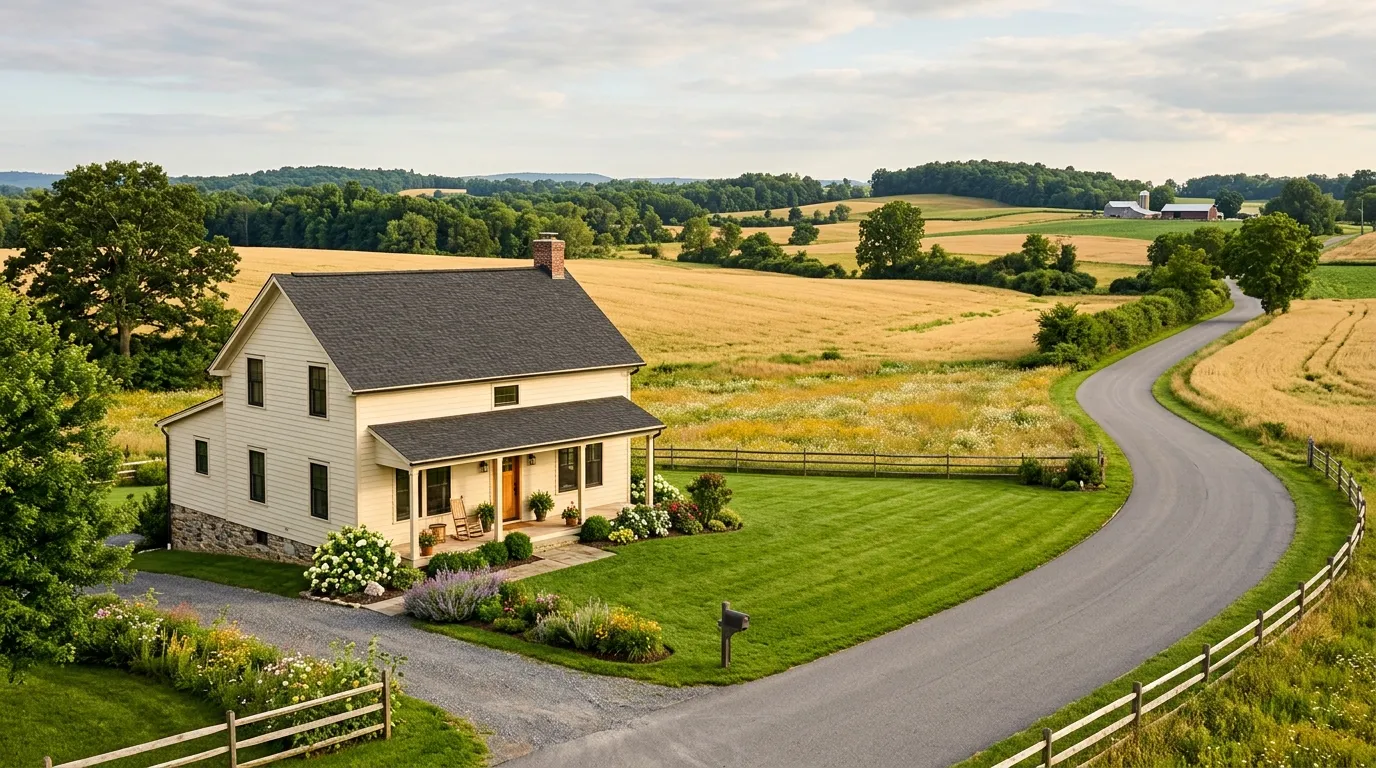
Green Valley sits on Highway 34 between Lancaster and Alexandria, a few minutes from the Quebec line and closer to our Saint-Laurent factory than many Montreal suburbs. Starting this fall, Unisson Groupe measures, manufactures and installs windows and doors here with the same crews that serve the West Island. This guide explains what factory-direct means for a Glengarry home, which products stand up to an open-field winter, and how the process works from measurement to installation.
Why Unisson now serves Green Valley
Green Valley is a compact rural community in the Municipality of South Glengarry, strung along Highway 34 with the 401 interchange at Lancaster a short drive south. From our factory in Saint-Laurent, the trip is roughly 115 km and a little over an hour by the 20 and the 401, which is shorter than some of our routes on the north shore of Montreal. That is why Green Valley is one of the first Ontario communities where we now offer in-home measurement, factory production and installation by our own team.
Factory-direct manufacturer is not a slogan here: it means the person measuring your openings works for the company that will build the frames, and the crew installing them is the same company again. There is no dealer margin between you and the plant, and there is no finger-pointing between a supplier and an installer if a unit is out of square or a sill leaks in March. One RBQ-licensed company (5670-0248) is responsible for the product, the fit and the finish.
Green Valley is also one of the most French-speaking corners of Glengarry, with families who move easily between the two languages. Our estimators and crews work in French and English, so your quote, your contract and the questions you ask on installation day all happen in the language you prefer.
Homes in Green Valley: what we see, what fails
The housing stock along Highway 34 and the concession roads is a mix that is typical of Glengarry: century farmhouses in brick or clapboard, bungalows and split-levels from the 1960s to the 1980s, and a scattering of newer builds on larger lots. Many of the older homes still carry original wood sash painted shut, or aluminum sliders installed in the 1970s that were never meant for a -30 °C night. Homes renovated in the 1990s often have first-generation vinyl windows whose sealed units are now fogging between the panes.
What fails in a farmhouse is rarely the glass alone. Drafts come through the gap between an old frame and the rough opening where the original oakum or fibreglass has settled, and the exterior sill or brickmould rots where snowmelt sits against the wood. On the inside, frost on the bottom corners of the glass in January is a sign that the spacer bar and the sealed unit are past their useful life, and condensation running onto the sill is what eventually damages the drywall and trim below.
The climate does the rest. Green Valley sits on flat, open farmland with little windbreak, so a north-west wind in February pushes cold air through any weak seal, and drifting snow piles against west-facing walls. Summers are humid, which means the freeze-thaw cycles of March and April swing between wet and frozen several times a week. Frames that expand and contract with those swings are exactly why we specify UPVC and hybrid systems with fusion-welded corners rather than mechanically joined ones.
- Century farmhouses: original wood sash, drafts at the frame perimeter, rot at sills and brickmould
- 1960s–80s bungalows: aluminum sliders, single-pane storms, cold conduction through the frame
- 1990s vinyl: fogged sealed units, stiff cranks, worn weatherstripping
- Climate stress: -30 °C nights, open-field wind, humid summers and repeated freeze-thaw
Which windows and doors fit here
For most Green Valley homes we recommend UPVC casement and awning windows with multi-point locking hardware. A casement pulls tight against its compression seal when locked, which is the single most effective defence against wind-driven air on an exposed lot. Our hybrid windows pair the same UPVC interior with an aluminum-clad exterior, a good choice for the street-facing side of a brick farmhouse where you want a painted colour that will not chalk or fade.
We strongly suggest triple glazing in this part of Ontario. Two low-E coatings and argon fill between three panes bring the interior glass surface several degrees closer to room temperature, which is what keeps condensation and frost off the bottom edge of the glass on the coldest nights. All our windows are ENERGY STAR certified: since 2020 Canada has used a single national specification, so a qualifying window must reach a U-factor of 1.22 W/m²·K or lower, or an Energy Rating of 34 or higher, regardless of where it is installed.
Doors matter just as much on a farm property where the side entry gets more traffic than the front. Our steel and fibreglass entry doors come with insulated cores, adjustable thresholds and multi-point locks, and our patio doors use the same low-E triple glazing as the windows, with stainless rollers that shrug off the sand and grit tracked in from a gravel driveway.
- UPVC casement / awning: compression seals, multi-point locks, fusion-welded corners
- Hybrid UPVC-aluminum: painted exterior colour for brick or heritage facades
- Triple glazing: two low-E coatings, argon fill, warm-edge spacer
- Entry & patio doors: insulated cores, adjustable thresholds, ENERGY STAR glazing
Ontario specifics: code, permits and rebates
Our Ontario installations follow the Ontario Building Code, whose 2024 edition came into force at the start of 2025. For replacement windows in an existing opening the practical impact is modest: the code's energy standard applies mainly to new construction, and an ENERGY STAR triple-glazed unit exceeds the U-values the code asks of a new house in this climate. Where the code does bite is egress: a basement bedroom window that is replaced must still provide the required clear opening, and we check that at measurement.
Whether a permit is needed depends on the municipality. A like-for-like replacement in the same opening generally does not require a building permit in Ontario, but enlarging an opening, adding a window in a load-bearing wall or changing a basement egress window usually does. Rules can differ from one township to the next, so for Green Valley we recommend a quick call to the South Glengarry building department before work begins, and we can help with drawings if a permit is required.
On rebates, the main program open in Ontario at the time of writing is the Home Renovation Savings Program, delivered by Save on Energy and Enbridge Gas with provincial backing. It has offered a fixed amount per ENERGY STAR window or door opening, but with conditions: a home energy assessment and at least two eligible upgrades done together, such as windows plus attic insulation or air sealing. Many Glengarry homes heat with propane, oil, electricity or wood rather than natural gas, and the program has had a separate stream for those homes. Terms and deadlines change, so verify eligibility with the program before you sign anything.
How it works from our Montreal factory
It starts with a free in-home estimate. An estimator drives out from Saint-Laurent, measures every opening, checks the condition of the frames and sills, and talks through frame types, glazing and colours with you at the kitchen table. You receive a written quote by email, in French or English, with no obligation.
Once you approve, the windows and doors are built in our own factory in Saint-Laurent. Production typically takes 6 to 10 weeks depending on the season and the number of units, and spring and early summer are our busiest periods. Delivery and installation are done by our own crews, usually in one or two days for a typical house, with the old units removed, the openings insulated and foamed, and the exterior capped or trimmed the same day.
Because the manufacturer and the installer are the same company, one written warranty covers both the product and the workmanship, with the frame, the sealed glass unit and the hardware described separately so you know exactly what is covered and for how long. Financing is available: you can apply online and spread payments over 12 to 240 months, which makes it realistic to do the whole house at once rather than a few windows each year.
- Step 1: free in-home measurement and written quote
- Step 2: manufacturing at our Saint-Laurent factory, typically 6–10 weeks
- Step 3: delivery and installation by our own crews, usually 1–2 days
- Step 4: one warranty for product and installation, financing over 12–240 months
Frequently Asked Questions
Do you really send your own crews from Montreal to Green Valley?
Yes. Green Valley is about 115 km from our Saint-Laurent factory, so measurement, delivery and installation are all done by Unisson employees, not a subcontractor found locally.
Is the estimate available in French?
Absolutely. Our estimators and installation crews are bilingual, and your quote and contract can be prepared in French or English.
Do I need a permit to replace windows in South Glengarry?
For a same-size replacement in an existing opening, usually not, but enlarging an opening or changing a basement egress window typically does. We recommend confirming with the South Glengarry building department, and we can supply drawings if needed.
Is triple glazing worth it on an old farmhouse?
In our experience, yes. On an exposed lot, triple glazing keeps the interior glass warmer, which reduces frost and condensation on the coldest nights and makes rooms noticeably more comfortable near the windows.
How long from signing to installation?
Plan on roughly 6 to 10 weeks for production, then one or two days of installation for a typical home. Spring and early summer bookings fill fastest.